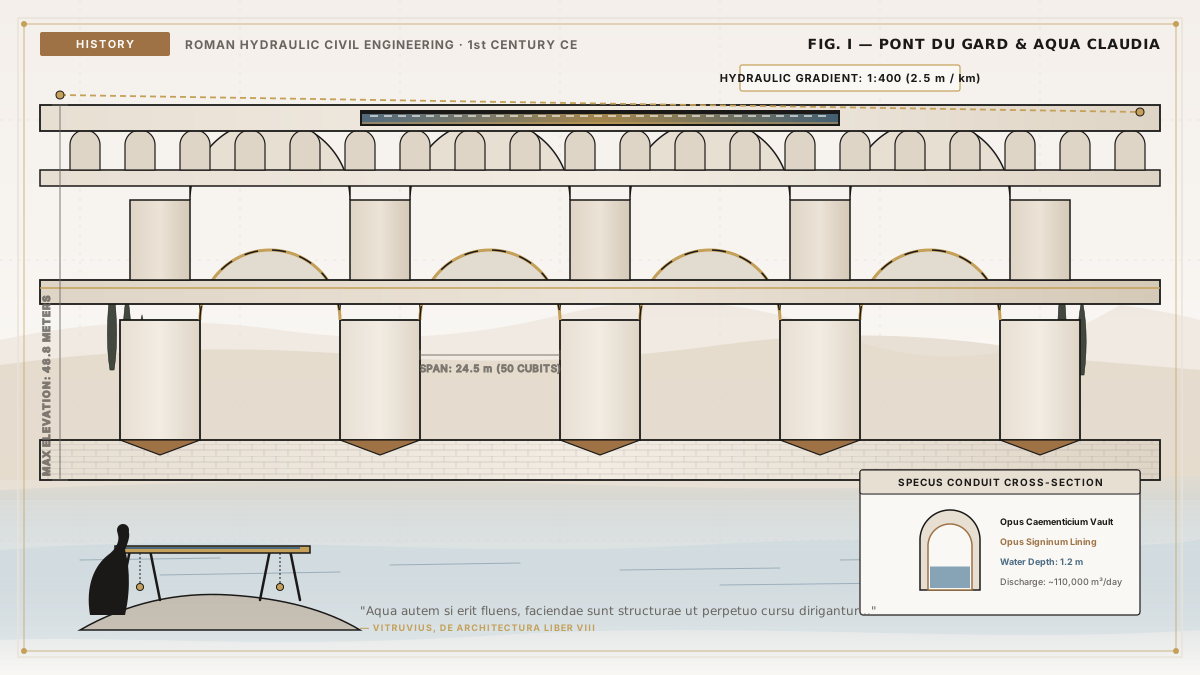
When modern travelers gaze upon the towering stone arches of the Pont du Gard in southern France or the magnificent elevated spans crossing Segovia, they are observing an optical illusion of Roman engineering. The popular imagination pictures aqueducts as perpetual stone bridges marching triumphantly across continents. In reality, elevated arcades comprised fewer than twelve percent of Rome's total hydrological network. The true genius of Roman water conveyance lay hidden deep beneath the Mediterranean earth, operating without pumps, steam, or mechanical engines, guided entirely by the unrelenting pull of planetary gravity.
At its imperial zenith in the late first century CE, eleven major aqueduct systems converged on the capital city, channeling an estimated one million cubic meters of pristine mountain spring water into public fountains, imperial baths, and private residences every twenty-four hours. Maintaining a continuous, non-stagnant flow over distances exceeding ninety kilometers required an unprecedented mastery of geodesy, topography, and hydraulic masonry.
"Water is an absolute necessity not only for life, but for daily comfort and sanitation. If anyone will consider the abundance of water publicly supplied for baths, pools, open trenches, houses, and gardens, he will confess that nothing more wonderful has ever existed in the entire world." — Pliny the Elder, Naturalis Historia (77 CE)
The Precision of the Gradient: The Chorobates and Dioptra
The primary challenge confronting Roman military surveyors (agrimensores) was mathematical calculation: how to maintain a gentle, continuous descent over dozens of miles of irregular terrain. If the slope was too steep, the rushing water would generate destructive hydrodynamic pressure, scouring the waterproof mortar lining and destabilizing the conduit. If the gradient was too shallow, the flow would slow, deposition of calcium carbonate (sinter) would accelerate, and the stream would stagnate.
The Roman surveyor relied on two fundamental instruments:
- The Chorobates: A heavy wooden bench approximately twenty feet long, equipped with plumb bobs on each side and a five-foot carved water channel along the top rail. In windy conditions where plumb lines swung erratically, water poured into the central groove revealed true horizontal level.
- The Dioptra and Groma: Sophisticated sighting tables that allowed surveyors to calculate vertical angles and shoot straight grid lines across rugged valleys and forested hillsides.
Working with these analog wooden tools, Roman engineers achieved gradients that astonish modern civil engineers. The Aqueduct of Nîmes, which incorporates the Pont du Gard, falls merely seventeen meters over its entire fifty-kilometer course—an average slope of approximately one foot per mile (a gradient of 1:3,000). Over specific stretches, the gradient was held steady at a slope of less than 1:10,000.
Underground vs. Arched Monuments: The Real Anatomy of Aqueducts
Building underground masonry tunnels was far more economical, durable, and secure than erecting elevated stone arcades. Underground channels protected urban drinking water from airborne pollutants, animal contamination, summer heat evaporation, and enemy sabotage during times of siege.
The standard subterranean conduit (specus) was carved directly through limestone bedrock or excavated as a trench lined with cut stone masonry (opus caementicium). The interior channel was meticulously lined with opus signinum—a specialized waterproof mortar formulated from crushed terracotta tiles, pozzolanic volcanic ash, and slaked lime. This remarkable composite resisted hydrostatic pressure and chemical erosion for centuries.
Elevated stone arches were deployed only as a last resort when the conduit encountered a deep valley or when the channel needed to gain elevation before entering the city walls to feed elevated distribution towers (castella aquae). By stacking tiers of semicircular arches, Roman masons minimized lateral wind resistance while maximizing compressive structural strength, using interlocking keystones without mortar to absorb thermal expansion and seismic shocks.
Inverted Siphons: Overcoming Deep Ravines
When an aqueduct route encountered a canyon too wide and deep for stone arches—such as the massive valleys surrounding Lyon (ancient Lugdunum)—Roman engineers abandoned open gravity channels and designed inverted siphons.
The physics was rooted in the communicating-vessels principle: water flowing down a sealed pipe from an elevated header tank will build sufficient hydrostatic head to climb up the opposing hillside to a receiving tank situated slightly below the original elevation.
Because Roman metallurgical technology could not manufacture cast iron pipes capable of withstanding hundreds of pounds per square inch of hydraulic pressure, engineers fabricated siphons out of thick lead sheets soldered into nine-inch pipes. To distribute the immense bursting pressures, the siphon stream was split across ten to twelve parallel lead pipes laid along the valley floor atop low ramparts (venter bridges). Inspection vents and elbow stones prevented water hammer effects from rupturing the seam welds.
Sextus Julius Frontinus and Municipal Water Administration
The operational complexity of the Roman water system is preserved in extraordinary detail thanks to Sextus Julius Frontinus, appointed Water Commissioner (Curator Aquarum) of Rome by Emperor Nerva in 97 CE. Frontinus conducted the ancient world's first comprehensive municipal infrastructure audit.
In his treatise De Aquis Urbis Romae, Frontinus cataloged illegal tapping of water pipes by corrupt landholders, documented the exact discharge rates of each aqueduct using standard bronze pipe nozzles (calices), and instituted rotating maintenance teams of state-owned slaves (aquarii):
+-------------------+-----------------+----------------+---------------------+
| Aqueduct Name     | Year Built      | Length (km)    | Daily Volume (m³)   |
+-------------------+-----------------+----------------+---------------------+
| Aqua Appia        | 312 BCE         | 16.4 km        | ~73,000 m³          |
| Aqua Anio Vetus   | 272 BCE         | 63.7 km        | ~180,000 m³         |
| Aqua Marcia       | 144 BCE         | 91.4 km        | ~190,000 m³         |
| Aqua Virgo        | 19 BCE          | 20.6 km        | ~100,000 m³         |
| Aqua Claudia      | 52 CE           | 69.0 km        | ~191,000 m³         |
| Anio Novus        | 52 CE           | 86.9 km        | ~196,000 m³         |
+-------------------+-----------------+----------------+---------------------+
Frontinus categorized urban water distribution into three distinct priority streams:
- Public basins and street fountains: Guaranteed priority so every citizen had access to free drinking water.
- Public amenities: Imperial baths, amphitheaters, and naval staging basins.
- Private domestic concessions: Granted solely to private citizens who paid a dedicated water tax based on calibrated pipe diameter.
Key Takeaways
- Over 80% Subterranean: Contrary to popular belief, the vast majority of Roman aqueduct systems were subterranean masonry trenches and tunnels rather than stone bridges.
- Gravity Without Pumps: The entire network operated purely on gravity, requiring surveyors to calculate slopes as delicate as 1:3,000 using wooden chorobates benches.
- Hydraulic Mortar Innovation: Interior conduits were sealed with opus signinum, an impervious blend of slaked lime, crushed ceramic tiles, and volcanic pozzolana.
- Inverted Siphons: Where canyons were too deep for masonry bridges, pressurized lead siphon pipe networks traversed valleys using simple communicating-vessels physics.
Archival References & Historical Documentation
- Frontinus, Sextus Julius. De Aquis Urbis Romae (The Water Supply of the City of Rome), trans. R. H. Rodgers, Cambridge University Press, 2004.
- Hodge, A. Trevor. Roman Aqueducts & Water Supply. London: Duckworth Academic, 2002.
- Ashby, Thomas. The Aqueducts of Ancient Rome. Oxford: Clarendon Press, 1935.
- Leveau, Philippe. "The Pont du Gard and the Aqueduct of Nîmes." American Journal of Archaeology, vol. 95, no. 1, 1991, pp. 147–152.