Is Ball Lightning Real? What Scientists Know
Ball lightning is a strange sky phenomenon: glowing spheres reported for centuries. In 2014 scientists captured the first spectrum — here is what it revealed.
Key takeaways
- Ball lightning is real in the sense that it has been reported for centuries and, in 2014, was recorded on camera with a spectrometer for the first time.
- The first spectrum showed silicon, calcium, iron, nitrogen and oxygen — elements from soil — supporting the vaporized-soil hypothesis.
- Typical reports describe glowing spheres from 10 to 20 cm across, lasting seconds to a minute, drifting a few meters per second.
- Leading theories include oxidizing silicon nanoparticles and microwave-trapped plasma bubbles, but none explains every observation.
- Ball lightning should not be confused with St. Elmo's fire or will-o'-the-wisp, which are separate, better-understood phenomena.
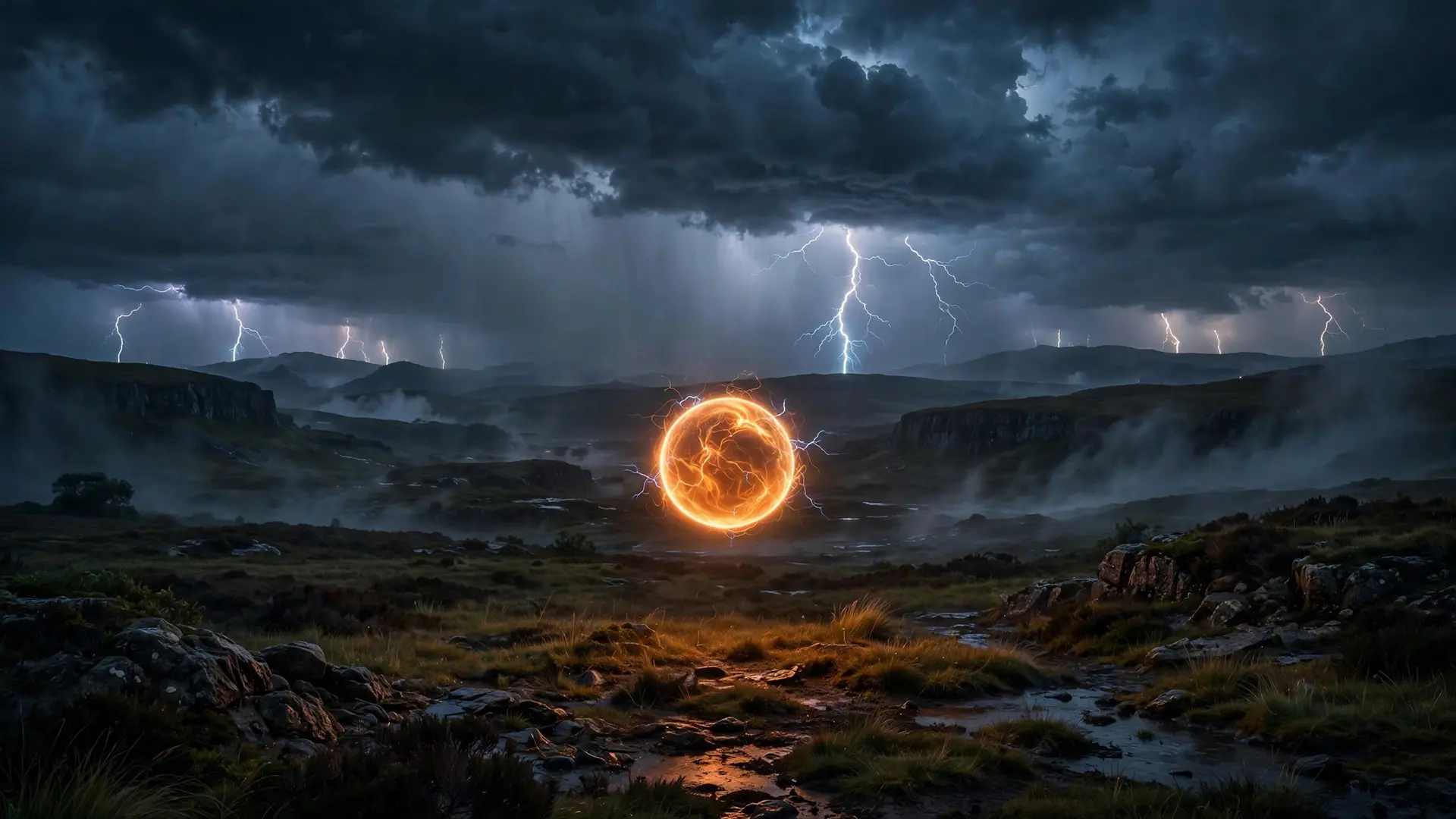
Yes — but scientists still cannot fully explain it. Ball lightning has been reported for centuries: glowing spheres that drift through the air during thunderstorms, sometimes harmlessly, sometimes destructively. In 2014 it was captured on scientific instruments for the first time, and that single recording reshaped what researchers believe.
What do witnesses actually see?
The descriptions are remarkably consistent. Ball lightning typically appears during or just after a thunderstorm as a glowing ball, most often 10 to 20 centimeters across — grapefruit-sized — though reports range from pea-sized to several meters. Its brightness is about that of a household lamp, and the most common colors are red, orange and yellow. The balls drift, usually horizontally, at a walking pace, sometimes spinning, and last anywhere from a second to over a minute before fading or bursting. Some accounts push stranger boundaries. People have watched glowing spheres pass through closed windows and doors, move along metal fences, or drift down the aisle of an aircraft. They often carry a sharp odor of ozone or burning sulfur. Some end quietly; others end with a violent explosion. History is full of such reports. A chronicle entry from 1195 describes a fiery globe falling from a dark cloud near London. On an October night in 1638, during the great thunderstorm at Widecombe-in-the-Moor, witnesses described an eight-foot ball of fire smashing through a church. In March 1963, the astronomer Roger Jennison was flying through a storm when, just after lightning struck the plane, a glowing sphere about 20 centimeters across emerged from the pilot's cabin and floated steadily down the aisle. Even Tsar Nicholas II recorded seeing a fiery ball whirl around a church floor during a thunderstorm in his childhood.
What did the 2014 recording reveal?
For all these centuries of stories, hard data was almost nonexistent — until a team at China's Northwest Normal University got spectacularly lucky. In July 2012, Ping Yuan and colleagues had set up spectrometers on the remote Qinghai Plateau to study ordinary lightning when ball lightning appeared about 900 meters from their instruments, right after a cloud-to-ground strike. They captured it on high-speed video and recorded its spectrum, publishing the results in Physical Review Letters in 2014. The glowing region spanned roughly five meters, though the ball itself was smaller. Over about a second it shifted from white to reddish, drifted roughly ten meters horizontally and rose about three meters. The spectrum carried the emission lines of silicon, iron and calcium — elements abundant in soil. That fingerprint breathed new life into one of the oldest hypotheses. The idea goes like this: when lightning strikes the ground, its enormous heat vaporizes silicate minerals in the soil. Carbon in the soil strips oxygen from the silicates, leaving a gas of silicon atoms that clump into nanoparticles. Those particles, lofted into the air, slowly oxidize — burning gently rather than exploding — and glow as they do. The 2014 spectrum matches that story: the orb was, in effect, vaporized earth still burning. Caution is warranted. Lightning specialist Martin Uman of the University of Florida noted that this single event does not settle which theory is correct. Scientists have created glowing plasma balls in the lab — by firing intense microwaves through air or by discharging electricity underwater — but those experiments may have nothing to do with how nature produces the real thing. Yuan's team hopes to recreate the phenomenon under controlled conditions, and until they do, ball lightning remains an observation looking for a full explanation.
What are the competing theories?
No single theory has explained everything, and that is why ball lightning remains a genuine scientific puzzle. The vaporized-silicon model fits the 2014 data beautifully, but it struggles with reports of ball lightning appearing high in the air or inside metal aircraft, far from any soil.
Other researchers have proposed very different mechanisms. One theory holds that ball lightning is a bubble of plasma held together by microwaves trapped inside it. The microwaves are generated when electrons accelerated by a lightning stroke rush toward the ground; the radiation charges up the surrounding air into plasma, and its own pressure pushes the plasma outward into a sphere. This model, advanced by H.-C. Wu of Zhejiang University, elegantly explains the strangest observations: microwaves pass through glass, so a ball could drift through a closed window, and they generate ozone, explaining the acrid smell. Its weakness is that it rests on computer simulations, not experiments — no one has yet made ball lightning this way on demand. Further out on the spectrum of ideas are theories involving plasma toroids, tiny black holes, natural nuclear reactions, and even the notion that some sightings are optical illusions triggered by lightning's effect on the brain. Each accounts for some observations and fails on others.
What can we rule out?
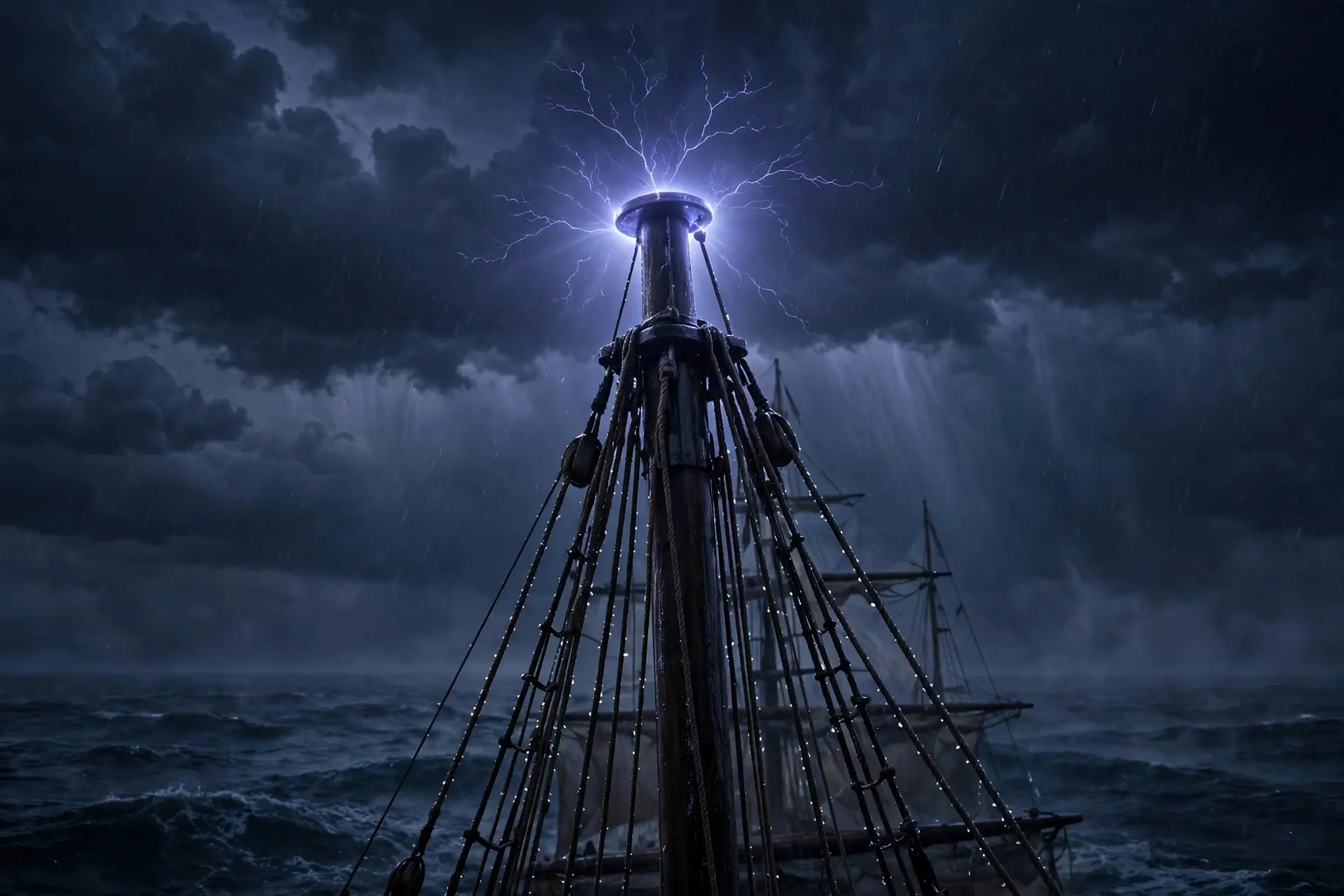
Two things are clear. First, ball lightning is not St. Elmo's fire — the blue-violet glow that sometimes crowns ship masts and aircraft wings — and it is not the will-o'-the-wisp that flickers over marshes, which comes from burning gases released by decaying matter. All three are glowing atmospheric phenomena, but they are distinct, and St. Elmo's fire and will-o'-the-wisp are both well understood. For the ordinary kind of lightning that starts the story, see what causes lightning. Second, the era of "nobody has ever measured one" is over. The 2014 observation proved the phenomenon can be captured instrumentally, and researchers are now trying to recreate the conditions — particularly the electron-microwave-plasma pathway and the nanoparticle-oxidation pathway — in the lab. The honest answer to "is ball lightning real?" is therefore layered. It is real enough to have been filmed and spectroscopically fingerprinted. It is mysterious enough that physicists still argue over what, exactly, keeps it glowing. Somewhere between a centuries-old folktale and a plasma physics paper, a small ball of light keeps drifting through our storms — and science is finally catching up with the witnesses. Like other rare sky phenomena, from the aurora to the halos that ring the sun and moon, it rewards the people patient enough to watch the sky.
Frequently asked questions
Has ball lightning ever been photographed with scientific instruments?
Yes. In 2014, researchers at China's Northwest Normal University accidentally recorded a ball lightning event on high-speed video with a spectrograph during a lightning field study. It lasted just over 1.5 seconds and its spectrum revealed soil elements like silicon and iron.
How big is ball lightning usually?
Reports range from pea-sized to several meters across, but most cluster between 10 and 20 cm — about the size of a grapefruit. They typically drift a few meters per second, often horizontally.
Can ball lightning pass through glass?
Witnesses have reported it entering homes through closed windows. One theory holds that microwaves trapped in a plasma bubble simply pass through glass, which would explain this baffling observation.
Is ball lightning dangerous?
It can be. Some accounts describe harmless glowing balls drifting through rooms, while others report explosions, burns and property damage. Its danger is one reason scientists want a reliable theory.