How Deep Is Krubera, the Deepest Cave on Earth?
Krubera Cave drops 2,224 metres into the Arabika Massif, per a 2024 survey, edging out neighbour Veryovkina. But the record depends on which survey you accept.
Key takeaways
- Survey work in 2024 put Krubera Cave at 2,224 metres deep, ahead of neighbouring Veryovkina at a revised 2,209 metres.
- Some record lists still credit Veryovkina at 2,212 metres, so the deepest-cave title depends on which survey is accepted.
- Krubera and Veryovkina are the only two known caves deeper than 2,000 metres, and both sit in the same Arabika Massif.
- The cave formed as water dissolved thick limestone over millions of years, carving vertical shafts down toward the Black Sea.
- A 2026 expedition installed monitoring stations in Krubera down to 1,400 metres, finding air warming with depth.
The deepest cave on Earth drops 2,224 metres straight down into a mountain in the Western Caucasus. That is the depth survey work in 2024 gave to Krubera Cave, in the Arabika Massif near the Black Sea, putting it just ahead of its neighbour Veryovkina. But the answer comes with a footnote that matters: some record lists still name Veryovkina as the deepest, and the gap between the two rivals is only about fifteen metres after more than two kilometres of descent. Krubera, also known as Krubera-Voronya, is not a single hole in the ground. It is a system of vertical shafts, narrow meanders, flooded sumps and chambers, explored shaft by shaft over decades. Its depth is measured the way all cave depths are measured: as the vertical drop from its highest entrance to the lowest point explorers have physically reached. That definition is why the record can change without anyone digging anything new. Re-survey an entrance, re-measure a sump, and the number moves.
Why do two caves claim the same record?
Because they are neighbours, and because both have been re-measured. For years, the widely quoted figures were 2,199 metres for Krubera and 2,212 metres for Veryovkina, a gap of thirteen metres in Veryovkina's favour. Visual Capitalist's 2026 ranking still uses those figures, listing Veryovkina first and Krubera second, with four of the world's ten deepest caves clustered in the same Arabika Massif. Then came the 2024 reassessment. A full re-survey of Krubera, including a dive in its bottom sump, put its total depth at 2,224 metres, while Veryovkina's depth was revised down to 2,209 metres on more precise measurements of the height difference between its entrance and its deepest point. On those numbers, Krubera retakes a title it held for more than a decade before Veryovkina passed it in 2017. Reporting on the reassessment in 2026 describes Krubera plainly as the world's deepest known cave. Yet not every list has caught up. A 2026 BBC Wildlife Magazine piece still calls Veryovkina the record holder, noting that it holds the Guinness World Record, while acknowledging that the 2024 Krubera measurement would make Krubera slightly deeper. The honest answer, then, is that Krubera is the deepest cave on the latest survey, while Veryovkina remains the deepest on some official record books. Either way, the two are the only caves known to pass 2,000 metres, and they sit in the same mountain range, a few kilometres apart.
How did water carve a hole over two kilometres deep?
The Arabika Massif is a block of thick, soluble limestone in the Western Caucasus, laid down in the Upper Jurassic and Lower Cretaceous periods, roughly 160 to 100 million years ago. Rain and meltwater on the high plateau, slightly acidic from carbon dioxide picked up in the air and soil, seep into cracks in that limestone and slowly dissolve it. Over millions of years, the cracks widen into shafts, and the shafts join into a system that drains downward toward the Black Sea. Height is the other half of the recipe. The massif rises high above the coast, so water has a long way to fall, and the limestone is thick enough to let it keep falling. The result is a cave dominated by vertical drops rather than horizontal wandering: a steep profile of pitches and shafts, broken by chambers and by sumps where the passage floods completely and only divers can continue. The same geology explains the clustering at the top of the depth rankings. Sarma, at 1,830 metres, and Snezhnaya, at 1,760 metres, also sit in the Arabika Massif or nearby, making the region home to the four deepest known caves on the planet.
What is it like to explore Krubera?
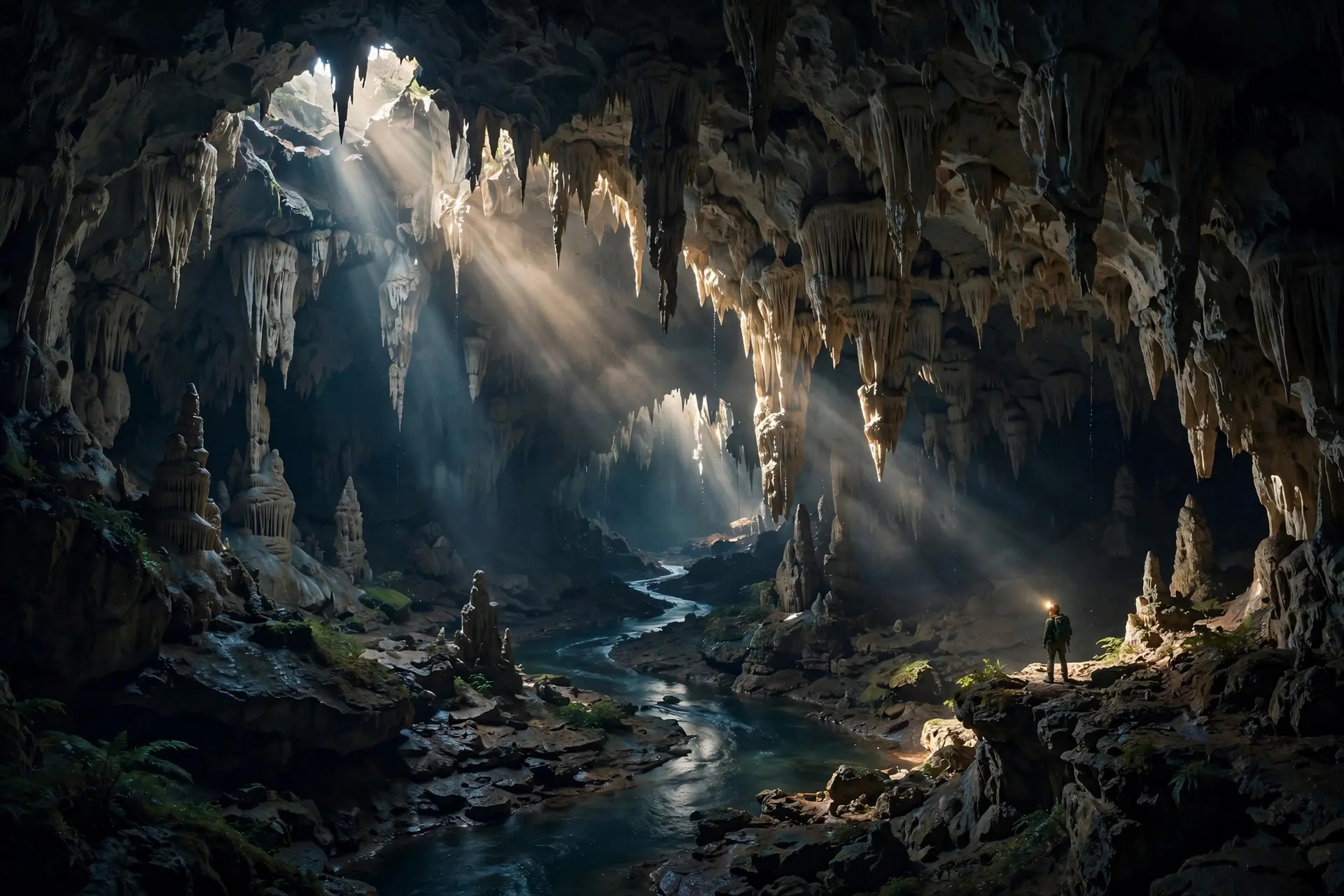
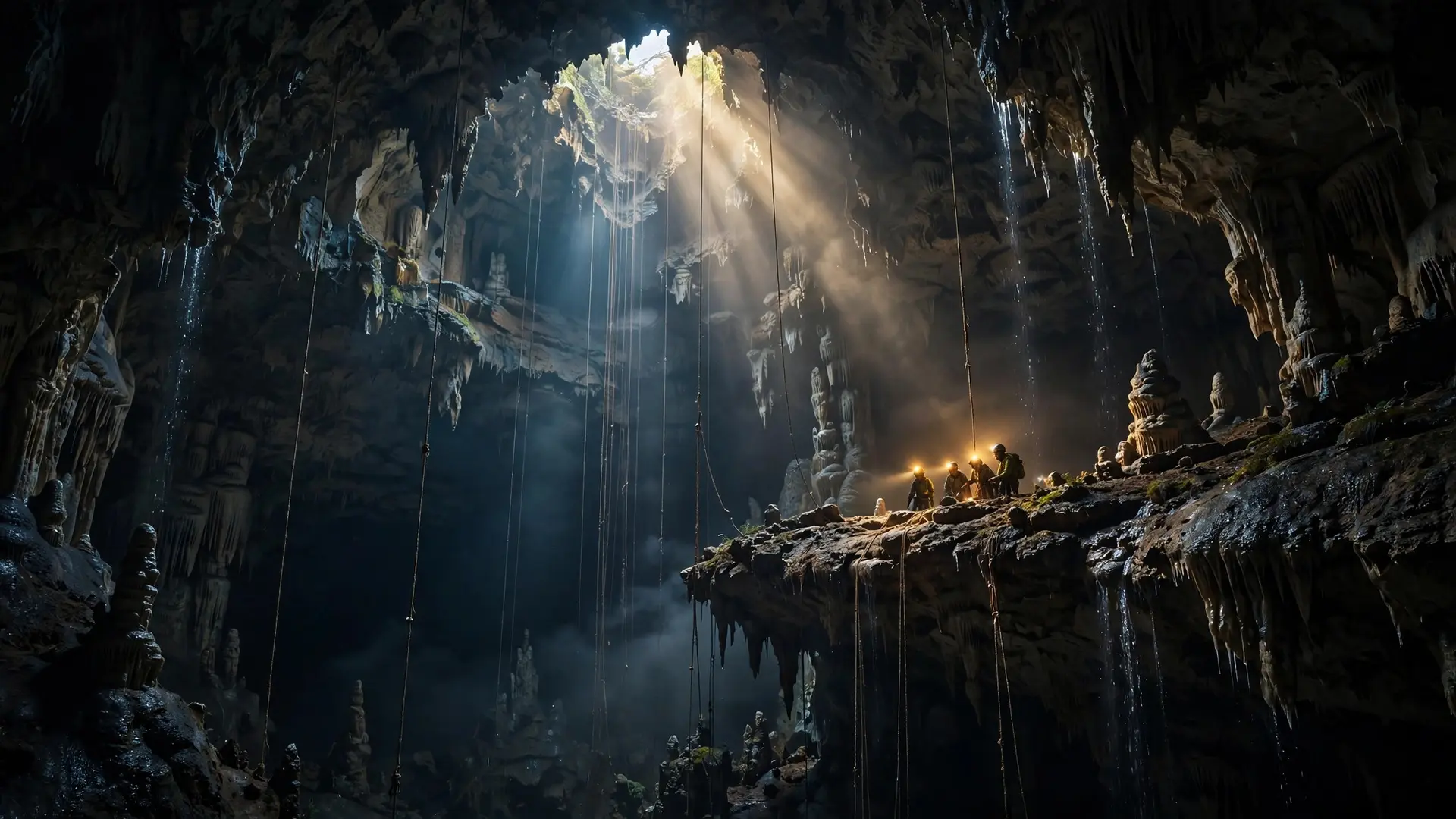
It is an expedition, not a trip. Because the cave is so deep, no one can reach the bottom and return to the surface in a single day. Teams set up camps underground, eat, sleep and work in the dark for days or weeks, and leave rigging in place for later parties. One caver who joined a Ukrainian Speleological Association expedition in 2016 spent close to a day underground on a first descent, then returned the next day for roughly a week below the surface, relying on camps established by earlier teams. The hazards are specific to the place. Water is the constant threat: underground floods can rise suddenly after rain on the surface, cutting off passages and stranding teams. In 2012, an international expedition that included researchers from Hebrew University was cut off by a flash flood underground for about thirty hours, while in a nearby cave an explorer from another team died during a complex evacuation. That same expedition worked at depths down to 2,080 metres without technical diving, and one of its members spent 24 consecutive days underground. At the bottom, the cave ends in a flooded sump, and reaching the deepest point requires diving through water at about two degrees Celsius.
The work is not only about depth. Krubera is a scientific site as much as a sporting one: its passages record how groundwater moves through the massif, its formations hold clues to past climates, and its dark, cold waters host life adapted to conditions no sunlight ever reaches. In 2012, researchers on the Hebrew University team reported finding a new species of transparent fish living in water at two degrees at a depth of about two thousand metres. That scientific work is now becoming continuous. In August 2026, an international expedition installed a monitoring network in Krubera, with stations operating at 60, 1,200 and 1,400 metres and more planned for 2027, eventually reaching the bottom. Early readings already show a pattern: air temperature rises with depth, from about 3 degrees at 700 metres to 4.65 degrees at 1,400 metres and 7.5 degrees at 2,000 metres, which the expedition leader attributed to geothermal warmth from the rock itself. Sensors also picked up elevated carbon dioxide deep in the cave, possibly entering through a fissure in the rock, though the team cautioned that more monitoring is needed to confirm the source. A damaged section of fibre-optic cable, believed to have been broken by underground floods, is a reminder of how hostile the environment is even to instruments.
Is the record settled, then?
Not quite, and that is part of the point. A cave's depth is not a fixed property like a mountain's height. It is a measurement of how far people have managed to go, and it changes when surveys improve, when a sump is dived a little deeper, or when two cave systems are found to connect. Visual Capitalist notes that a 2026 expedition in Mexico is even attempting to link Cheve Cave to a lower system, which could in theory unseat both Caucasus caves. For now, the Caucasus still holds the title, whichever of its two giants you count. For readers, the takeaway is simpler than the record books. Krubera descends 2,224 metres on the latest survey, further below the surface than any other explored cave, in a limestone massif where water has been dissolving rock for millions of years. It took decades of expeditions, underground camps and cold-water dives to prove that depth, and the instruments now ticking away in its shafts may soon tell us more about what the deep Earth is like than the record itself. The Mariana Trench is the ocean's equivalent frontier, plunging far deeper still, while the Kola borehole shows how far humans have drilled downward through solid rock in search of the same answers.
Frequently asked questions
How deep is the deepest cave on Earth?
Krubera Cave, at 2,224 metres according to survey work in 2024. Its neighbour Veryovkina was revised to 2,209 metres in the same reassessment, though some record lists still give Veryovkina at 2,212 metres.
Where is Krubera Cave?
In the Arabika Massif of the Gagra Range in the Western Caucasus, near the Black Sea coast, in the disputed region of Abkhazia, which most countries regard as part of Georgia.
Can tourists visit Krubera Cave?
No. It is an expedition cave for experienced cavers only, reached through vertical shafts, flooded sumps and weeks underground. There is no tourist route to the bottom.
How is a cave's depth measured?
As the vertical difference between its highest entrance and its lowest explored point, not the total length of its passages. A cave can be long without being deep, and deep without being long.
Sources
- Monitoring Network Installed in Abkhazia's Krubera Cave, AbkhazWorld
- Ranked: The World's Deepest Caves, Visual Capitalist
- The cave that's so deep it could swallow six Eiffel Towers, BBC Wildlife Magazine
- Israeli cave explorers return from record-breaking expedition of 'Everest of the caves', EurekAlert