The Ocean Beneath Our Feet: Earth's Deep Mantle Secrets
Scientists have discovered evidence of a vast reservoir of water locked inside the Earth's mantle, containing three times the volume of all surface oceans combined.
When we think of Earth as the "Blue Marble," we envision the vast, shimmering oceans that cover 71% of its surface. But a startling discovery reveals that we might be looking at only a fraction of our planet's water. Geologists have found compelling evidence of a massive reservoir of water hidden deep beneath the Earth’s surface—one that could hold up to three times the volume of all surface oceans combined.
This isn't an underground sea of liquid water where one might launch a submarine. Instead, it is a hidden ocean locked within the molecular structure of rocks in the Earth's mantle.
Ringwoodite: The Water Sponge
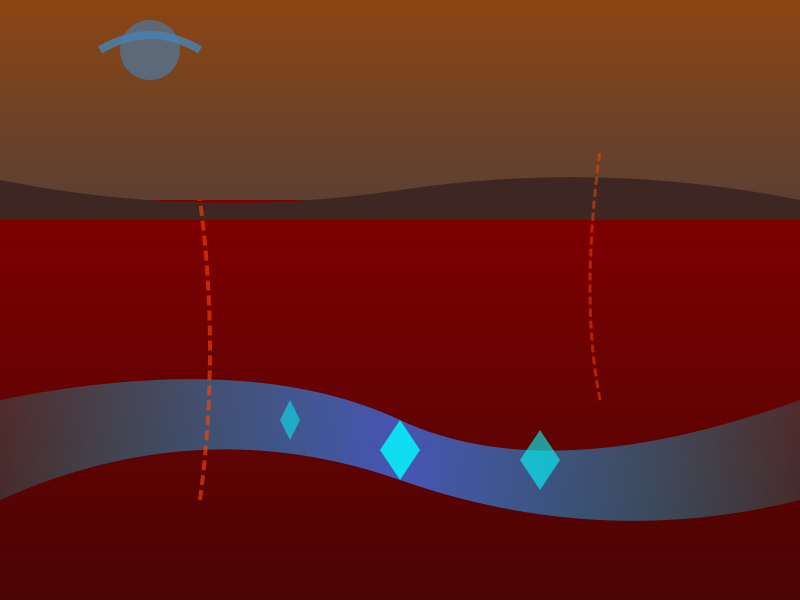
The key to this discovery lies in a blue mineral called ringwoodite. Found in the transition zone of the Earth's mantle, roughly 410 to 660 kilometers (250 to 410 miles) below the surface, ringwoodite acts like a sponge for water molecules.
Under the immense pressure and temperature of the deep Earth, water doesn't exist as a liquid, ice, or vapor. It is split into hydroxyl radicals (one oxygen atom and one hydrogen atom) and trapped within the crystal structure of minerals.
By studying seismic waves generated by earthquakes, researchers noticed that the waves slowed down as they passed through the transition zone. The most logical explanation for this dampening effect is the presence of widespread "wet" rock.
"The transition zone can hold a lot of water, and we have found evidence that it actually does. This is a crucial step in understanding the origin of Earth's water." — Dr. Steve Jacobsen, Geophysicist
Where Did Earth's Water Come From?
For decades, the prevailing theory was that Earth's surface water arrived via icy comets striking the planet early in its history. However, this deep-mantle discovery lends strong support to an alternative theory: the "inside-out" model.
This model suggests that Earth's water was present in the cosmic dust and rock that initially formed the planet. Over billions of years, geological activity—like volcanic eruptions—gradually released this trapped water from the mantle to the surface, filling the oceans. The deep reservoir we see today might be the remnants of this original planetary building block.
The Planetary Water Cycle
This discovery also changes how we view the water cycle. We are taught that water cycles through evaporation, condensation, and precipitation. But there appears to be a much larger, slower cycle operating on geological timescales, where water is subducted deep into the Earth through tectonic plates and eventually brought back up through volcanic activity.
The underground ocean might act as a planetary buffer, helping to stabilize the volume of the surface oceans over millions of years. Without it, our surface oceans might dry up or flood the continents entirely.
Understanding the deep Earth reminds us that our planet is a complex, dynamic system. The mysteries beneath our feet are just as profound as those in the stars above.
Key Takeaways
- A massive reservoir of water, potentially three times the size of surface oceans, exists deep in Earth's mantle.
- The water is not liquid, but locked inside the crystal structure of a mineral called ringwoodite.
- This discovery supports the theory that Earth's water originated from within the planet itself, rather than arriving via comets.
References
- Schmandt, B., Jacobsen, S. D., Becker, T. W., Liu, Z., & Dueker, K. G. (2014). "Dehydration melting at the top of the lower mantle." Science.
- Pearson, D. G., et al. (2014). "Hydrous mantle transition zone indicated by ringwoodite included within diamond." Nature.