How Bluetooth Quietly Connects All Your Devices
Bluetooth hops across 79 radio channels 1,600 times per second to link your earbuds, watch, and car — and it is named after a Viking king. Here is how it works.
Key takeaways
- Bluetooth is named after Harald Bluetooth, a 10th-century king famed for uniting Denmark and Norway; an Intel engineer proposed the name as a project codename in the 1990s.
- Links hop across 79 one-megahertz channels in the 2.4 GHz band up to 1,600 times per second, letting audio survive interference from Wi-Fi and microwave ovens.
- One piconet holds a master and up to seven active slaves; the master cycles through tiny time slots so quickly that every device feels continuously connected.
- Pairing exchanges cryptographic keys under Secure Simple Pairing, so keystrokes and calls stay encrypted between the two devices.
Every morning, your earbuds find your phone in seconds, your watch syncs your steps, and your car stereo resumes the podcast where you left it — all without a single cable. That quiet reliability is not an accident. It is the result of a radio technology that hops between 79 frequencies up to 1,600 times every second, choreographed by one device playing conductor to a small orchestra of others.
Why Is a Wireless Standard Named After a Viking King?
The strangest thing about Bluetooth is its name — and it has nothing to do with teeth. In the mid-1990s, engineers at Intel, Ericsson, and Nokia were each developing their own short-range radio technologies to replace the cables linking mobile phones to laptops. Rather than fight over incompatible proprietary links, the companies agreed to merge their efforts into a single industry standard. The project needed a codename. Jim Kardach, an Intel engineer and history enthusiast, suggested "Bluetooth" after Harald Gormsson — Harald Bluetooth — a 10th-century king famous for uniting Denmark and Norway, just as the engineers hoped to unite the PC and cellular industries with a short-range wireless link. Kardach had picked up the story from Frans G. Bengtsson's novel The Longships during a business trip to Toronto with an Ericsson colleague, and the metaphor fit too well to resist. The plan was always to replace the codename with something marketable — the front-runner was the dull but descriptive "Personal Area Network" — but a trademark search killed PAN, and no one cleared the backup name in time for launch. So the codename stuck, and the standard was formalized in 1998 under the Bluetooth Special Interest Group (SIG), the non-profit consortium that still governs it today. The king even lives on in the logo: the familiar Bluetooth symbol combines the Younger Futhark runes for "H" and "B" — Harald Bluetooth's initials. So every time you tap that rune-like icon on your phone, you are invoking a medieval Scandinavian king.
How Do Two Devices Actually Find Each Other?
Before any music flows, two devices must discover each other and agree to trust one another — a dance with several deliberate steps. It begins with one device going "discoverable" and broadcasting inquiry messages while the other scans for them. Once radio contact is made, the devices exchange paging messages to synchronize, then run service discovery to learn what the other can do: stream stereo audio, transfer files, act as a keyboard, and so on. Then comes pairing, the step most people know as the code prompt on their screen. Modern Bluetooth uses Secure Simple Pairing, in which both devices exchange cryptographic keys and confirm the match — sometimes by comparing a six-digit number on two phones, sometimes automatically for accessories with no screen. These keys seed the encryption of everything that follows, so your keyboard strokes, calls, and file transfers stay private between exactly those two devices. This is also why troubleshooting guides tell you to "forget" a device and re-pair it: the two ends need to negotiate fresh keys and a clean link state, and stale keys are the usual culprit behind a connection that refuses to come back. If your phone has ever asked you to confirm a pairing code, you have witnessed this quiet trust ceremony yourself.
What Keeps Your Music Stream Interference-Free?
Bluetooth lives in the crowded 2.4 GHz ISM band — the same unlicensed slice of spectrum used by Wi-Fi routers, microwave ovens, baby monitors, and every neighbor's network. It survives there with a clever trick called frequency-hopping spread spectrum. The band is divided into 79 channels, each 1 MHz wide, spanning roughly 2.402 to 2.480 GHz. Instead of camping on one channel, a Bluetooth link hops across them in a pseudorandom sequence up to 1,600 times per second — a new channel every 625 microseconds. Both devices know the sequence in advance, so they hop in perfect lockstep. Any interference, like a burst of energy from a microwave oven, ruins only a fraction of a millisecond of audio before the pair is already on a clean channel again.
Modern Bluetooth goes further with adaptive frequency hopping: the link continuously maps which channels are polluted — say, by a busy Wi-Fi network — and simply avoids them, using only the clear frequencies. This is why your earbuds can hold a steady stream in an office with fifty laptops online. Fixed-channel systems like Wi-Fi face the same interference head-on, but Bluetooth slips between the gaps like water flowing around stones.
How Do So Many Devices Share One Tiny Radio Band?
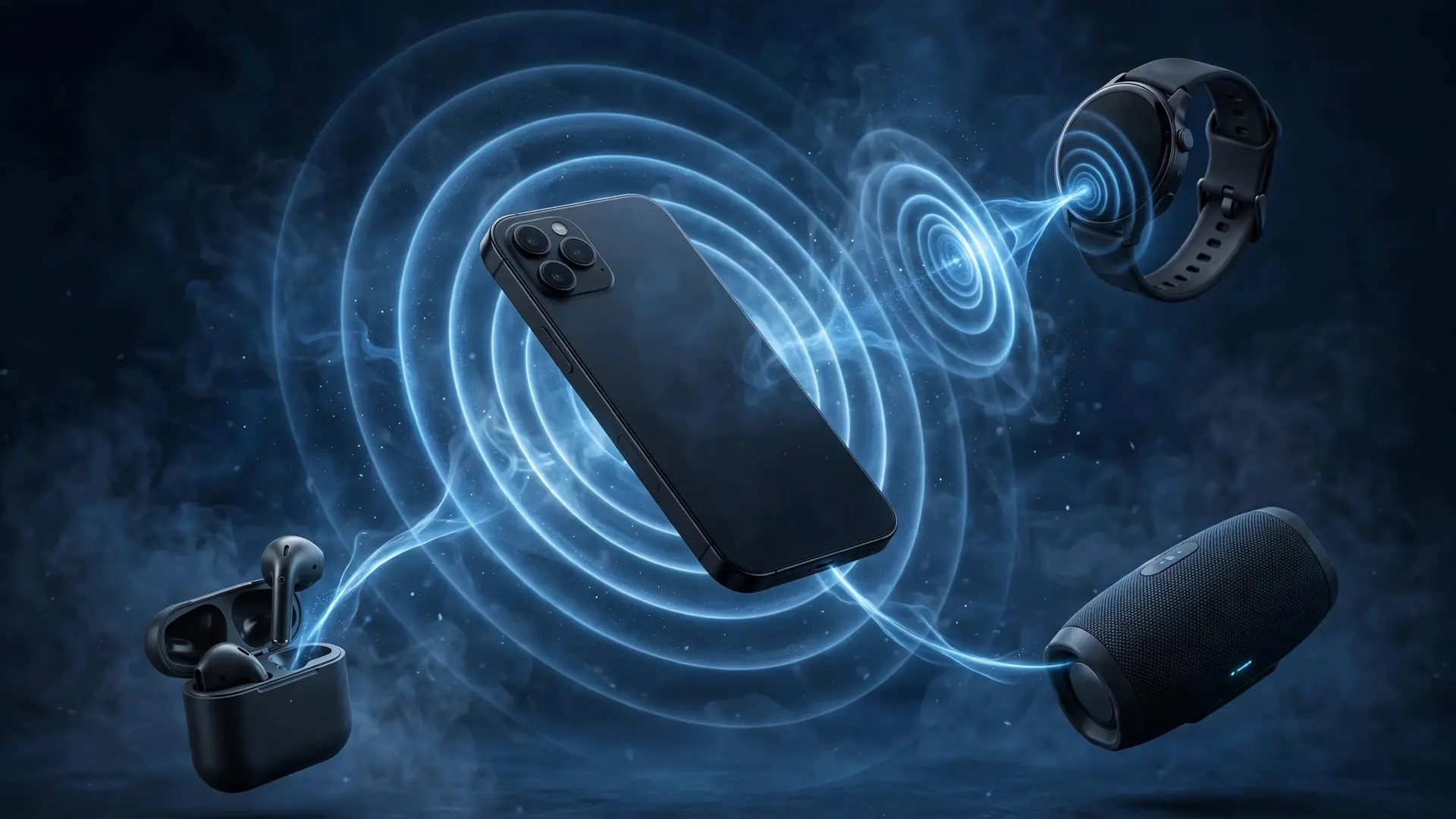
Every Bluetooth connection is organized as a piconet: one master device and up to seven actively connected slaves. Your phone is usually the master; your earbuds, watch, and car stereo are the slaves. The master sets the shared clock and the hopping sequence, and every slave follows it — that common rhythm is what keeps the whole network hopping in unison. Here is the subtle part: the master actually talks to only one slave at a time, in tiny numbered time slots. It cycles through its slaves so rapidly — hopping frequencies and switching partners thousands of times per second — that it feels like everything is connected at once. It is a beautifully fast illusion of simultaneity, the same sleight of hand a juggler uses to keep five balls in the air with two hands. Devices can even belong to multiple piconets at once, serving as master in one and slave in another; chained piconets form a wider scatternet. And power is kept deliberately tiny: Bluetooth radios sip only a few milliwatts at short range, with long-range Class 1 radios (up to about 100 mW) reaching roughly 100 meters in open space. That frugality is why a coin-cell sensor or a pair of earbuds can run for days on a charge. The standard also speaks several "profiles" — agreed dialects for specific jobs. A2DP carries stereo audio to your headphones, HFP handles hands-free calls, HID drives keyboards and mice, and Bluetooth Low Energy runs a leaner variant of the protocol for beacons, trackers, and health sensors. Contactless payments ride on a different radio technology — NFC — but the wearables that initiate them often pair through the same Bluetooth trust steps, and you can read how the tap itself works in our explainer on contactless payments. Bluetooth has quietly grown from a cable-replacement hack into the fabric of personal-area networking: billions of devices ship with it every year, and each new generation extends range and speed while cutting power further. The next time your music starts the moment your earbuds leave the case, remember the Viking king, the hopping radio, and the master-slave dance making it all invisible.
Frequently asked questions
Why is Bluetooth named after a Viking king?
Intel engineer Jim Kardach chose the codename after Harald Bluetooth, who united Denmark and Norway, as a metaphor for uniting the PC and cellular industries. It stuck after a trademark search ruled out the planned name 'Personal Area Network'.
Does Bluetooth interfere with Wi-Fi?
Both share the 2.4 GHz band, but Bluetooth hops across 79 channels up to 1,600 times per second and actively avoids crowded channels, so the two normally coexist without trouble.
What is Bluetooth Low Energy (BLE)?
A leaner variant of the protocol built for coin-cell devices like trackers, beacons, and health sensors, trading raw data rate for months or years of battery life.
How many devices can connect over Bluetooth at once?
One piconet supports a master plus up to seven active slaves. Devices can also bridge multiple piconets at once, and chained piconets form a scatternet.