How GPS Satellites Keep Atomic Time Against Relativity
GPS is really a global clock, not just a navigator. Learn how atomic clocks in orbit correct for Einstein's relativity to keep your position accurate to meters.
When a motorist taps their smartphone screen to navigate an unfamiliar city street, or an autonomous agricultural combine maps a wheat field down to the centimeter, they are engaging with the most pervasive utility on Earth: the Global Positioning System (GPS). Most users assume that GPS is an orbital mapping service—a cluster of celestial cameras or radar stations observing the globe.
In physical reality, GPS is not a navigation system at all. It is an ultra-precise, globally synchronized clock.
GPS determines terrestrial position not by measuring distance directly, but by measuring the microscopic propagation delay of radio waves traveling at the speed of light. To achieve positioning accuracy within meters, the satellites orbiting 20,200 kilometers above our heads must track time to within a few billionths of a second. Doing so requires human engineering to reconcile the most exotic theoretical physics of the twentieth century: Albert Einstein's theories of Special and General Relativity.
"Had engineers ignored Albert Einstein's relativistic equations when launching the GPS constellation, positioning errors would have accumulated at a rate of ten kilometers every twenty-four hours, rendering the entire satellite network useless within two minutes." — Dr. Neil Ashby, University of Colorado, Relativity in the Global Positioning System (2002)
The Geometry of Trilateration: Measuring Time as Distance
The operational GPS constellation consists of at least twenty-four operational satellites distributed across six orbital planes, ensuring that at least four satellites are visible from virtually any point on Earth at any time.
The system operates via trilateration:
- Each satellite constantly broadcasts a radio signal containing two pieces of information: its exact orbital position (ephemeris) and the precise timestamp when the radio signal was transmitted.
- The user's receiver (such as a smartphone chip) intercepts the signal and notes the exact time of arrival.
- Multiplying the transit time by the speed of light ($c \approx 299,792,458 \text{ m/s}$) yields the precise distance from the satellite to the user:
$$\text{Distance} = c \times (t_{\text{arrival}} - t_{\text{transmit}})$$
Because a radio photon travels approximately thirty centimeters (one foot) in a single nanosecond ($10^{-9}$ seconds), a timing error of merely one microsecond ($10^{-6}$ seconds) translates into an unacceptable positional error of three hundred meters.
To calculate three-dimensional position (latitude, longitude, and altitude), a receiver needs signals from three satellites. A fourth satellite is required to correct for the quartz clock inaccuracies inside consumer smartphone chips, synchronizing the handset's internal clock with master GPS time.
The Resonator Core: Cesium and Rubidium Atomic Standards
Mechanical pendulums and quartz crystals are far too unstable to govern satellite navigation; thermal fluctuations and gravitational shifts cause them to drift rapidly. GPS satellites carry specialized atomic clocks governed by the quantum mechanics of the atom.
Atomic clocks do not measure mechanical movement. They measure the unyielding electromagnetic frequency emitted when electrons jump between energy states in an atom:
- Rubidium Clocks: Compact atomic standards utilizing the 6.83 GHz hyperfine microwave transition of rubidium-87 vapor.
- Cesium Clocks: The foundational definition of the International System of Units (SI) second: exactly 9,192,631,770 cycles of the microwave radiation corresponding to the transition between two hyperfine levels of the ground state of the cesium-133 atom.
Each modern GPS Block III satellite carries multiple redundant atomic standards (typically two rubidium and two cesium units) sealed in temperature-controlled, magnetically shielded compartments, guaranteeing stability down to a few parts in $10^{14}$.
The Relativistic Duel: Special Relativity vs. General Relativity
When GPS was initially designed in the 1970s by the United States Department of Defense, a contentious debate erupted among engineers and physicists. Many military engineers questioned whether Einstein's theories of relativity—developed purely through thought experiments—would have any measurable impact on practical radio hardware in Earth orbit.
In reality, GPS satellites exist in an extreme relativistic environment that experiences two opposing time-dilation effects simultaneously:
1. Special Relativity: Moving Clocks Run Slow (Velocity Effect)
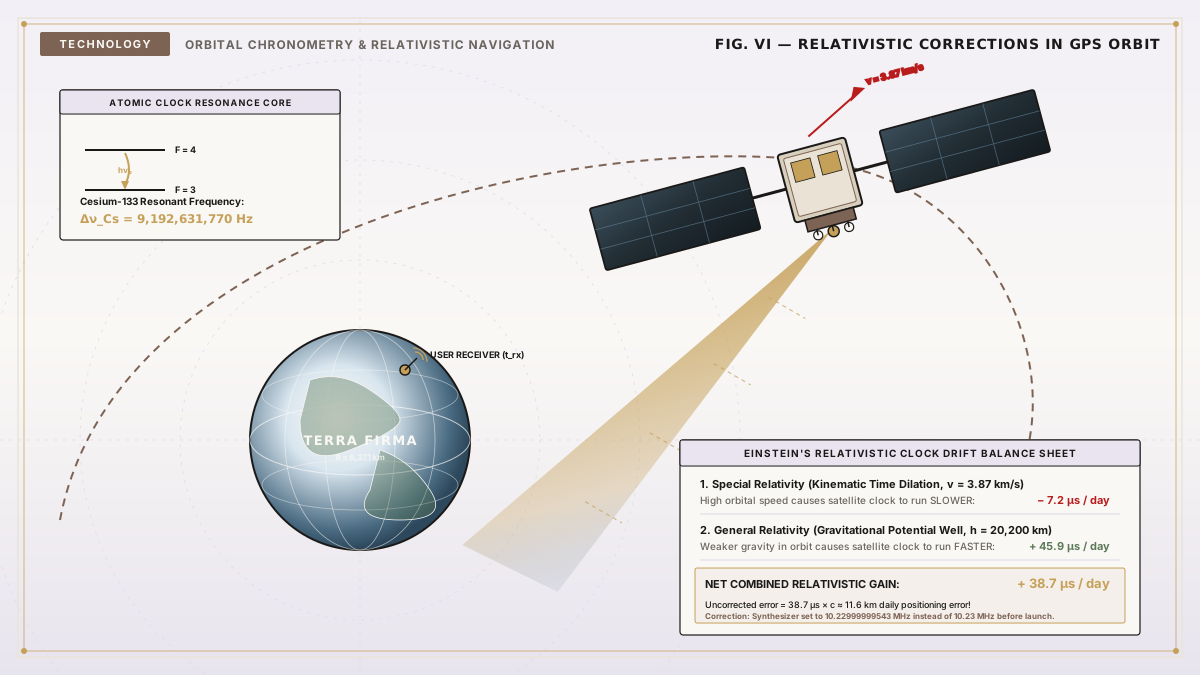
According to Einstein's 1905 Special Theory of Relativity, an object moving at high velocity relative to an inertial observer experiences time dilation. GPS satellites travel at approximately 3.9 kilometers per second (roughly 14,000 km/h) relative to ground stations on Earth.
Because of this high orbital speed, special relativity dictates that satellite atomic clocks tick slower than stationary clocks on Earth's surface by approximately 7 microseconds per day:
$$\Delta t_{\text{special}} \approx -7.2 \ \mu\text{s/day}$$
2. General Relativity: Clocks in Weaker Gravity Run Fast (Gravitational Effect)
According to Einstein's 1915 General Theory of Relativity, gravity is the curvature of spacetime caused by mass. Clocks situated deep inside a gravitational potential well (such as humans standing on Earth's surface) tick slower than clocks placed higher up where gravitational potential is weaker.
GPS satellites orbit at an altitude of 20,200 kilometers, where Earth's gravitational pull is roughly one-quarter of its surface value. Because they operate in a significantly weaker gravitational field, satellite atomic clocks tick faster than identical clocks on Earth's surface by approximately 45 microseconds per day:
$$\Delta t_{\text{general}} \approx +45.9 \ \mu\text{s/day}$$
The Net Relativistic Sum: The 38-Microsecond Surplus
Combining these two conflicting relativistic effects yields a net daily discrepancy:
$$\Delta t_{\text{net}} = +45.9 \ \mu\text{s} - 7.2 \ \mu\text{s} = +38.7 \ \mu\text{s per day}$$
The satellite atomic clocks tick faster than terrestrial clocks by approximately 38.7 microseconds every single day.
+--------------------------+-----------------------+----------------------------------+
| Relativistic Effect      | Cause                 | Impact on Orbiting Clock Rate    |
+--------------------------+-----------------------+----------------------------------+
| Special Relativity       | High Velocity (3.9 km/s)| Ticks SLOWER by ~7.2 µs / day    |
| General Relativity       | Weaker Gravity (20,200 km)| Ticks FASTER by ~45.9 µs / day   |
| Combined Net Drift       | Superposition         | Ticks FASTER by +38.7 µs / day   |
+--------------------------+-----------------------+----------------------------------+
If left uncorrected, an error of 38.7 microseconds multiplied by the speed of light would produce a positional drift of 11.6 kilometers (7.2 miles) per day, accumulating continuously. Within hours, GPS would be completely incapable of guiding an airplane to a runway or finding an address.
The Engineering Triumph: The Pre-Launch Frequency Offset
To resolve this relativistic drift without burdening satellite microprocessors with continuous software calculations, aerospace engineers implemented an astonishingly elegant solution prior to launch.
The fundamental resonant frequency for GPS atomic clocks is 10.23 MHz (10,230,000 Hertz). To cancel out the 38.7-microsecond daily acceleration in orbit, engineers tuned the satellite master clock oscillators downward before launching them into space:
$$\text{Tuned Launch Frequency} = 10.22999999543 \text{ MHz}$$
When the satellites reached their 20,200-kilometer orbits, the relativistic acceleration pushed their operating frequency upward, causing them to tick at precisely 10.23000000000 MHz relative to ground stations on Earth.
Today, ground master stations in Colorado Springs track the satellite constellation around the clock, applying microsecond phase adjustments (clock bias parameters) to keep GPS time synchronized with Coordinated Universal Time (UTC) to within nanoseconds.
Key Takeaways
- GPS Is an Atomic Clock Network: Satellite navigation works through trilateration by measuring the exact nanosecond arrival times of radio waves moving at the speed of light ($c$).
- The Relativistic Duel: Orbital atomic clocks experience time dilation from velocity (running 7 µs/day slower) and gravitational potential (running 45 µs/day faster).
- The 38-Microsecond Net Drift: Without compensating for the net +38.7 microsecond daily surplus, GPS navigation would drift by more than 11 kilometers each day.
- Pre-Launch Frequency Offset: Clocks are intentionally tuned down to 10.22999999543 MHz on the ground so that orbital relativity shifts them to exactly 10.23 MHz in space.
Technical Specifications & Foundational Papers
- Ashby, Neil. "Relativity in the Global Positioning System." Living Reviews in Relativity, vol. 6, no. 1, 2003, pp. 1–42.
- Parkinson, Bradford W., and James J. Spilker Jr., editors. Global Positioning System: Theory and Applications. American Institute of Aeronautics and Astronautics (AIAA), 1996.
- Allan, David W. "Time and Frequency (Time-Domain) Characterization, Estimation, and Prediction of Precision Clocks and Oscillators." IEEE Transactions on Ultrasonics, Ferroelectrics, and Frequency Control, 1987.
- Misra, Pratap, and Per Enge. Global Positioning System: Signals, Measurements, and Performance. Ganga-Jamuna Press, 2006.