
For more than a century, classical forestry conceived the woodland canopy through the lens of pure Darwinian competition: an uncompromising arena where individual trees waged silent economic war against their neighbors, competing ruthlessly for access to sunlight, moisture, and soil nitrogen. Taller crowns cast deadly shade over younger saplings, and root systems struggled to exhaust the surrounding soil of moisture before competitors could take hold.
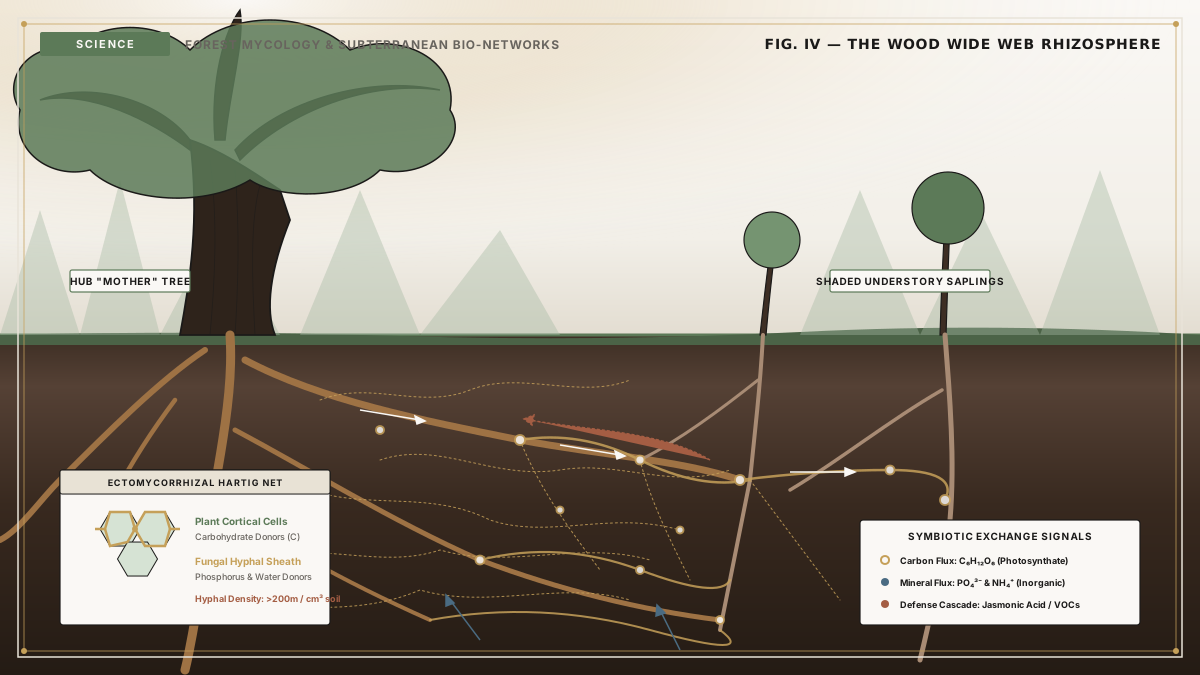
Over the past three decades, a revolution in subterranean ecology has dismantled this solitary paradigm. Pioneering isotopic labeling studies, spearheaded by forest ecologist Dr. Suzanne Simard and global mycorrhizal researchers, have revealed that forest trees are not discrete, disconnected individuals. Beneath the damp moss and leaf litter lies a massive, continuous underground biological network: an intricate mutualistic fungal grid dubbed the "Wood Wide Web." Through this living subterranean infrastructure, trees share nutrients, allocate carbon subsidies to ailing neighbors, and transmit biochemical defense alerts across distinct species barriers.
"A forest is not simply a collection of trees competing for light; it is a complex, cooperative society where resources flow dynamically along gradients of abundance to regions of deficit through microscopic fungal bridges." — Dr. Suzanne Simard, Finding the Mother Tree (2021)
The Mutualist Bargain: Sugars for Minerals
At the core of forest connectivity lies an ancient mutualistic symbiosis between plant roots and mycorrhizal fungi (myco meaning fungus, rhiza meaning root). This biological partnership originated more than 400 million years ago, facilitating the colonization of dry land by early terrestrial plants that lacked developed root systems.
The underlying economic exchange is remarkably straightforward yet biochemically essential:
- The Plant's Contribution: Through oxygenic photosynthesis in the canopy, mature trees convert atmospheric carbon dioxide into energetic carbohydrates (glucose and sucrose). Trees routinely allocate twenty to forty percent of their total photosynthesized carbon down into their root systems to feed fungal partners.
- The Fungus's Contribution: Fungi cannot photosynthesize, but their vegetative bodies—composed of microscopic threads called hyphae—are biological marvels of surface area. A single teaspoon of healthy forest soil contains miles of fungal hyphae. These microscopic filaments penetrate microscopic soil pores far too tiny for woody plant root hairs, dissolving and extracting mineral nutrients like phosphorus, nitrogen, zinc, and magnesium, and transporting them directly into plant root cells.
In temperate and boreal forests, this union primarily takes the form of ectomycorrhizae, where fungal hyphae wrap around root tips in a dense sheath (the Hartig net), exchanging solutes between plant cell walls without penetrating the cell membrane.
Common Mycorrhizal Networks (CMNs): The Underground Conduit
The crucial ecological discovery of recent decades is that mycorrhizal hyphae do not restrict themselves to a single host. A single fungal mycelium can colonize the root systems of dozens of adjacent trees, while a single tree's roots may interface with hundreds of distinct fungal species simultaneously.
This creates a Common Mycorrhizal Network (CMN)—a continuous, living biological grid that links entire forest stands into a shared physiological collective:
[Douglas Fir Canopy]                [Paper Birch Canopy]
         |                                   |
    (Photosynthesis)                    (Photosynthesis)
         |                                   |
   [Root System]                       [Root System]
         \                                   /
          \---- [Common Mycorrhizal Grid] --/
                   - Carbon-13 Shuttling
                   - Jasmonate Defense Signals
                   - Phosphorus & Nitrogen Balancing
Using stable carbon isotopes ($^{13}C$ and $^{14}C$), researchers tracked the movement of molecules between trees. In famous field experiments conducted in British Columbia, Dr. Simard shaded paper birch trees (Betula papyrifera) during summer months, reducing their photosynthetic capacity. Within days, isotopic analysis demonstrated that neighboring Douglas fir trees (Pseudotsuga menziesii) bathed in sunlight were exporting substantial volumes of carbon sugars through the fungal network directly into the root systems of the shaded birch trees.
In the autumn, when deciduous birch trees shed their leaves, the net direction of carbon transfer reversed: birch trees funneled carbon reserves back across the fungal grid to evergreen firs entering winter dormancy.
Early Warning Transmissions: Chemical Alarm Systems
Beyond nutritional bartering, Common Mycorrhizal Networks operate as rapid telecommunication channels for pest defense.
When an herbivorous insect, such as an aphid or caterpillar, attacks the foliage of a tree, the victimized plant initiates an internal immune response, synthesizing defense hormones such as jasmonic acid and volatile organic compounds (VOCs) that make its leaves toxic or unpalatable, while signaling predatory wasps to attack the pests.
Astonishingly, uninfected neighboring trees connected to the same mycorrhizal network begin producing identical defensive enzymes hours before any insect physically lands on their leaves. Laboratory experiments by Dr. David Johnson at the University of Aberdeen verified that when airborne pathways are strictly sealed with airtight barriers, warning signals still travel through subterranean hyphal conduits. The fungal network functions as an underground early-warning telegraph, allowing the wider forest community to preemptively harden its defenses against impending pathogen outbreaks.
Mother Trees and Kin Selection
Network analysis reveals that mycorrhizal grids exhibit "scale-free" architecture similar to modern telecommunication systems and neural networks. They possess central hubs: the oldest, largest, most deeply rooted canopy trees, affectionately termed "Mother Trees."
A single ancient Mother Tree may be physically connected to hundreds of neighboring trees. When tiny seedlings germinate on the shaded forest floor, their modest root systems cannot penetrate deep soil layers, and their sparse leaves receive less than three percent of ambient canopy sunlight. Under classical competition models, these saplings would inevitably starve.
Instead, Mother Trees detect the seedlings through the mycorrhizal grid, channeling vital subsidies of water, carbon, and mycorrhizal colonization into the saplings' roots. Intriguingly, experiments have shown that Mother Trees preferentially allocate greater carbon resources toward seedlings sharing their own genetic lineage, demonstrating a form of botanical kin recognition.
Ecological Nuance: Cooperation vs. Fungal Self-Interest
While popular media frequently anthropomorphizes mycorrhizal networks into utopian, compassionate societies, evolutionary biologists urge scientific caution:
- Fungi are not altruistic couriers acting for the benefit of trees; they are autonomous organisms operating under intense evolutionary pressures.
- Fungi require carbon to survive and grow. When a fungus facilitates nutrient transfer between two trees, it acts as an active broker, levying a significant "energy tax" on every transaction to fuel its own metabolic processes.
- Some plant species, such as parasitic ghost pipes (Monotropa uniflora), have evolved to hack the mycorrhizal network, siphoning carbon away from photosynthetic trees without returning any nutrients.
Nevertheless, the discovery of mycorrhizal networking has fundamentally transformed conservation biology and commercial forestry. Industrial clear-cutting does not merely remove timber; it obliterates the subterranean mycelial architecture that took centuries to mature. Preserving the subterranean fungal web is now recognized as foundational to maintaining forest resilience in an era of accelerating climate change.
Key Takeaways
- Subterranean Symbiosis: Over ninety percent of terrestrial plant species form mutualistic partnerships with mycorrhizal fungi, trading photosynthetic carbon for soil minerals and water.
- Cross-Species Connectivity: Fungal hyphae link disparate trees into Common Mycorrhizal Networks (CMNs), enabling bidirectional resource transfers even between unrelated species.
- Biochemical Early Warnings: Plants under pest infestation transmit warning chemical signals through fungal networks, triggering defensive hormone production in neighboring trees ahead of attack.
- Mother Tree Hubs: Ancient canopy trees function as critical network nodes that nurture establishing saplings, demonstrating complex forest-wide self-regulation.
Scientific References & Peer-Reviewed Literature
- Simard, Suzanne W., et al. "Net transfer of carbon between ectomycorrhizal tree species in the field." Nature, vol. 388, no. 6642, 1997, pp. 579–582.
- Babikova, Zdenka, et al. "Underground signals carried through fungal networks warn neighbouring plants of aphid attack." Ecology Letters, vol. 16, no. 7, 2013, pp. 835–843.
- Beiler, Kevin J., et al. "Architecture of the wood-wide web: Rhizopogon mycorrhizal networks link multiple cohorts of Douglas-fir with old-growth trees." New Phytologist, vol. 185, no. 2, 2010, pp. 543–553.
- Simard, Suzanne. Finding the Mother Tree: Discovering the Wisdom of the Forest. Alfred A. Knopf, 2021.