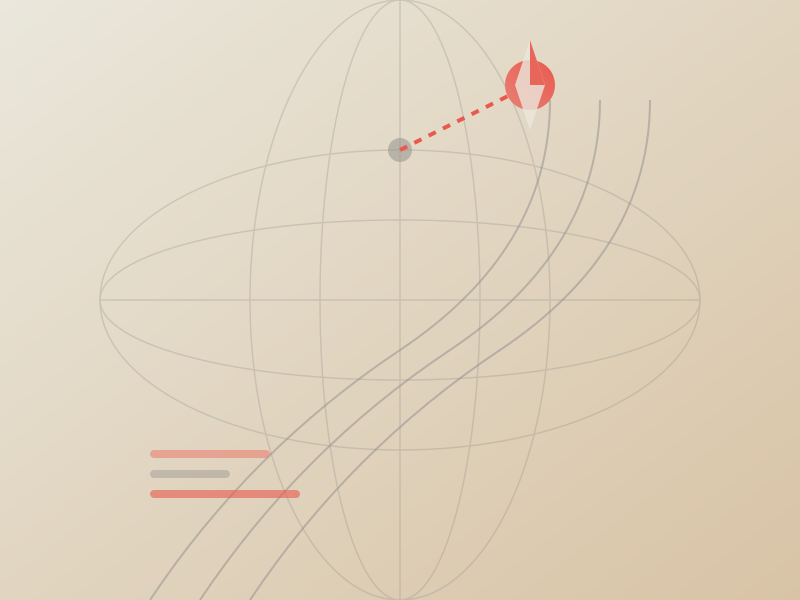
When we look at a map, we tend to think of the North Pole as a fixed point at the very top of our world. But while the geographic North Pole—the axis on which the Earth spins—remains reliably stationary, its magnetic counterpart has a mind of its own. Deep beneath our feet, the Earth's liquid outer core is churning, generating a magnetic field that shields us from solar radiation and guides compasses worldwide. Right now, that magnetic north is moving, and it is doing so faster than it has in recorded history.
Since it was first documented in the Canadian Arctic in 1831, the magnetic North Pole has been drifting across the frozen tundra. For most of the 20th century, it moved at a leisurely pace of about 10 miles per year. Then, around the turn of the millennium, it suddenly accelerated. By 2019, it was hurtling toward Siberia at over 34 miles per year.
This unexpected sprint sent geophysicists scrambling to update the World Magnetic Model, the crucial navigational system that underpins everything from smartphone maps to commercial airline routes.
The Geography of the Deep Earth
To understand why the pole is moving, we have to look 1,800 miles below the surface. The Earth’s magnetic field is generated by a geodynamo—swirling oceans of molten iron and nickel in the outer core. As heat from the solid inner core radiates outward, it causes these liquid metals to convect. The Earth's rotation twists these currents into spirals, generating an electromagnetic field.
"Think of the outer core as a boiling pot of thick soup on a stove. The flow of that liquid metal is chaotic and unpredictable, and changes in that flow directly alter the magnetic field on the surface."
Recently, scientists have observed a localized tug-of-war beneath the Arctic. Two massive lobes of magnetic force—one under Canada and one under Siberia—compete for dominance. Over the last few decades, the Canadian lobe has elongated and weakened, allowing the Siberian lobe to pull the magnetic pole across the geographic pole.
What This Means for Us
For the average person navigating an unfamiliar city using Google Maps, the shifting pole goes largely unnoticed. Our devices rely on the World Magnetic Model, which is periodically updated by agencies like the US National Oceanic and Atmospheric Administration (NOAA) and the British Geological Survey to account for these changes. However, when the pole began its rapid sprint, these agencies had to release an out-of-cycle update in 2019 because the built-in error margins for navigation systems were being exceeded.
Aviation and maritime navigation face more direct impacts. Airport runways are actually named based on their magnetic headings. A runway facing due east (90 degrees) is named Runway 09. As the magnetic declination changes over time, some airports, like Fairbanks International in Alaska or Tampa International in Florida, have had to repaint the massive numbers on their runways to reflect their new magnetic orientations.
Then there is the natural world. Countless species—from sea turtles and salmon to migratory birds—rely on magnetoreception to navigate. They possess an internal compass that reads the Earth's magnetic field, allowing them to traverse thousands of miles with pinpoint accuracy. A rapidly moving magnetic pole could subtly alter their migratory routes. While most species can adapt to gradual shifts, the current speed of the migration presents an intriguing question for biologists studying animal navigation.
A Reversal on the Horizon?
The erratic behavior of the magnetic pole has sparked conversations about a potential magnetic reversal—an event where the magnetic north and south poles swap places. Geological records show that this has happened hundreds of times in Earth's history, typically every 200,000 to 300,000 years. The last reversal occurred roughly 780,000 years ago, meaning we are statistically overdue.
While a reversal would not destroy the Earth—we would not suddenly be unprotected from solar winds, as the field becomes complex and multi-polar rather than disappearing entirely—it would require significant adjustments to our satellite networks, power grids, and global communication infrastructure. However, these reversals take thousands of years to complete. The current dash toward Siberia is likely just a short-term anomaly rather than the start of a flip.
The drifting magnetic pole is a powerful reminder that our planet is not a static rock, but a dynamic, living system. Even the fundamental directions we use to orient ourselves in the world are subject to the restless forces churning deep beneath the crust.
Key Takeaways
- The magnetic North Pole is currently drifting from the Canadian Arctic towards Siberia at an unusually fast pace.
- This movement is caused by changes in the flow of molten iron in the Earth's outer core.
- Navigation systems, including smartphone maps and airport runways, must be regularly updated to account for the shift.
- The shifting pole highlights the dynamic, ever-changing nature of the Earth's internal geography.
References
- National Centers for Environmental Information (NCEI), "World Magnetic Model."
- Nature, "Earth's magnetic field is acting up and geologists don't know why," 2019.
- British Geological Survey, "Magnetic Poles."