
Penicillin: The Accidental Spore That Changed Medicine
A petri dish, a damp breeze, and a drifting mold spore gave Alexander Fleming the discovery that launched the antibiotic era and saved millions of lives.
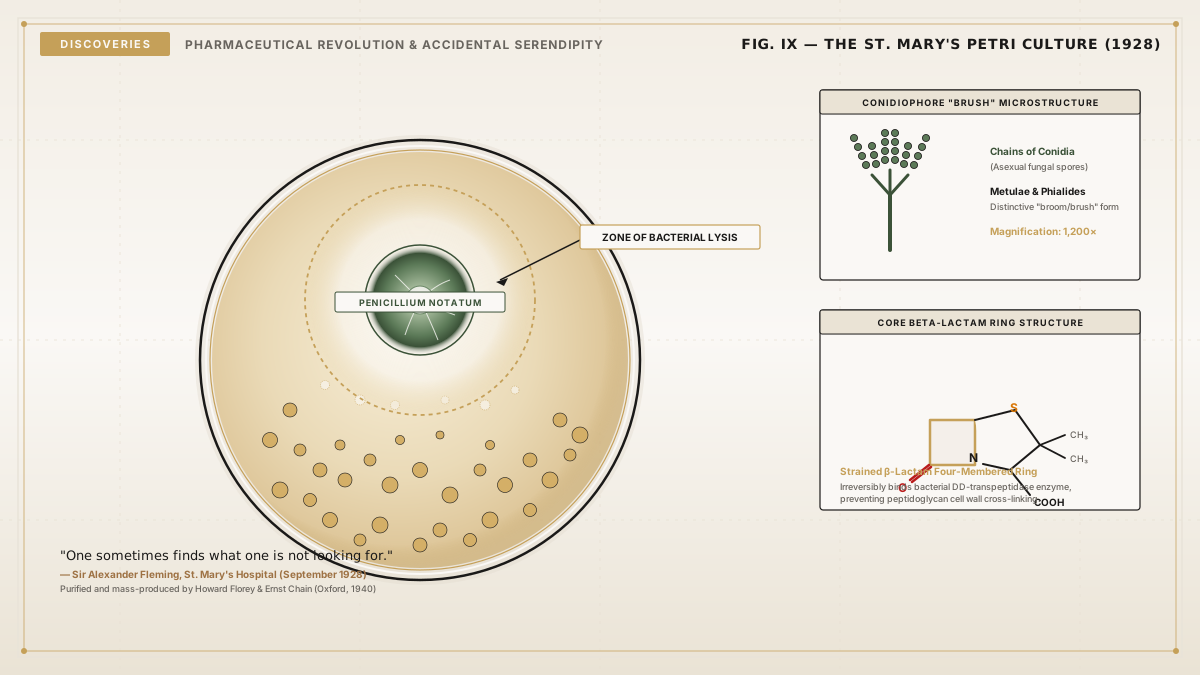
On a damp Monday morning in September 1928, Scottish bacteriologist Dr. Alexander Fleming returned to his notoriously cluttered second-floor laboratory at St. Mary's Hospital in London. Fleming had spent the preceding month on summer vacation with his family in Suffolk, leaving behind stacks of glass petri dishes smeared with virulent cultures of Staphylococcus aureus—the lethal bacterium responsible for boils, surgical sepsis, and fatal bloodstream infections.
As Fleming sorted through the discarded dishes to wash them in Lysol disinfectant, he paused over a single plate that had been left partially unsealed near a drafty window.
A stray speck of mold had drifted onto the agar jelly. But what caught Fleming's trained eye was not the invasive fungal growth. It was what was missing around it: in a wide, clear halo surrounding the fuzzy blue-green fungal colony, the dense lawn of golden staphylococcal bacteria had dissolved completely, bursting like soap bubbles.
Fleming famously uttered an understated observation: "That's funny."
That modest observation unlocked the modern antibiotic age, transforming diseases that had decimated human civilizations for millennia—from pneumonia and syphilis to scarlet fever and battlefield wound infections—into easily curable minor ailments.
"One sometimes finds what one is not looking for. When I woke up just after dawn on September 28, 1928, I certainly didn't plan to revolutionize all medicine by discovering the world's first antibiotic. But I suppose that was exactly what I did." — Alexander Fleming, Nobel Banquet Speech (1945)
The Unlikely Chain of Meteorological Serendipity
Modern historians and microbiologists who have attempted to recreate Fleming's breakthrough have discovered that the discovery of penicillin required a staggering convergence of improbable environmental accidents:
- The Downstairs Mycologist: Fleming did not cultivate molds. Directly beneath his laboratory on the first floor, Irish mycologist C.J. La Touche was conducting asthma research, cultivating dozens of fungal specimens collected from London homes. A spore of a rare strain—Penicillium notatum—drifted upstairs through open stairwells and drafty windows, landing squarely on Fleming's open staph plate.
- The London August Temperature Fluke: Penicillium mold secretes its antibacterial enzyme only when it grows before bacteria establish a thick colony. In August 1928, London experienced an uncharacteristic nine-day cold snap, which slowed the growth of warm-loving staph bacteria while allowing the cold-tolerant Penicillium mold to flourish and flood the agar with penicillin.
- The Subsequent Warm Front: The cold snap was immediately followed by warm weather, which allowed the staph bacteria to grow around the periphery—forming the dramatic visual contrast of a cleared zone of inhibition that alerted Fleming to the mold's chemical weapon.
Had London experienced normal summer temperatures, the bacteria would have overgrown the agar before the mold spore could germinate, and the dish would have been scrubbed clean without a second glance.
The Decade of Stagnation: The Purification Impasse
While Fleming demonstrated that the "mold juice" (which he formally named penicillin in his 1929 paper in the British Journal of Experimental Pathology) was non-toxic to human white blood cells and deadly to Gram-positive bacteria, he faced a catastrophic chemical barrier: instability.
Penicillin is an extraordinarily fragile beta-lactam molecule. Whenever Fleming and his laboratory assistants attempted to isolate and purify the active chemical from the liquid mold broth, it degraded into inactive organic sludge. Unable to stabilize the drug in concentrated therapeutic doses or produce it in significant volume, Fleming largely abandoned his experiments in the early 1930s, preserving only a frozen sample of the mold culture.
For an entire decade, the greatest medical miracle in human history remained a laboratory curiosity.
The Oxford Team: Florey, Chain, and the Peoria Cantaloupe
The resurrection of penicillin arrived on the eve of World War II through an interdisciplinary team of researchers at the University of Oxford, spearheaded by Australian pathologist Howard Florey, German-Jewish refugee biochemist Ernst Boris Chain, and British biophysicist Norman Heatley.
Working in wartime Oxford with cobbled-together dairy equipment, hospital bedpans, and lemonade bottles, Heatley invented a delicate solvent extraction technique using ether and water at controlled pH levels to extract pure penicillin powder:
[ WWI / Early Era ]               [ The Oxford Breakthrough (1940) ]
Mortal bacterial sepsis            Freeze-dried stable penicillin salt
No effective chemotherapy          Mouse trial: 8 mice injected with lethal streptococcus
                                   - 4 untreated mice: Dead within 17 hours
                                   - 4 penicillin mice: Survived 100%
In 1941, the Oxford team treated their first human patient: Albert Alexander, an Oxford police constable dying of severe facial sepsis from a scratch. When injected with penicillin, his raging fever broke and his delirium cleared within twenty-four hours. Tragically, the team did not have enough drug; when their meager supply ran out, Alexander relapsed and died.
Recognizing that war-torn Britain lacked the industrial manufacturing capacity to mass-produce the antibiotic, Florey and Heatley flew to the United States. They established operations at the USDA Northern Regional Research Laboratory in Peoria, Illinois.
In Peoria, American agricultural scientists revolutionized production:
- Corn Steep Liquor: Scientists substituted expensive lab broth with corn steep liquor (a cheap, nutrient-rich byproduct of industrial cornstarch refining), increasing penicillin yields five-hundred-fold.
- The Moldy Cantaloupe: Laboratory technician Mary Hunt searched local Peoria grocery markets for superior mold strains. She discovered a rotting cantaloupe covered in a golden-yellow mold: Penicillium chrysogenum. This strain produced 200 times more penicillin than Fleming's original London mold.
By D-Day in June 1944, American pharmaceutical companies were manufacturing billions of units of penicillin in giant deep-vat fermentation tanks, ensuring that Allied soldiers wounded in the Normandy invasion had immediate access to the miracle drug.
The Prophecy: Fleming's Nobel Warning on Resistance
In December 1945, Alexander Fleming, Howard Florey, and Ernst Chain were jointly awarded the Nobel Prize in Physiology or Medicine.
During his Nobel lecture, Fleming demonstrated remarkable prescience. He warned that the ease of penicillin treatment harbored the seeds of future medical catastrophe:
"The time may come when penicillin can be bought by anyone in the shops. Then there is the danger that the ignorant man may easily underdose himself and by exposing his microbes to non-lethal quantities of the drug make them resistant."
Fleming correctly predicted the mechanism of antimicrobial resistance (AMR): exposing bacteria to sub-lethal concentrations of antibiotics selects for rare genetic mutants capable of producing beta-lactamase enzymes that destroy the drug. Today, the rise of multi-drug resistant superbugs stands as one of the preeminent global public health challenges of the twenty-first century, fulfilling Fleming's eight-decade-old warning.
Key Takeaways
- The Serendipity Triad: Fleming's discovery relied on an unsealed dish, an airborne spore from a downstairs lab, and an anomalous London weather sequence of cold and warmth.
- The Purification Crisis: Fleming could not stabilize penicillin in clinical quantities; the drug was saved by the Oxford team of Howard Florey, Ernst Chain, and Norman Heatley.
- Industrial Scaling in Peoria: Mass production succeeded using corn steep liquor and a high-yielding Penicillium chrysogenum mold discovered on a local Peoria cantaloupe.
- Prophetic Nobel Warning: In 1945, Fleming warned against underdosing and the inevitable emergence of antibiotic-resistant bacterial strains.
Archival Medical References & Nobel Laureate Documents
- Fleming, Alexander. "On the Antibacterial Action of Cultures of a Penicillium, with Special Reference to their Use in the Isolation of B. influenzae." British Journal of Experimental Pathology, vol. 10, no. 3, 1929, pp. 226–236.
- Chain, E., H. W. Florey, et al. "Penicillin as a Chemotherapeutic Agent." The Lancet, vol. 236, no. 6104, 1940, pp. 226–228.
- Macfarlane, Gwyn. Alexander Fleming: The Man and the Myth. Harvard University Press, 1984.
- Fleming, Alexander. "Penicillin." Nobel Lecture, Physiology or Medicine, Karolinska Institute, Stockholm, December 11, 1945.