What Causes Sun Pillars in a Cold Winter Sky?
A sun pillar is not a beam of light at all, but millions of tiny ice mirrors reflecting the low sun. Here is how flat crystals paint a column in the sky.
Key takeaways
- A sun pillar is a column of reflected sunlight, not a beam: millions of flat hexagonal ice crystals act as tiny mirrors aligned nearly horizontally.
- Pillars appear when the sun is low, at sunrise or sunset, so the light strikes the crystals at a shallow angle and reflects toward the viewer.
- Slight wobbles in the crystals stretch the reflection upward, which is why the pillar looks tall instead of like a single bright spot.
- The finest pillars often form in very cold, calm air near the ground, where plate crystals drift as diamond dust.
- The same reflection can make moon pillars, planet pillars, and pillars above city lights on cold nights.
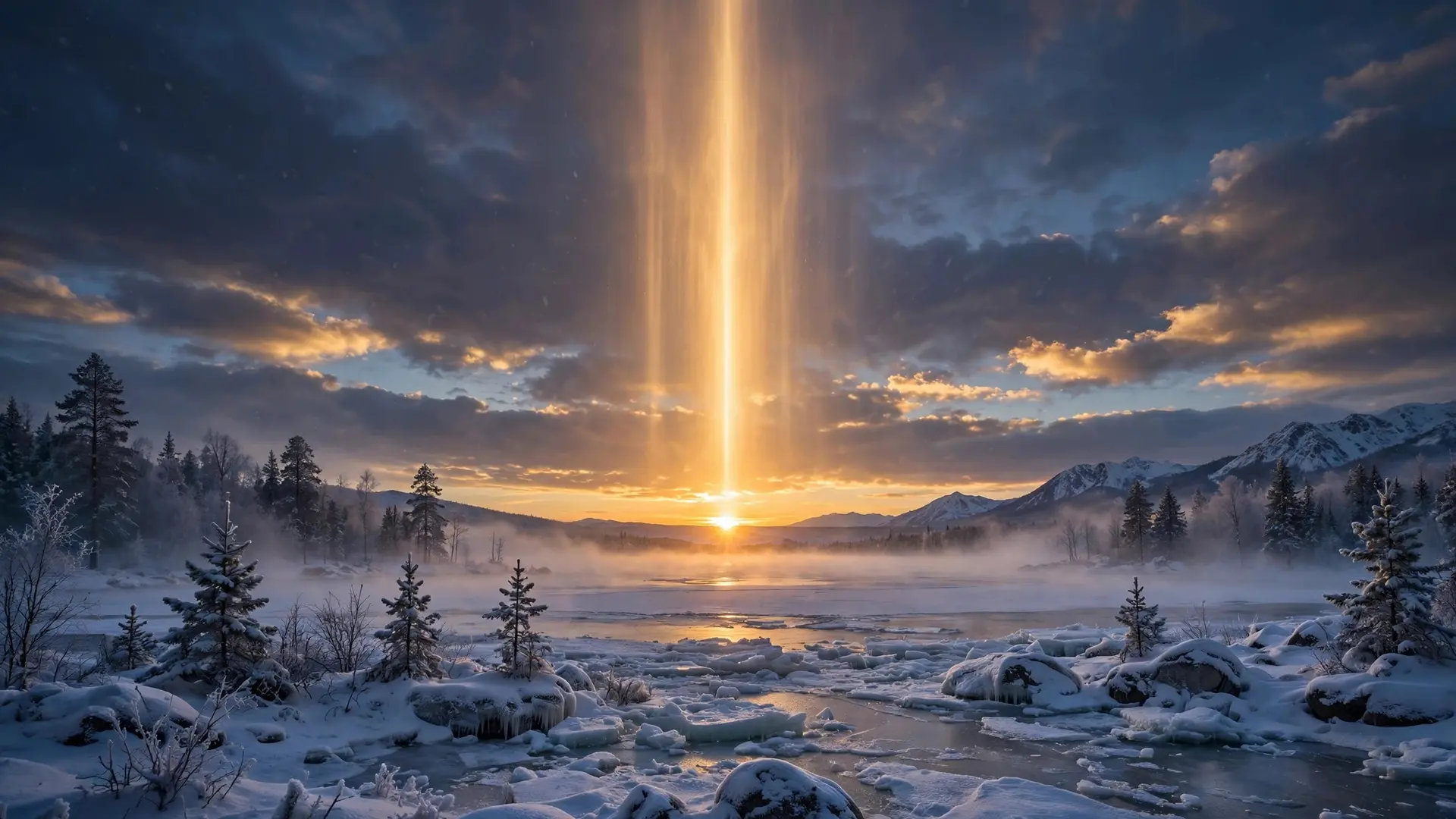
A sun pillar is not a beam of light shooting into the sky. It is a trick of reflection: sunlight bouncing off millions of tiny, flat ice crystals drifting in the cold air, each one sending a small glint toward your eyes. Stacked together, those glints look like a glowing column rising straight above the sun — but there is no column there at all. The best time to catch one is a cold, calm morning or evening, when the sun sits low near the horizon. The pillar usually takes on the color of the sunlight itself, golden or orange at sunset, pale at dawn, and it can stretch surprisingly high, sometimes as tall as the width of your outstretched hand held at arm's length. It fades as quickly as it arrived, the moment the crystals shift or the sun sinks too far.
What kind of ice makes a pillar?
The crystals that matter are plates: thin, flat, six-sided flakes, wider than they are thick. As they drift through the air, drag tends to settle them with their broad faces roughly horizontal, like a dinner plate carried flat through the wind. That alignment is everything. A plate tilted the wrong way reflects its sunlight somewhere else; a plate lying flat reflects it straight back toward someone standing in the right place. The sun needs to be low for the geometry to work. When the sun hangs near the horizon at sunrise or sunset, its light strikes those horizontal plates at a shallow angle and glances off their undersides toward observers on the ground. NASA's explanation puts it simply: when the air is cold and the sun is rising or setting, falling ice crystals can reflect sunlight and create an unusual column of light, because air resistance causes the flat crystals to lie nearly flat as they flutter downward, and sunlight reflects off the crystals that are properly aligned. Those crystals can come from two places. Often they hang in high, thin clouds such as cirrus or altostratus, where the air is far below freezing even when the ground is mild. In the coldest weather, they can also float right near the ground as diamond dust, the glittering ice fog that sparkles in Arctic and far-northern air. The lower, calmer air near the ground is actually better for alignment: high up, the atmosphere is almost always turbulent, which tumbles the crystals out of position, while calm air near the surface lets them settle flat.
Why does it look like a tall pillar instead of a spot?
If every crystal lay perfectly flat, you would see something quite different: a single bright spot, called a subsun, mirrored below the sun's position. A pillar appears because real crystals are imperfect. The larger plates wobble as they drift, tilting a few degrees this way and that, and each tilted plate reflects the sun from a slightly different height in the sky. Your eye collects all those glints at once — some from crystals high up, some from crystals lower down — and reads them as a continuous vertical shaft. That is also why pillars vary so much. A display made of well-aligned crystals is short and sharp; one made of wobblier plates stretches taller and looks softer, sometimes lumpy, as the density of crystals changes with height. Occasionally, a different crystal shape takes over: long, column-shaped crystals with their axes horizontal can produce exceptionally tall pillars, sometimes reaching up to a bright arc high above the sun. The pillar's height, in other words, is a rough measure of how unsteady its crystals are. The pillar's color tells a simpler story. It is just the sun's own color, reflected. At sunset the light is already reddened by its long passage through the atmosphere, so the pillar glows gold or orange; near noon, when the sun is too high for the geometry anyway, no pillar forms at all. A pillar seen after the sun has set is still lit by a sun below the horizon, which is why the column can linger in twilight, slowly shifting as the sun sinks deeper.
Do you need freezing weather on the ground?
This is the most common misunderstanding about sun pillars, and the answer is no — not necessarily. The crystals only need to be cold where they are, and the high clouds that carry plate crystals are below freezing year-round, all over the world. A sun pillar photographed in warm May in Italy, for example, came from icy clouds high overhead, not from cold air at the photographer's feet. Low ground temperatures are not required; sub-zero temperatures in the clouds are enough.
Winter still wins for the finest displays, for three practical reasons. The sun stays low for longer, giving the geometry more time to work. Cold air near the ground can itself carry plate crystals as diamond dust, putting the mirrors close to the observer. And winter's calm, clear spells provide the still air that lets crystals align instead of tumble. The most dramatic pillars on record, including displays over frozen Kansas after an Arctic blast, came from exactly that combination: bitter cold, calm air, and crystals near the surface. The same physics works for other lights, too. A bright moon can make a moon pillar in a dark sky, the planet Venus has been known to produce a faint pillar, and on cold nights, streetlights and other artificial lights can sprout their own multicolored columns as their light reflects off nearby diamond dust. Because nearby lights send out rays that are not parallel, those artificial pillars can look stranger than solar ones, sometimes leaning or flaring in odd shapes.
How is a pillar different from a halo or a sun dog?
All three belong to the same family of ice halos, but they use the ice differently. Halos and sun dogs are made by refraction: sunlight bends as it passes through a crystal, emerging at a new angle. A halo spreads that bent light into a ring, and a sun dog concentrates it into bright spots beside the sun. A pillar, by contrast, is made by reflection: the light never enters the crystal at all, it simply glances off a flat face like light off a mirror. That distinction explains why the displays look so different and why they often appear together. The same cloud can hold both randomly tumbling crystals, which paint a halo, and horizontally aligned plates, which paint a pillar, so a single sunset can show a ring, a pair of mock suns, and a column all at once. The pillar stands apart because it points vertically, directly above or below the sun, while the halo circles it and the sun dogs flank it. It also explains why a pillar can appear without any halo. The best pillars come from large, imperfect, wobbly plates, and other halos prefer more perfectly aligned ice — so a sky full of wobbly plates may show a pillar and nothing else. The crystals that make the prettiest pillar are, in a sense, the sloppiest ones in the cloud. A pillar is easy to miss if you are not looking for it, because it appears only where the sun, the crystals, and your eyes line up, and it vanishes when any one of them moves. But once you know the trick — that you are watching millions of tiny mirrors, not a beam — the sight becomes stranger, not less so. The sky has not sent up a searchlight; it has simply arranged its ice so that the sun can look back at you, one glint at a time. And like the bending of light that makes rainbows, it is a reminder that much of what we call sky color is really geometry, written in water and light.
Frequently asked questions
Is a sun pillar a real beam of light shooting into the sky?
No. There is no physical column of light. What you see is the combined reflection of sunlight off millions of ice crystals at different heights and distances, and each crystal sends only a tiny glint toward your eyes. The pillar exists only in your view of the scene.
Why do sun pillars appear mostly in winter?
Winter favors them because the sun stays low, cold air near the ground can carry plate-shaped ice crystals, and calm conditions let those crystals settle into a horizontal alignment. Pillars can occur in any season from high icy clouds, but the most spectacular displays come with sub-zero temperatures.
What is the difference between a sun pillar and a sun dog?
Both come from hexagonal ice crystals, but they use different optics. A sun pillar is sunlight reflected off the flat faces of plate crystals, while a sun dog is sunlight refracted, or bent, as it passes through the crystals, appearing as bright spots beside the sun.
Sources
- APOD: 1999 July 06 - A Sun Pillar, NASA Science
- What was that column of light extending above the setting sun?, University of Wisconsin-Madison, The Weather Guys
- Sun, moon, planet and light pillars, Atmospheric Optics
- What causes a Sun pillar?, Fox Weather