The tragic incineration of the Great Library of Alexandria is one of Western civilization's most enduring cultural laments. In cinematic retellings and popular history, a monolithic ivory hall filled with half a million scrolls is engulfed in a single terrifying sheet of flame—usually attributed to Julius Caesar in 48 BCE, or religious mobs centuries later—instantly plunging humanity into a thousand years of intellectual darkness.
It is a cinematic narrative, emotionally resonant and dramatically potent. It is also almost entirely historical fiction.
Decades of rigorous archaeological excavations in Alexandria's royal quarter (Bruchion), combined with close re-examinations of papyrological correspondence and contemporary Greco-Roman chronicles, present a far more nuanced—and sobering—reality. The Great Library was never destroyed in a single apocalyptic inferno. Instead, antiquity's preeminent research university suffered the far more mundane fate of modern institutions: political purges, imperial budget cuts, administrative neglect, and the relentless, quiet decay of organic papyrus in a humid coastal climate.
"The true loss of Alexandria was not that its scrolls burned in a single afternoon, but that an empire stopped copying them. Knowledge does not vanish because of torches; it vanishes when society forgets how to pay for scribes." — Dr. Luciano Canfora, The Vanished Library (1987)
The Mouseion's Audacious Mandate: Seizing Scrolls from Harbor Ships
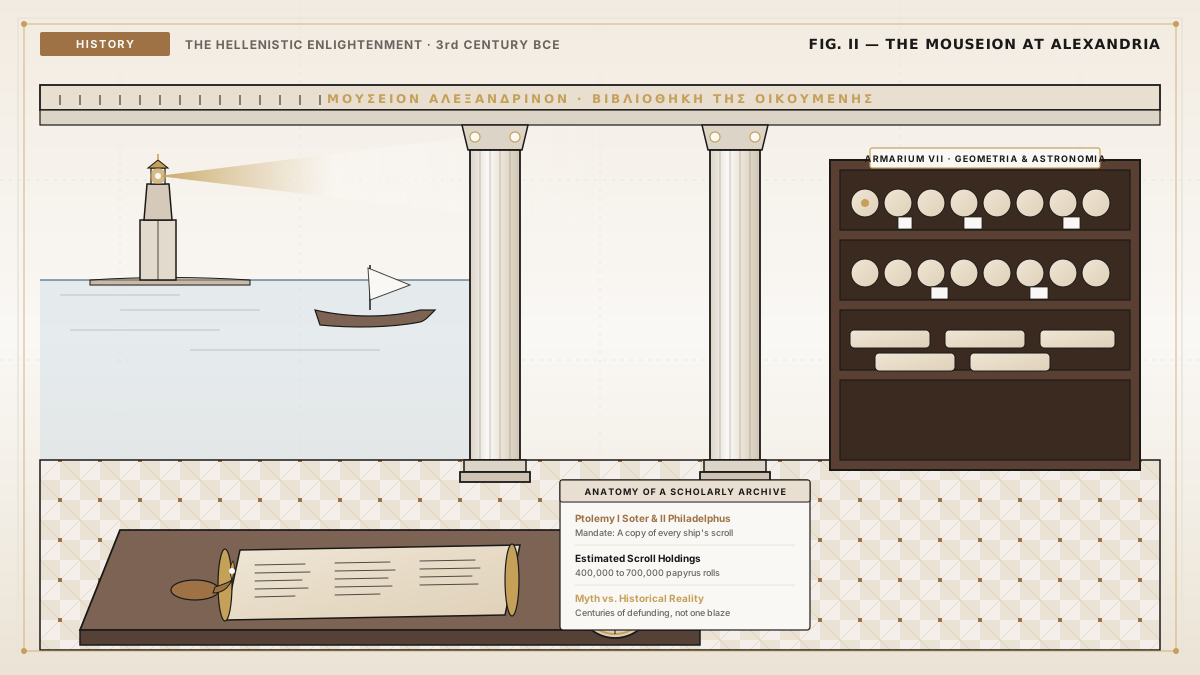
Founded around 295 BCE by Ptolemy I Soter under the intellectual guidance of Demetrius of Phalerum (an exile from Aristotle's school in Athens), the Library was not an isolated public lending facility. It was part of the Mouseion—a royal research institution dedicated to the Nine Muses, complete with botanical gardens, astronomical observatories, lecture halls, and a communal dining chamber where subsidized scholars lived tax-free.
The Ptolemaic dynasty pursued the acquisition of texts with aggressive, near-piratical obsession:
- The Harbor Decree: Every merchant vessel entering the port of Alexandria was boarded by royal inspectors. Any manuscripts found on board were confiscated, transported to the scriptorium, and copied by scribes. The owners were given the newly penned copies, while the original manuscripts were deposited into the Library's royal shelves with the accession tag "from the ships."
- The Athens Swindle: Ptolemy III Euergetes borrowed the official Athenian state copies of the plays of Aeschylus, Sophocles, and Euripides to have them copied. He deposited an exorbitant pledge of fifteen silver talents as collateral. Once the scrolls reached Alexandria, Ptolemy forfeited the silver, kept the pristine originals, and sent back deluxe parchment duplicates with an apology.
At its height under the chief librarians Zenodotus, Callimachus, and Eratosthenes, the Library housed between 200,000 and 700,000 papyrus rolls. Callimachus created the Pinakes—a 120-volume catalog that organized the vast intellectual canon by genre, author, and opening lines, inventing the foundational discipline of library science.
Caesar's Harbor Fire of 48 BCE: Dockside Depots vs. The Royal Sanctuary
The persistent belief that Julius Caesar destroyed the Library traces to the Alexandrian civil war of 48 BCE. Besieged by Egyptian forces in the royal harbor, Caesar ordered his legionaries to set fire to his own fleet to prevent the ships from falling into enemy hands.
The flames jumped from the docks to dockside warehouses along the quayside. Roman chroniclers, writing generations later, conflated these dockside export warehouses with the royal library complex located further inland within the palatial precinct.
Contemporary eyewitness accounts provide crucial clarity:
- Julius Caesar himself, writing in his detailed military account De Bello Alexandrino, describes the harbor fire and urban street fighting but never mentions damaging the famous Mouseion or its literary collections.
- Strabo, the great geographer who worked in Alexandria in 24 BCE (more than twenty years after Caesar's visit), writes extensively about conducting research within the Mouseion, walking its colonnades and consulting its resident scholars without expressing dismay over an ashes-strewn wasteland.
What burned along the docks was almost certainly a consignment of blank papyrus rolls and export inventories awaiting commercial transit, rather than the core archival collection.
The Real Culprit: Bureaucratic Decay, Imperial Expulsions, and Neglect
The true decline of Alexandria's intellectual hegemony was structural and political:
1. The Purge of Ptolemy VIII (145 BCE)
During a brutal dynastic civil war, Ptolemy VIII Euergetes II launched violent purges against Alexandria's Greek intellectual elite who had supported his brother. The chief librarian Aristarchus of Samothrace fled into exile alongside hundreds of grammarians, scientists, and philosophers. The intellectual diaspora scattered to Rhodes, Pergamum, and Rome, irreversibly breaking Alexandria's monopoly on classical scholarship.
2. Roman Provincial Demotion (30 BCE onward)
When Augustus annexed Egypt following the death of Cleopatra VII, Alexandria ceased to be a royal capital. The Mouseion lost its royal patrons and was relegated to a provincial Roman outpost. Imperial Rome prioritized law and engineering over Greek philological poetry; financial subsidies for resident scholars were steadily slashed.
3. Organic Papyrus Rot
Papyrus is manufactured from reeds harvested along the Nile Delta. In the bone-dry sands of Upper Egypt (such as Oxyrhynchus), papyrus survives for millennia. In the humid maritime atmosphere of coastal Alexandria, however, unrolled papyrus scrolls had an average lifespan of merely 100 to 200 years before becoming brittle and succumbing to fungal mildew, bookworms, and moisture. Unless a manuscript was painstakingly recopied by hand every century, it dissolved into dust.
The Dispersal of Knowledge: How the Canon Survived
The tragedy of antiquity's lost literature is not that Alexandria burned, but that the ancient world lacked the reproductive technology to survive systemic political fragmentation. When the Western Roman Empire collapsed and Byzantine budgets contracted, texts that existed in only one or two archival copies simply slipped out of circulation.
The texts that survived to the modern era—the philosophies of Plato, the geometry of Euclid, the dramas of Sophocles—did not survive because they were safeguarded in a single fortress. They survived because they were decentralized: copied by Byzantine scribes in Constantinople, translated into Arabic by scholars in Abbasid Baghdad, and preserved in remote Irish and Carolingian monastic scriptoria across medieval Europe.
Key Takeaways
- A Multi-Century Atrophy: The Library of Alexandria was never destroyed in a single catastrophic afternoon; its demise was a gradual process of political purges, financial neglect, and physical decay spanning four centuries.
- The 48 BCE Harbor Fire: Julius Caesar burned dockside export warehouses containing trade scrolls and blank papyrus, leaving the interior Mouseion operational for scholars like Strabo decades later.
- Organic Material Limits: In Alexandria's coastal humidity, papyrus rolls rotted naturally within one to two centuries, requiring continuous funding for copyists that imperial Rome failed to sustain.
- The Lesson of Decentralization: The preservation of human knowledge depends not on monumental centralized repositories, but on continuous replication across diverse, decentralized networks.
Archival References & Historical Documentation
- Canfora, Luciano. The Vanished Library: A Wonder of the Ancient World. University of California Press, 1989.
- MacLeod, Roy, editor. The Library of Alexandria: Centre of Learning in the Ancient World. I.B. Tauris, 2004.
- Bagnall, Roger S. "Alexandria: Library of Dreams." Proceedings of the American Philosophical Society, vol. 146, no. 4, 2002, pp. 348–362.
- Fraser, P. M. Ptolemaic Alexandria. 3 vols. Oxford: Clarendon Press, 1972.