The Rosetta Stone: How a Lost Script Was Deciphered
For 1,400 years Egyptian hieroglyphs were silent. Discover how the Rosetta Stone's inscription gave Champollion the key to resurrect a lost civilization.
For more than fourteen hundred years, the monumental temples, royal tombs, and towering obelisks of ancient Egypt stood in total, impenetrable silence. While millions of exquisitely carved figures—hawks, beetles, lions, eyes, and geometric zigzags—covered millions of square feet of limestone along the Nile, not a single living human being on Earth could read a single sentence.
The last known authentic hieroglyphic inscription was carved into the temple walls of Philae on August 24, 394 CE. Following the Roman Empire's Christianization and the closing of pagan temples, the ancient Egyptian priestly caste vanished, and with it, the linguistic key to three millennia of pharaonic civilization was completely lost.
For centuries, European scholars fell victim to a colossal intellectual misconception: they assumed hieroglyphs were purely mystical symbols, ideograms, and allegories representing abstract cosmic secrets rather than phonetic letters forming a spoken human language.
The key that shattered this fourteen-century silence was unearthed by accident in July 1799 in the marshy mud of the Nile Delta by French military engineers: an irregularly shaped, 760-kilogram slab of dark granodiorite known to history as the Rosetta Stone.
"I have got it! (Je tiens mon affaire!)" — Jean-François Champollion, bursting into his brother's Paris office before collapsing from exhaustion (September 14, 1822)
The Fortuitous Discovery at Fort Julien (1799)
In 1798, Napoleon Bonaparte invaded Egypt, aiming to disrupt British trade routes to India. Uniquely, Napoleon brought an expeditionary army not only of soldiers, but of 167 elite scientists, engineers, and scholars (savants).
In mid-July 1799, French engineering officer Pierre-François Bouchard was directing construction crews excavating fortifications at Fort Julien near the port city of Rashid (anglicized as Rosetta). While demolishing a dilapidated medieval Mamluk wall, Bouchard's soldiers struck a buried stone slab displaying carved inscriptions. Bouchard immediately recognized its extraordinary value: the stone presented three distinct bands of writing.
Following the defeat of French forces in Egypt in 1801, British troops demanded the surrender of all antiquities collected by the French savants. Under the Treaty of Alexandria, the Rosetta Stone was transported to England, entering the British Museum in 1802, where it has remained on public display ever since.
The Trilingual Key: Three Scripts, One Decree
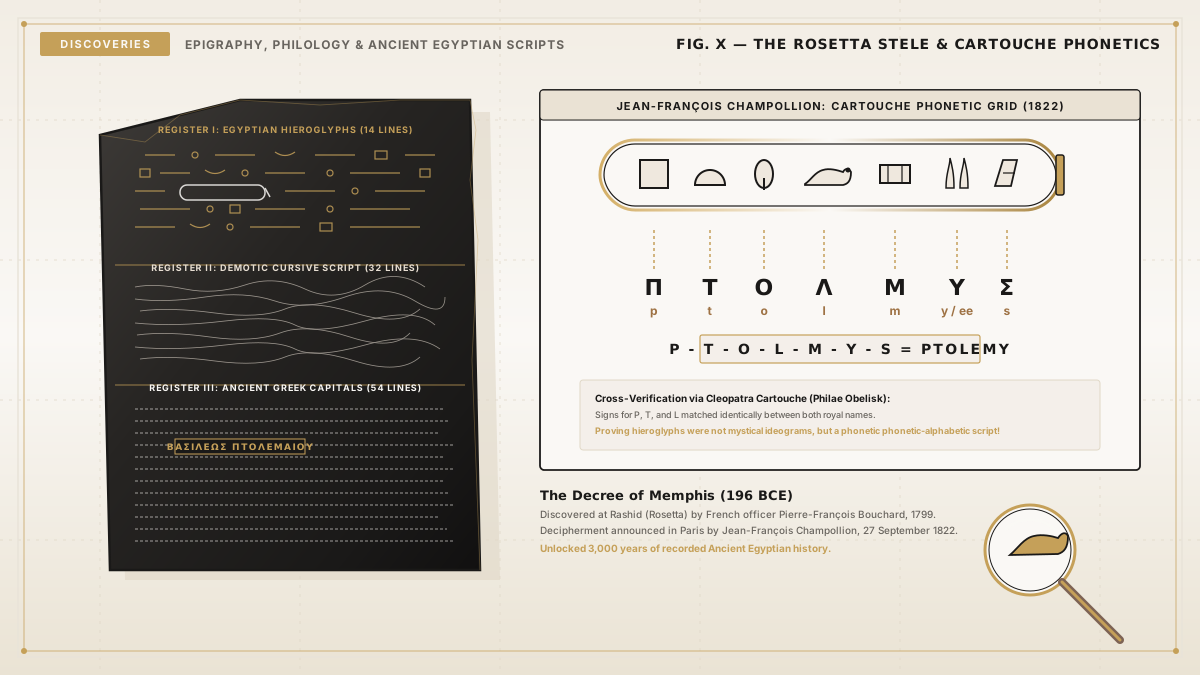
The Rosetta Stone is not a philosophical treatise or sacred revelation. It is an administrative tax decree issued at Memphis in 196 BCE by a synod of Egyptian priests to commemorate the coronation of the Ptolemaic pharaoh Ptolemy V Epiphanes.
The genius of the stone lay in its political necessity: to ensure that the royal decree was understood by all segments of Egypt's multi-ethnic Hellenistic society, the priests carved the identical administrative text in three distinct scripts:
+------------------------------------+---------------------------------------------------+
| Text Register                      | Target Audience & Script Purpose                  |
+------------------------------------+---------------------------------------------------+
| 1. Ancient Egyptian Hieroglyphs    | The sacred script of the gods, read by priests     |
| 2. Demotic Script                  | The cursive daily script used by the populace     |
| 3. Ancient Greek                   | The administrative language of the Ptolemaic court|
+------------------------------------+---------------------------------------------------+
Because ancient Greek was widely understood by 19th-century European classicists, scholars instantly possessed a "Rosetta" crib: the known Greek text provided the semantic meaning of the unknown hieroglyphic and demotic inscriptions above it.
The Ideographic Dogma and Thomas Young's Cartouches
Despite having the Greek translation, deciphering the hieroglyphs took more than two decades of intense cryptanalysis. Scholars remained trapped in the dogma of the Roman-era philosopher Horapollo, who insisted that hieroglyphs were purely symbolic pictures (e.g., that a goose meant "son" because geese loved their offspring).
The first major breakthrough was made by the brilliant English polymath Thomas Young (famed for proving the wave theory of light). Young turned his attention to the cartouches—the oval loops enclosing specific sequences of hieroglyphs.
Young reasoned logically:
- When a foreign ruler with a Greek name like Ptolemaios (Ptolemy) became Pharaoh, Egyptian scribes could not represent his name with an ideogram for an abstract concept.
- They had to spell his foreign name phonetically, sound by sound.
- Therefore, the symbols inside cartouches had to be phonetic alphabet signs.
Young matched the Greek name Ptolemaios with the hieroglyphs in the royal cartouche:
Cartouche of Ptolemy:
[ p - t - o - l - m - y - s ]
  |   |   |   |   |   |   |
 Square / Semicircle / Lasso / Lion / Folded Cloth / Reeds
Young successfully identified six phonetic values. However, Young believed that phonetic spelling was an exceptional crude trick used only for foreign Greek names, asserting that the rest of the hieroglyphic language remained purely symbolic ideograms.
Jean-François Champollion and the Decipherment Epiphany
The decisive linguistic triumph belonged to a young French prodigy: Jean-François Champollion.
Champollion possessed a crucial linguistic advantage over all rivals: fluency in Coptic. Coptic was the direct linguistic descendant of ancient Egyptian, written using the Greek alphabet with seven additional letters, preserved in the liturgical chants of Christian Egyptian monasteries. Champollion understood the grammar, syntax, and vocabulary of spoken ancient Egyptian.
In 1822, Champollion examined drawings of a newly discovered bilingual inscription from the Temple of Isis at Philae, which contained cartouches for both Ptolemy and Cleopatra:
Common Signs in Both Cartouches:
- The Lion sign represented 'L' in both Ptolemy and Cleopatra
- The Semicircle represented 'T'
- The Reed leaf represented 'E/I'
The sign values cross-verified with mathematical precision.
The supreme breakthrough occurred on the morning of September 14, 1822, when Champollion received sketches of a cartouche from the rock temple of Abu Simbel. This cartouche did not belong to a foreign Greek ruler; it belonged to an ancient native Egyptian pharaoh who ruled a millennium before the Greeks.
Inside the cartouche, Champollion observed:
- A circle with a dot in the center: the symbol of the Sun, known in Coptic as Ra.
- An unknown middle sign consisting of three loops.
- Two folded cloth signs, which Champollion already knew represented S-S.
Remembering the Coptic word for "to give birth" (misa), Champollion read the name aloud: Ra - Mes - Su: Ramesses.
Hieroglyphs were not crude ideograms, nor were phonetic signs restricted to foreign names. Egyptian writing was a sophisticated, flexible writing system combining phonetic sound signs, logograms, and determinatives into a unified written script.
In his watershed publication Lettre à M. Dacier (1822) and subsequent Précis du système hiéroglyphique (1824), Champollion unveiled his discovery:
"It is a complex system; an alphabet at once figurative, symbolic, and phonetic in one and the same text, in one and the same sentence, and, I might even say, in one and the same word."
The Resurrection of an Empire
With Champollion's grammar in hand, the silent stone walls of the Nile Valley spoke once more. Historians could suddenly read the medical papyri of Imhotep, the poetry of the New Kingdom, the battle chronicles of Kadesh, and the spiritual liturgy of the Book of the Dead. The discovery of the Rosetta Stone rescued an entire civilization from the fog of myth, restoring ancient Egypt to human intellectual history.
Key Takeaways
- Fourteen Centuries of Silence: Hieroglyphic literacy vanished after 394 CE, obscured by the false assumption that signs were mystical ideograms rather than phonetic language.
- Accidental Discovery: The 760 kg granodiorite slab was unearthed in 1799 by French soldiers rebuilding a fort at Rashid (Rosetta) during Napoleon's Egyptian campaign.
- The Trilingual Crib: A single coronation decree carved in Hieroglyphs (sacred), Demotic (common), and Ancient Greek (court) provided classicists with a known translation.
- Champollion's Coptic Key: Fluency in Coptic allowed Champollion to realize that hieroglyphs were simultaneously phonetic, symbolic, and figurative across all native Egyptian words.
Philological References & Decipherment Memoirs
- Champollion, Jean-François. Lettre à M. Dacier relative à l'alphabet des hiéroglyphes phonétiques. Paris: Firmin Didot, 1822.
- Parkinson, Richard. The Rosetta Stone. British Museum Press, 2005.
- Adkins, Lesley, and Roy Adkins. The Keys of Egypt: The Obsession to Decipher Egyptian Hieroglyphs. HarperCollins, 2000.
- Ray, John. The Rosetta Stone and the Rebirth of Ancient Egypt. Harvard University Press, 2007.