Why Airplane Windows Are Rounded: Lessons From the Comet
Rounded airliner windows aren't a design choice - they're a safety lesson. Discover how the de Havilland Comet's crashes revealed the danger of square corners.
Every commercial passenger who has settled into a window seat on a transatlantic flight has rested their gaze against the smooth, curved contours of an aircraft window. These rounded apertures seem so aesthetically intuitive, so harmoniously integrated into modern industrial cabin design, that few travelers consider them an engineering necessity.
Yet the gentle curves of airliner windows are not the work of interior stylists or ergonomic architects. They represent one of the most painful, hard-won safety lessons in aviation history. Every rounded window flying today is a permanent mechanical monument to fifty-six passengers and crew who perished in 1954 when the world's first commercial jetliner, the de Havilland Comet, shattered mid-flight over the Mediterranean Sea.
"The corners of rectangular openings in a pressurized aircraft fuselage act as stress raisers of extraordinary severity. Metal does not break merely under overwhelming loads; it tears quietly under repeated cycles at points where geometry concentrates force." — Sir Arnold Hall, Director of the Royal Aircraft Establishment, Farnborough Report (1955)
The Dawn of Pressurized Flight: Flying Above the Weather
In the late 1940s, Great Britain stood on the verge of total commercial aviation dominance. The British aviation manufacturer de Havilland introduced the DH.106 Comet: a sleek, four-engine passenger jet capable of cruising at 480 miles per hour at altitudes of 36,000 feet—nearly twice as high and twice as fast as contemporary propeller-driven airliners.
Flying in the stratosphere brought immense commercial benefits:
- Fuel Efficiency: The thin air offered far less aerodynamic drag, maximizing jet engine thrust.
- Smooth Passenger Comfort: Flying at 36,000 feet allowed the Comet to soar above turbulent storm clouds that battered lower-altitude propeller planes.
However, humans cannot survive in the sub-zero, oxygen-deprived environment of 36,000 feet, where ambient atmospheric pressure drops to merely 3.3 pounds per square inch (psi), compared to 14.7 psi at sea level. To keep passengers conscious and comfortable, de Havilland designed a sealed cabin pressurized to roughly 8.25 psi above the outside atmosphere.
Every time the Comet took off, the fuselage inflated like a long, thin aluminum balloon; every time it descended and landed, the pressure equalized and the fuselage relaxed.
The Disasters of 1954: Unexplained Breakups Over the Mediterranean
On January 10, 1954, BOAC Flight 781 took off from Rome's Ciampino Airport bound for London. Twenty minutes into the climb, at an altitude of 26,000 feet, the aircraft suddenly broke apart in mid-air and plunged into the sea near the island of Elba. All thirty-five people aboard were killed.
The Comet fleet was briefly grounded and inspected, but no obvious mechanical defects were found. Flight operations resumed.
Less than three months later, on April 8, 1954, South African Airways Flight 201 departed Rome for Cairo. Climbing through 35,000 feet over the Tyrrhenian Sea, the aircraft experienced an identical catastrophic structural failure, disintegrating mid-air and killing all twenty-one passengers and crew.
Prime Minister Winston Churchill immediately grounded the entire Comet fleet, declaring that no cost or effort should be spared to unravel the mystery of the falling Comets.
Sir Arnold Hall's Water Tank Experiment at Farnborough
The task of solving the structural mystery fell to Sir Arnold Hall, Director of the Royal Aircraft Establishment (RAE) at Farnborough. Hall recognized that ordinary static stress tests were insufficient; the problem was dynamic and cyclical.
Hall constructed a gargantuan water tank capable of holding 250,000 gallons of water. A complete, retired Comet airframe was submerged inside the tank:
[ Water-Filled Pressure Test Chamber ]
-----------------------------------------------------------------
|  Comet Fuselage Submerged in Water                            |
|  - Water pumped inside cabin to simulate 8.25 psi expansion   |
|  - Hydraulic jacks flexed wings up and down to mimic gusts   |
|  - 3,000 continuous pressure cycles executed around the clock |
-----------------------------------------------------------------
By pumping water in and out of the submerged cabin, the RAE simulated the pressurization cycles of thousands of flights without the danger of an explosive pneumatic decompression.
After 3,060 simulated flights, the tank registered a sudden drop in pressure. Divers entered the tank and discovered a colossal fracture: an eight-foot crack had ripped open the fuselage skin, originating from the corner of an escape hatch window and tearing through the aluminum fuselage like parchment.
The Physics of Stress Concentration: The Fatal Square Corner
The culprits were the Comet's large, picture-frame rectangular windows.
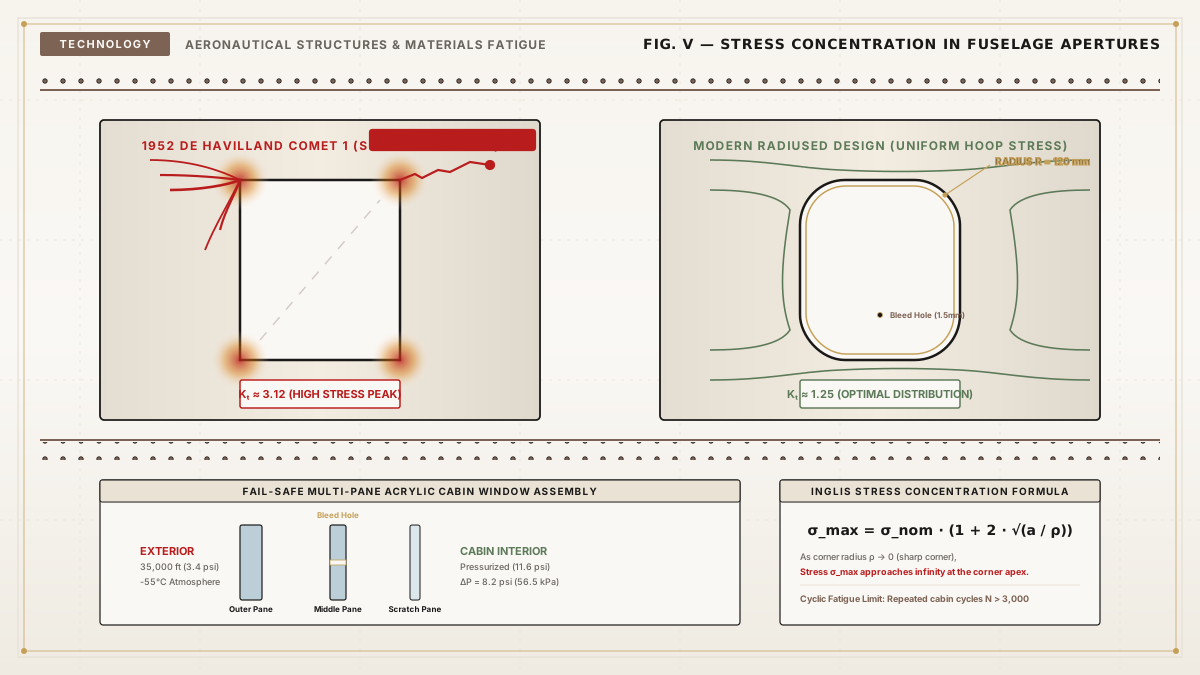
In a pressurized cylindrical vessel, tensile hoop stresses flow continuously along the metal skin, seeking a path of least resistance around openings. When stress lines encounter a smooth circular or rounded boundary, they deflect smoothly and distribute their load evenly across the surrounding material.
However, when stress lines encounter a sharp 90-degree corner, they have no room to distribute:
Rectangular Window (High Stress)        Rounded Window (Low Stress)
        ||||||||||||||                          ((((((()))))))
     +-----------------+                     /-----------------\
     |      90°        |                    /                   \
     |  [STRESS PEAK]  |                   |   Distributed Load  |
     |   Concentrated  |                   |    No Sharp Angles  |
     |   Force x3.0    |                   \                   /
     +-----------------+                     \-----------------/
        ||||||||||||||                          ((((((()))))))
At the apex of a sharp 90-degree corner, the stress concentration factor ($K_t$) spikes dramatically. Testing revealed that while the Comet's general fuselage experienced nominal stresses of about 15,000 psi, the metal immediately adjacent to the window corners was subjected to local stresses exceeding 45,000 psi—nearly tripling the expected load.
During each flight cycle, microscopic micro-tears formed in the aluminum-copper alloy. Over hundreds of flights, this metal fatigue grew silently until a single microscopic fissure reached critical crack length, triggering an explosive, catastrophic fuselage unzip in a fraction of a second.
The Modern Solution: Radiused Curves and Triple-Pane Acrylic
The RAE's findings permanently altered global aeronautical engineering standards. Aviation regulators mandated that all pressurized aircraft openings—windows, emergency exits, passenger doors, and cargo hatches—must feature generous, radiused curves with zero sharp angles.
Modern airliner windows feature a sophisticated multi-pane safety architecture:
- Outer Pane: A structural acrylic layer approximately 12 mm thick designed to carry the full 8.5 psi cabin pressure differential.
- Middle Pane: A secondary fail-safe acrylic pane designed to hold full cabin pressure if the outer pane shatters.
- The Tiny Bleed Hole: A microscopic pinhole drilled into the bottom of the middle pane (the breather hole) that equalizes pressure between the cabin and the inter-pane air gap, ensuring the outer pane bears the load while preventing condensation and frost.
- Inner Scratch Pane: An unsealed plastic barrier protecting the structural panes from passenger contact.
The tragedy of the de Havilland Comet cost Britain its initial lead in the commercial jet age, paving the way for the Boeing 707 and Douglas DC-8. But the lessons learned at Farnborough transformed aviation from an experimental frontier into the safest mass transportation system on planet Earth.
Key Takeaways
- Metal Fatigue Pioneer: The 1954 de Havilland Comet disasters unraveled the previously misunderstood phenomenon of cyclical metal fatigue in pressurized passenger fuselages.
- Stress Concentration at 90 Degrees: Sharp square corners concentrate mechanical tensile stress up to three times higher than smooth curves, creating localized micro-fractures.
- The Farnborough Water Tank: Sir Arnold Hall's full-scale water submersion fatigue tests proved that airframes could catastrophically fail under repeated pressure cycles even when static load tests passed.
- Modern Tri-Pane Architecture: Today's aircraft windows use curved radiused acrylic with structural outer panes and microscopic pressure-equalization bleed holes.
Engineering Reports & Historical References
- Hall, Arnold A., et al. "Report of the Court of Inquiry into the Accidents to the Comet Aircraft G-ALYP and G-ALYY." Ministry of Transport and Civil Aviation, Her Majesty's Stationery Office (HMSO), London, 1955.
- Petroski, Henry. To Engineer Is Human: The Role of Failure in Successful Design. St. Martin's Press, 1985.
- Swift, P. B., and R. T. Smith. "Fatigue in Aircraft Structures: Lessons from the Comet Disasters." Aeronautical Journal, vol. 62, no. 569, 1958, pp. 315–329.
- Davies, R. E. G. A History of the World's Airlines. Oxford University Press, 1964.