Why the Moon Looks Bigger on the Horizon, Explained
The horizon Moon is 6,400 km farther from you — photographs prove it never grows. So why does it look enormous? Science has theories, but no final answer.
Key takeaways
- The Moon illusion is entirely in the brain: photographs prove the Moon is the same width at the horizon as overhead.
- The horizon Moon is actually about 6,400 km farther from you — and 1.5% smaller on your retina.
- Leading explanations include the apparent-distance theory and the Ponzo-like relative-size effect.
- NASA states flatly that there is still no satisfying scientific explanation for why we see it.
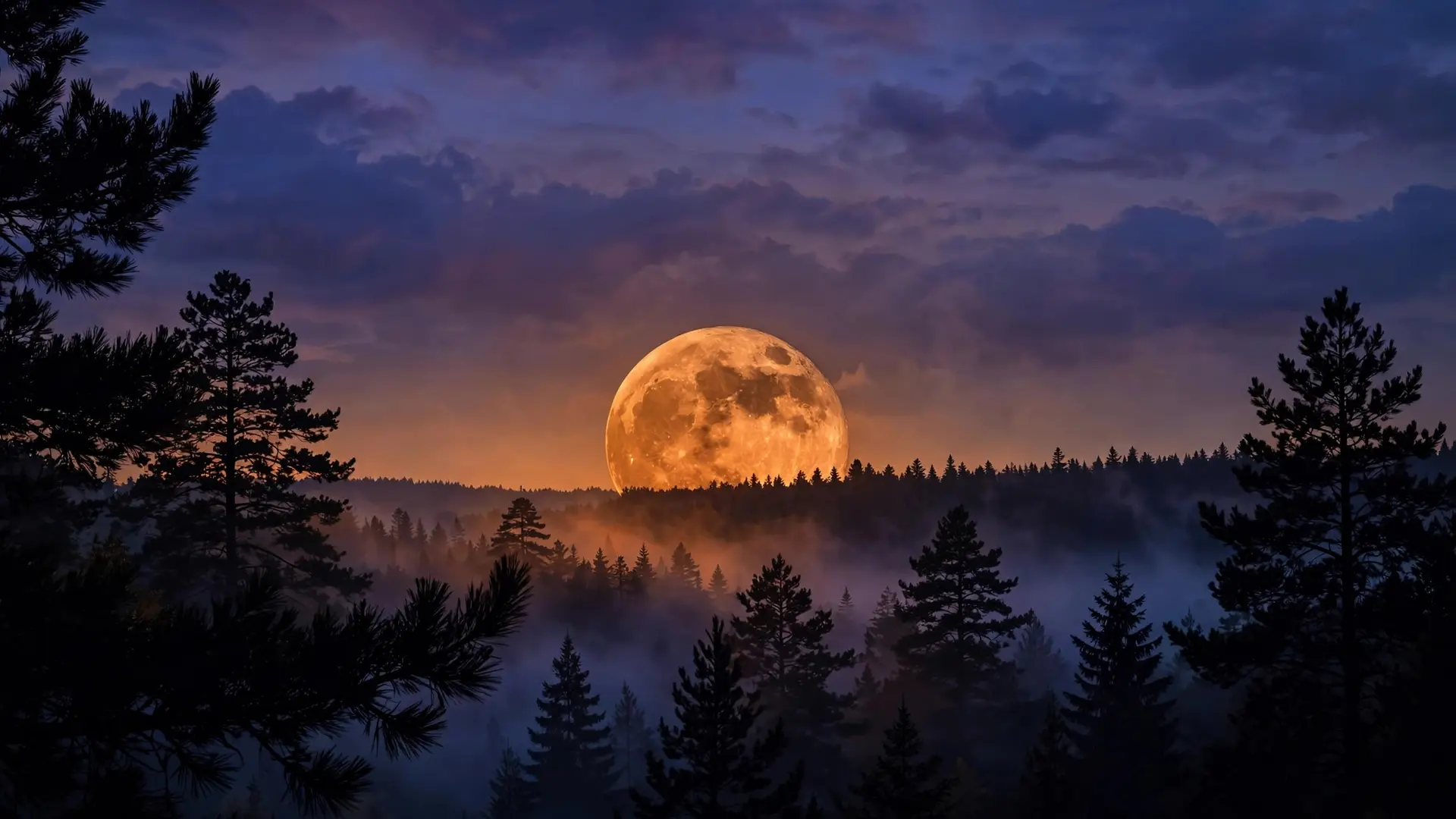
Everyone has seen it: the Moon rising over the treeline, huge and golden, looking close enough to touch. An hour later it is high in the sky and oddly small. It feels impossible that nothing changed. And yet photographs prove nothing changed. The Moon is exactly the same size at the horizon as overhead — and, stranger still, it is actually farther from you when it looks biggest. Your eyes are not lying about what you see; your brain is lying about what it means. This is the Moon illusion, and here is the twist that makes it one of science's most delightful embarrassments: after more than two thousand years of observation, there is still no satisfying explanation. NASA says so flatly.
Is the Moon actually bigger at the horizon?
No — and the proof is easy. Photograph the Moon at moonrise and again when it is high, at the same zoom: it is the same width. Hold your thumb out next to the rising Moon, look through a paper tube, or view it between your legs upside down — the illusion shrinks or vanishes, because you have removed the context your brain uses to build it. Now the counterintuitive part. The horizon Moon is farther from you — roughly 6,400 kilometers farther, because at moonrise it sits at Earth's full radius beyond your position. On your retina, the horizon Moon is about 1.5 percent smaller than the overhead Moon. Your brain receives a smaller image and reports a bigger one. Nobody misreads a photograph that badly. The orange color and slightly squashed shape of the low Moon are separate, real physics, and neither explains the size illusion. Moonlight at the horizon travels a longer path through the atmosphere, which scatters away the blue wavelengths — exactly like a sunset — and atmospheric refraction flattens the bottom edge. Color and shape are physics. Size is psychology.
What is the apparent-distance theory?
The oldest leading theory goes back to the 11th century and the polymath Ibn al-Haytham (Alhazen). We perceive the sky not as a dome but as a flattened dome — the horizon feels farther away than the point overhead. So the brain reasons: the Moon on the horizon looks "farther away," and a same-sized object that seems farther must be bigger. It is elegant, and it has lab support. In 2000, Lloyd and James Kaufman published experiments in the journal PNAS using artificial moons, confirming that the horizon Moon is perceived at a greater distance than the elevated Moon — and that perceived distance drives perceived size. But "perceived distance" is a description, not quite an explanation. It moves the mystery one step back: why does the brain do this math so badly, so consistently? Partly because size and distance are tangled in the brain's wiring — a same-sized object that seems farther away must be larger, and the horizon always seems farther away.
What is the relative-size theory?
The second leading theory treats the illusion like a Ponzo illusion — the classic image where a line drawn between converging railroad tracks looks longer than an identical line on open ground. At the horizon, foreground objects (trees, houses, mountains) act like those converging lines, calibrating the brain's depth sense and tricking it into enlarging the Moon. This theory has a problem, and it is a good one: NASA astronauts in orbit report seeing the Moon illusion with no foreground objects at all. If trees and houses were the whole story, the illusion should vanish in space. It does not. There is more going on than foreground context. Related sky phenomena, like the moonbow's strange light, show how much of what we see in the sky is interpretation, not image.
What do we know for sure about the Moon illusion?
Strip away the theories, and the established facts are these. The Moon's angular size in the sky does not change — photographs taken at the same zoom prove it. The Moon is farther away at the horizon than overhead, by roughly 6,400 kilometers. Its image on the retina is about 1.5 percent smaller at moonrise. The atmosphere changes its color and slightly flattens its shape, but does not magnify it. Everything else — the flattened-dome account, the Ponzo-like foreground effect, the perceptual-distance experiments — is an attempt to explain why the brain consistently reports the opposite of what the eyes deliver. Aristotle noticed the effect in the 4th century B.C.E. and blamed the atmosphere. Ibn al-Haytham proposed the distance explanation in the 11th century. Lloyd and James Kaufman confirmed the perceptual-distance link in controlled PNAS experiments in 2000. Astronauts in orbit showed that foreground objects cannot be the whole story. Two thousand years of cleverness, and the brain still will not confess.
Why has no one solved it yet?
Because the Moon illusion is not a physics problem — it is a perception problem, and perception is hard. The brain seems to weight depth context over the raw retinal image: when the sky says "far," the Moon must be "big," even when the eyes report otherwise. The theories compete without any of them closing the case. Aristotle, noting the effect in the 4th century B.C.E., blamed the atmosphere; he was wrong about the mechanism, and two millennia later we are still circling the real one. There is something satisfying about a mystery that resists photographs, experiments, and space travel. The Moon looks enormous at the horizon for the same reason the aurora dances without touching us: because the brain is not a camera. It builds the world from hints, and sometimes — on a clear evening, with the Moon rising over the trees — it builds one that is wrong in the most beautiful way. The illusion is also a reminder that everything else about the rising Moon is measurable physics: its distance, its color, its flattened shape. Only its size is a story the brain tells. Next time it rises huge over the treeline, you can enjoy it twice — once as a beautiful sight, and once as a beautiful error.
Frequently asked questions
Why does the Moon look bigger on the horizon?
It is an illusion in the brain. The leading theories: we perceive the sky as a flattened dome, so the horizon Moon reads as 'farther away and therefore bigger,' and foreground objects like trees and houses trick our depth calibration into enlarging it.
Is the Moon really bigger at the horizon?
No — photographs prove it is exactly the same width. In fact, the horizon Moon is about 6,400 km farther from you and 1.5% smaller on your retina.
Does the atmosphere magnify the Moon?
No. Aristotle blamed atmospheric magnification in the 4th century B.C.E., but it is debunked. The atmosphere changes the Moon's color and slightly flattens its shape — not its size.
Do astronauts see the Moon illusion in space?
Yes — astronauts in orbit report seeing the Moon illusion with no foreground objects at all, which rules out any theory based only on trees, houses, or mountains.