From the terraces of ancient Babylon to the notebooks of Leonardo da Vinci, few natural phenomena have provoked as much contemplation as the azure ceiling of Earth's atmosphere. For centuries, philosophers hypothesized that air was inherently blue, or that the atmosphere acted as a vast optical mirror reflecting the deep waters of the world's oceans. Even Isaac Newton, who revolutionized optics by demonstrating that white sunlight was a composite spectrum of colored rays, mistakenly concluded that the sky's color arose from water droplets acting like microscopic prisms.
The true explanation was not formulated until the late nineteenth century, when the British physicist John William Strutt, third Baron Rayleigh, published a mathematical description of electromagnetic wave behavior. Rayleigh demonstrated that the sky is not colored by particulate matter, moisture, or dust. Rather, the color of the clear daytime sky is an inescapable consequence of the fundamental interaction between visible electromagnetic radiation and the individual molecules of nitrogen and oxygen that constitute dry air.
"The light scattered from particles smaller than the wavelength of light varies inversely as the fourth power of the wavelength. Hence, the blue rays are scattered much more copiously than the red." — Lord Rayleigh, Philosophical Magazine (1871)
Lord Rayleigh's Inverse-Fourth-Power Law
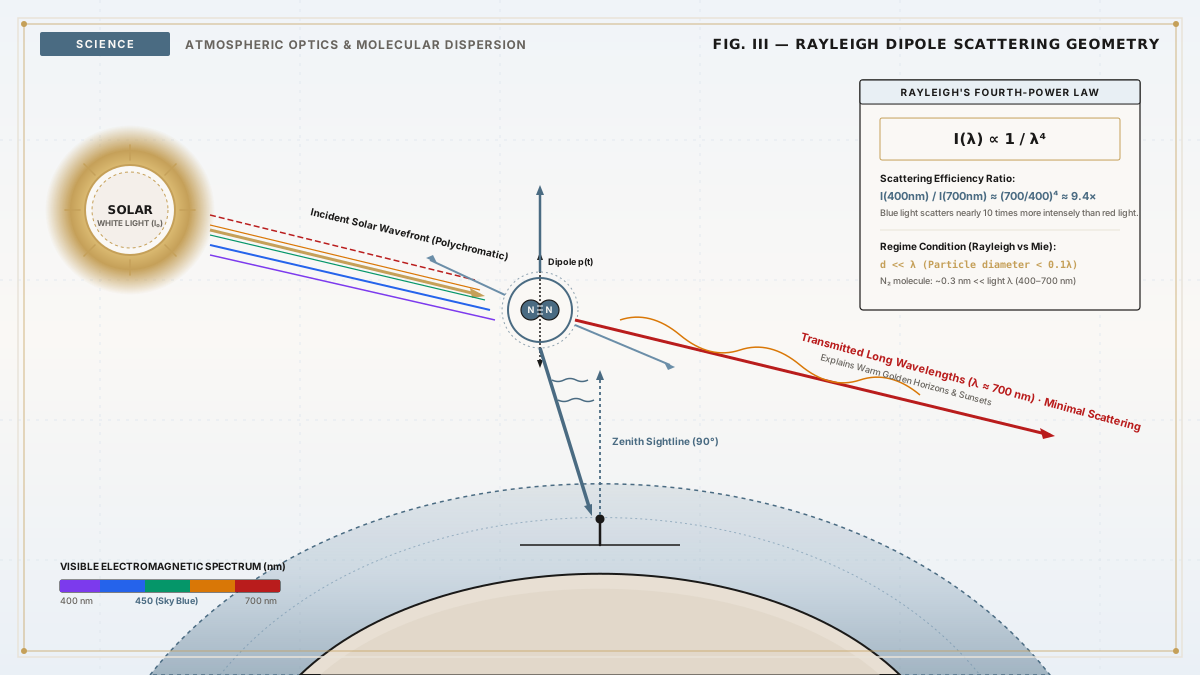
The sun radiates white light, which contains photons across all wavelengths of the visible spectrum, ranging from red (approximately 700 nanometers) to violet (approximately 400 nanometers). When this radiation reaches Earth, it encounters a gaseous envelope composed of roughly seventy-eight percent nitrogen ($N_2$) and twenty-one percent oxygen ($O_2$).
Crucially, the physical diameter of these diatomic molecules—about 0.3 nanometers—is more than a thousand times smaller than the wavelengths of visible light. When an electromagnetic wave strikes a particle significantly smaller than its own wavelength, the electric field of the wave oscillates the electron cloud of the molecule. The oscillating molecule acts as a microscopic dipole antenna, absorbing the incoming photon's energy and immediately re-radiating it in all directions. This omnidirectional redistribution is known as elastic Rayleigh scattering.
The key mathematical insight discovered by Lord Rayleigh is the inverse-fourth-power relationship:
$$I \propto \frac{1}{\lambda^4}$$
Where:
- $I$ is the intensity of the scattered light.
- $\lambda$ (lambda) is the wavelength of the incident light.
Because the scattering efficiency is inversely proportional to the fourth power of the wavelength, even modest differences in wavelength yield staggering differences in scattering intensity:
+---------------+-----------------+--------------------+----------------------------+
| Color Spectrum| Wavelength (nm) | Relative Factor    | Relative Scattering Ratio  |
+---------------+-----------------+--------------------+----------------------------+
| Red           | ~700 nm         | 1.00x              | 1.00x (Baseline)           |
| Orange        | ~620 nm         | 1.13x              | 1.63x                      |
| Yellow        | ~580 nm         | 1.21x              | 2.13x                      |
| Green         | ~530 nm         | 1.32x              | 3.05x                      |
| Blue          | ~450 nm         | 1.55x              | 5.86x                      |
| Violet        | ~400 nm         | 1.75x              | 9.38x                      |
+---------------+-----------------+--------------------+----------------------------+
As the table demonstrates, blue light at 450 nanometers is scattered nearly six times more intensely than red light at 700 nanometers. Violet light at 400 nanometers is scattered more than nine times more intensely. As sunlight cascades through dozens of kilometers of atmospheric density, the longer red, orange, and yellow wavelengths travel unimpeded in a straight path from the solar disc, while the short blue and violet waves are scattered relentlessly in every conceivable direction, saturating the hemisphere with diffuse azure glow.
The Violet Paradox: Why Human Eyes See Azure Instead of Purple
If the inverse-fourth-power law dictates that violet light scatters nearly ten times more effectively than red, and significantly more than blue, a natural scientific paradox emerges: Why is the daytime sky not rich violet?
The resolution to the violet paradox lies not in atmospheric physics, but in human neurobiology and solar astrophysics:
1. Solar Emission Spectrum
The Sun is not a uniform radiator; it behaves approximately as a blackbody emitter at 5,778 Kelvin. The peak output of the solar emission spectrum occurs in the green-yellow region of visible light (~500 nm). The Sun produces substantially fewer violet photons than it does blue photons.
2. Human Photoreceptor Sensitivity
The human retina perceives color using three varieties of cone photoreceptor cells: S-cones (short wavelength, sensitive to blue/violet), M-cones (medium wavelength, sensitive to green), and L-cones (long wavelength, sensitive to red). While S-cones do respond to violet wavelengths, our eyes have vastly fewer S-cones than L- and M-cones. When the mixture of scattered blue and violet light strikes the retina, it simultaneously stimulates the blue S-cones and slightly stimulates the green M-cones and red L-cones. The human visual cortex interprets this composite neurological signal as a vivid sky blue (cerulean) rather than deep purple.
Sunset Geometry: How Long Optical Paths Create Golden Horizons
The identical physics that paints the midday sky blue is responsible for the fiery oranges and crimsons of sunrise and sunset.
At solar noon, sunlight strikes the atmosphere perpendicularly, penetrating only the direct thickness of the air column (one air mass, or approximately 100 kilometers of effective atmosphere). The red and green light passes through with minimal disruption, while the blue light scatters across the field of view.
At sunset, however, the geometry shifts dramatically:
- The sun sinks toward the horizon, and its rays must traverse Earth's atmosphere obliquely.
- The optical path length increases by a factor of ten or more (up to thirty air masses).
- Over this extended path, Rayleigh scattering is so extreme that nearly all blue, violet, and green wavelengths are scattered away before reaching the observer's eyes.
- Only the longest, least-scattered wavelengths—the deep ambers, oranges, and reds—survive the journey to illuminate the observer's horizon and cloud undersides.
The Martian Contrast: Why Dust Inverts the Martian Sky
Earth's atmospheric physics becomes even clearer when contrasted with our neighbor, Mars. The Martian atmosphere is exceptionally thin—less than one percent of Earth's sea-level pressure—meaning Rayleigh scattering by gas molecules is practically negligible.
Instead, the Martian atmosphere is filled with suspended mineral dust composed of iron oxide ($Fe_2O_3$). These dust grains are significantly larger than gas molecules, typically approaching or exceeding the wavelength of visible light. Their optical behavior is governed by Mie scattering, which is far less wavelength-dependent.
The fine rust dust absorbs blue light and scatters warm reds and oranges during the Martian day, creating a butterscotch-colored daytime sky. Near sunrise and sunset on Mars, the light passes through dense dust layers, scattering warm colors outward and leaving a cold, eerie blue halo immediately surrounding the Martian sun—the exact photographic inverse of Earth.
Key Takeaways
- Molecular Elastic Scattering: The sky is blue due to Rayleigh scattering from diatomic nitrogen and oxygen molecules, not dust, water vapor, or reflections of the ocean.
- Inverse-Fourth-Power Law: Shorter wavelengths scatter far more aggressively ($I \propto 1/\lambda^4$), causing blue light (~450 nm) to scatter nearly six times more intensely than red light (~700 nm).
- The Human Visual Factor: The sky appears blue rather than violet because the Sun emits fewer violet photons and human cone photoreceptors are dramatically more sensitive to blue and green wavelengths.
- Sunsets Are the Residual Spectrum: At twilight, extended atmospheric paths scatter away all short wavelengths, leaving only unscattered reds and oranges to reach our eyes.
Scientific References & Foundational Papers
- Strutt, J. W. (Lord Rayleigh). "On the Light from the Sky, its Polarization and Colour." Philosophical Magazine, Series 4, vol. 41, no. 271, 1871, pp. 107–120.
- Bohren, Craig F., and Donald R. Huffman. Absorption and Scattering of Light by Small Particles. John Wiley & Sons, 1983.
- Young, Andrew T. "Rayleigh Scattering." Physics Today, vol. 35, no. 1, 1982, pp. 42–48.
- Minnaert, Marcel. The Nature of Light and Colour in the Open Air. Dover Publications, 1954.