How Tall Is Angel Falls, Earth's Tallest Waterfall?
Angel Falls drops 979 metres from a flat-topped Venezuelan mountain, so high its water turns to mist before landing. Here is how that number is measured.
Key takeaways
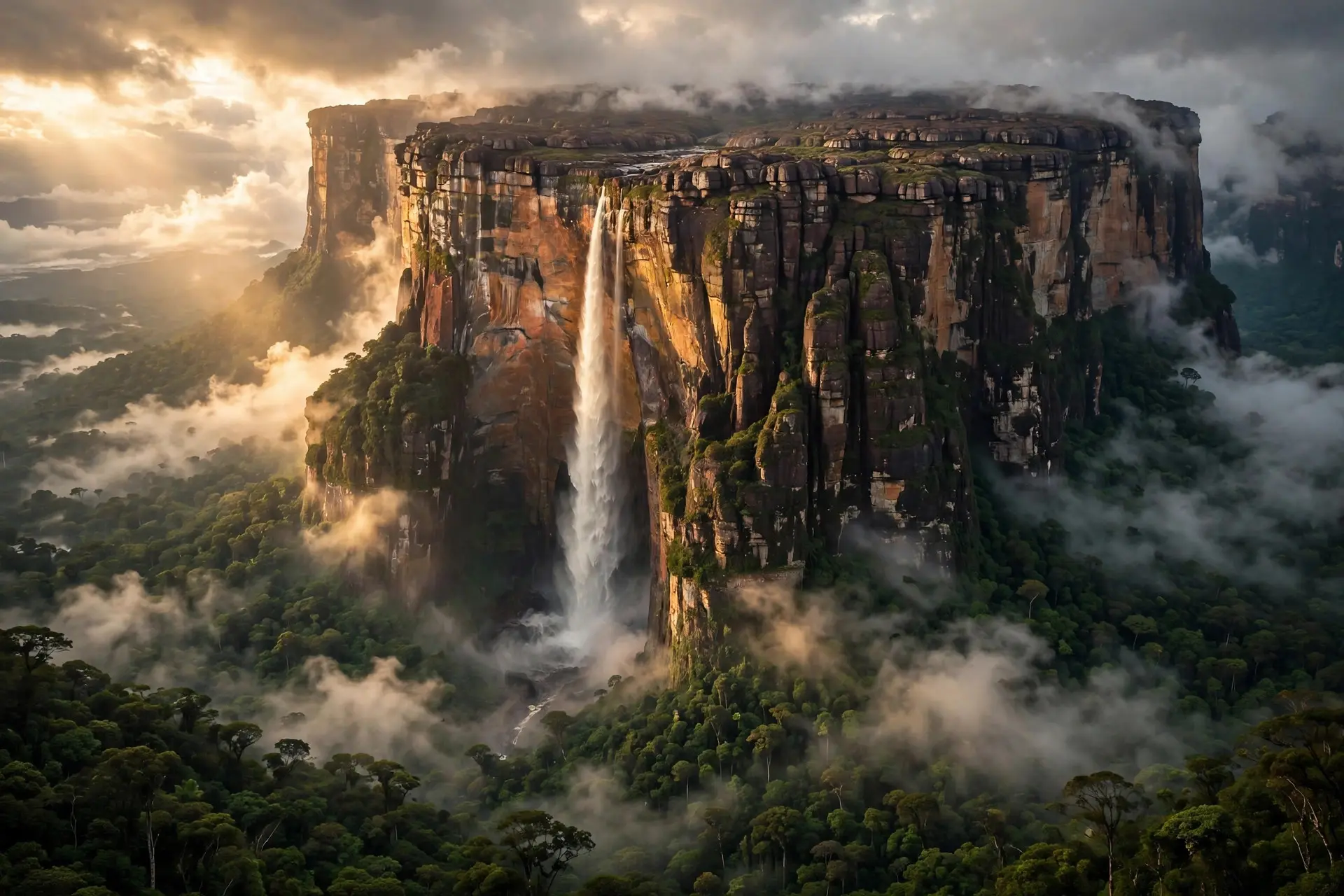
- Angel Falls stands 979 metres tall, with a single uninterrupted plunge of 807 metres from the edge of Auyán-tepui.
- The 979-metre total also includes about 400 metres of sloped cascade and a further 30-metre plunge below the main drop.
- The falls were named for American aviator Jimmie Angel, who flew over them in 1933 and crash-landed on the plateau in 1937.
- Canaima National Park, home of the falls, was established in 1962 and listed as a UNESCO World Heritage site in 1994.
Angel Falls is 979 metres tall, and that single number hides an argument. The headline figure counts more than one clean drop: a sheer plunge of 807 metres, then a long tumble down broken rock, then one last smaller fall. Ask how tall the waterfall is and you get a different answer depending on whether you count the plunge alone or the whole descent — and that is exactly what makes the world's tallest waterfall such a good story. It is not just high. It is high in a way that forces you to decide what "high" means.
What Does the 979-Metre Figure Actually Measure?
Picture a river running off the rim of a table mountain and falling almost a kilometre before it reaches the forest floor. The first and most dramatic part is the free fall: 807 metres of water dropping through open air, a distance so great that much of it breaks apart into spray before it ever lands. Below that, the water does not simply arrive. It slides and bounces down roughly 400 metres of sloped cascade over rock debris, then drops a further 30 metres into the river below. Add those three stages together and you get 979 metres, or 3,212 feet. UNESCO, which lists the surrounding park, rounds the whole spectacle to about 1,000 metres and calls it the world's highest waterfall. That rounding is honest rather than sloppy: the exact total depends on where you draw the line between the fall and the river, and on how much water is flowing when you measure. In the wet season, from May to November, the falls run at full volume and the drop looks its most dramatic. In the dry season the flow shrinks, and in a drought year the falls can be nearly invisible from the ground. A waterfall this tall is not a fixed object like a building; it is a seasonal event wearing a mountain's shape.
How Did a River End Up Falling Off a Table Mountain?
The answer is the tepui, the flat-topped sandstone mountain that gives the region its skyline. Canaima National Park, in southeastern Venezuela near the borders with Brazil and Guyana, covers about 30,000 square kilometres, and roughly 65 percent of it is tepui rock. These plateaus rise from the jungle with near-vertical walls over 1,000 metres high, a vertical world more like a mountain range turned on its side than a single peak such as Mount Everest, and their isolation has turned their summits into ecological islands, home to plants and animals found nowhere else. Auyán-tepui, the mountain behind Angel Falls, is the most famous of them: a vast, rain-scoured tabletop whose rim the river simply runs out of. The park itself was established in 1962 and declared a UNESCO World Heritage site in 1994, recognised for its scenery, its geology and its biodiversity. It is the second-largest national park in Venezuela and the sixth-largest in the world, a landscape of savannah, dense jungle and winding rivers where jaguars, giant armadillos, giant otters and harpy eagles still roam. The falls are only one feature of it, but they are the one that explains the rest: without the tepuis there would be no cliff, and without the cliff there would be no fall. The Pemón people, who have lived in the region for centuries and regard many tepuis as sacred, call the falls by a local name often translated as the waterfall of the deepest place. That name may be the most accurate description ever given to it.
Who Was Angel, and Why Does the Falls Bear His Name?
For all its grandeur, the falls stayed unknown to the outside world until the age of flight. American aviator Jimmie Angel was searching for gold ore deposits when he first flew over the waterfall in 1933, and the sight stayed with him. He returned in 1937, tried to land his plane on the boggy summit of Auyán-tepui, and crashed in the marshy ground. He and his crew walked out through the jungle for eleven days, and the story of their escape travelled further than any expedition report could have. The waterfall took his name, and has kept it ever since.
There is a useful lesson in that naming. Angel did not discover the falls — the Pemón had lived beside them for generations — but his crash turned a remote wonder into a world-famous landmark. The same pattern runs through exploration history: the person who brings the story home often gets the credit, while the people who knew the place all along get a footnote. Modern accounts increasingly use the Pemón name alongside the English one, a small correction to a century of one-sided storytelling. The falls themselves, of course, are indifferent to either name.
Why Is Reaching the Falls Still an Expedition?
There are no roads to Angel Falls, and that is part of its protection. Visitors fly first to Puerto Ordaz or Ciudad Bolívar, then take a small plane of about 45 minutes to Canaima village, the gateway to the park. From there the standard route is a multi-day motorised canoe trip up the Churún River and its tributaries, camping overnight, with the boat journey taking roughly five to six hours each way, followed by a jungle hike to the viewpoint. Overflights in small planes offer a faster aerial view, but they cannot replace standing at the base while spray drifts down like rain. That remoteness cuts both ways. It has kept the falls wild in a way that famous waterfalls rarely stay — compare the walkways and viewpoints of the Grand Canyon, where access is easy and crowds are part of the experience. But remoteness has not kept out every threat. In 2025, reporting on illegal mining inside Canaima described at least 30 mining sites within the park, in violation of Venezuelan law and international treaties, with one operation on a bank of the Carrao River not 15 miles from the falls. Environmental groups warned that large areas of the park rest on solid bedrock with little topsoil, so damage there could take centuries to recover. The falls may be nearly a kilometre tall, but the landscape around them is fragile in a way height alone does not suggest. Angel Falls earns its record honestly, with one condition attached: the 979 metres is a total, not a single leap. The plunge alone, at 807 metres, would still be the tallest uninterrupted drop on Earth, so the record survives either way you count it. What the full figure really measures is the whole journey of the water — off the rim, through the air, down the rocks and into the river — and that journey is the reason the falls feel less like a waterfall and more like weather. Stand beneath it in the wet season and you are not watching a river fall. You are watching a mountain pour.
Frequently asked questions
How tall is Angel Falls exactly?
The accepted total is 979 metres, or 3,212 feet. Of that, 807 metres is one uninterrupted plunge, followed by about 400 metres of sloped cascade and a final 30-metre drop, which is why UNESCO rounds the height to about 1,000 metres.
Why is Angel Falls called Angel Falls?
It is named for Jimmie Angel, an American aviator who flew over the falls in 1933 while searching for gold ore deposits. He returned in 1937, crashed his plane on the boggy summit of Auyán-tepui, and walked out through the jungle for eleven days.
Can you visit Angel Falls?
Yes, but there are no roads. Visitors fly to the village of Canaima, then travel by motorised canoe up the Churún River and its tributaries, a journey of several hours each way, followed by a jungle hike to the viewpoint.
Sources
- Canaima National Park, UNESCO World Heritage Centre
- Canaima National Park, national-parks.org
- Angel Falls, Mad Traveller
- Illegal mining reaches Venezuela's famed Angel Falls, threatens treasured national park, phys.org