The Strange World of Antimatter, Explained
Every particle has an antimatter twin, and when the two meet they vanish into pure energy. Here is what antimatter is, where it exists, and why it matters.
Key takeaways
- Antimatter is matter built from antiparticles — identical in mass to ordinary particles but opposite in charge, such as the positron (antielectron).
- When matter and antimatter meet, both annihilate into pure energy, mostly gamma rays and pions, with near-perfect efficiency — about 50 times better than fusion.
- The universe should contain equal matter and antimatter, yet almost none survives; physicists still cannot explain that imbalance — one of their deepest open questions.
- Antimatter is already useful: hospitals use positrons in PET scans, where annihilation gamma rays reveal tumors, brain activity, and heart function.
- Humanity has made only nanograms of antimatter in total — a year's output from CERN's factory holds about as much energy as a 100-watt bulb burning for five seconds.
Antimatter is exactly what it sounds like: matter assembled from mirror-image particles. The electron has a twin called the positron — same mass, opposite charge — and when the two meet, both vanish in a flash of pure energy. It sounds like science fiction, but antimatter is real, it is made daily in laboratories, and it already saves lives in hospitals. The strange part is not that it exists. The strange part is that the universe is not full of it.
What happens when matter meets antimatter?
Annihilation is the whole story. A particle and its antiparticle are perfect opposites, so when they collide, neither survives: their combined mass converts directly into energy, mostly gamma rays, neutrinos, and short-lived particles called pions. This is Einstein's E=mc² running at full power. The numbers are staggering. Reacting one kilogram of antimatter with one kilogram of matter would release about 1.8×10¹⁷ joules — roughly 180 petajoules, or around 43 megatons of TNT, slightly less than the largest thermonuclear weapon ever detonated. Ordinary nuclear reactions convert only a sliver of their fuel's mass into energy; annihilation converts nearly all of it, making it roughly fifty times more efficient than fusion. That perfection is also the catch. Antimatter cannot be kept in any ordinary container, because the container itself is matter. Charged antiparticles must be levitated in magnetic cages called Penning traps inside extreme vacuum; the record for keeping antiprotons alive is 405 days.
How did we discover it?
The story starts with an equation. In 1928, British physicist Paul Dirac combined quantum mechanics with special relativity to describe the electron, and his equation insisted on a second solution: a particle with the electron's mass but opposite charge. Nature confirmed it four years later. In 1932, Carl Anderson spotted the positron's curved trail in a cloud chamber photograph, naming it from "positive electron." The antiproton followed in 1955 at Berkeley's Bevatron, earning Emilio Segrè and Owen Chamberlain the 1959 Nobel Prize.
Building actual anti-atoms took longer. CERN created nine scorching-hot antihydrogen atoms in 1995 — too energetic to study. The first cold antihydrogen arrived in 2002, and in 2010 the ALPHA collaboration held 38 antihydrogen atoms for roughly a sixth of a second — the first capture of neutral antimatter. By 2011 they were holding hundreds of atoms for up to seventeen minutes. Precision tests keep confirming that antimatter behaves exactly like matter: a 2016 measurement of antihydrogen's spectrum matched hydrogen perfectly, and in 2023 the ALPHA-g experiment settled a decades-old question by confirming that antimatter drops downward like ordinary matter — most of the released atoms escaped through the bottom of the trap. A 2025 breakthrough then multiplied production eightfold with a new positron-cooling technique, producing more than 15,000 antihydrogen atoms within a few hours.
Where is antimatter right now?
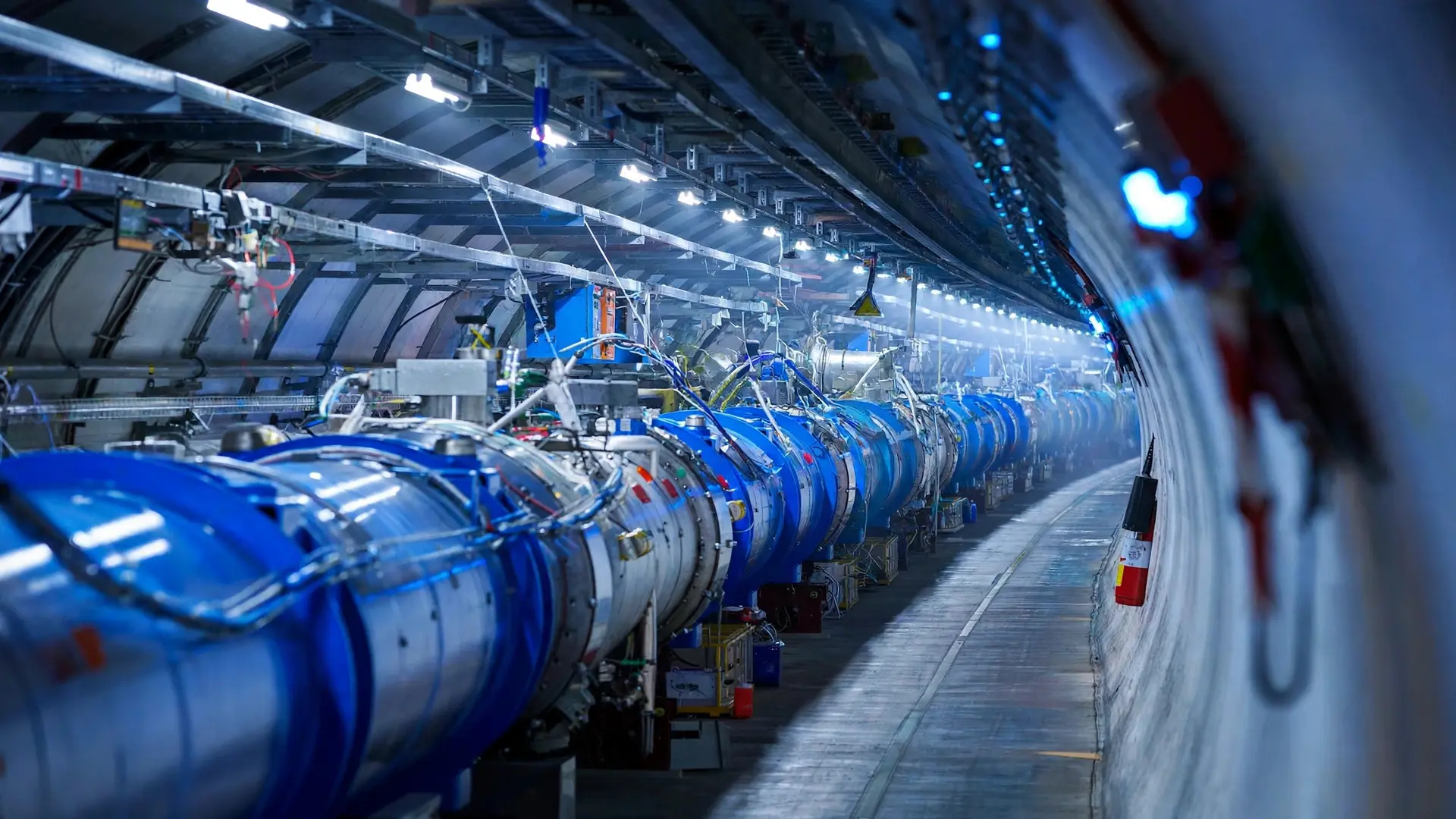
Antimatter is not only a laboratory product. Cosmic rays striking the atmosphere manufacture antiparticles constantly, and satellites have found antiprotons trapped in Earth's Van Allen belts. In 2011, researchers discovered positrons streaming from above thunderstorm clouds, born in the intense electric fields of terrestrial gamma-ray flashes. The jets of black holes are thought to flood their surroundings with electron-positron plasma, and detectors on the International Space Station are hunting cosmic antihelium nuclei that might betray distant antimatter structures. The most down-to-earth use is in medicine. Positron emission tomography — PET scanning — works by injecting a patient with a tracer containing fluorine-18, which decays and emits positrons. Each positron almost immediately meets an electron and annihilates, releasing two 511 keV gamma rays in opposite directions. Scanners detect those gamma rays to build three-dimensional images of metabolic activity, revealing cancers, mapping the brain, and assessing the heart. It is antimatter annihilation, performed millions of times a year, saving lives. CERN's Antimatter Factory is the largest dedicated source. When running, it delivers some 400 million antiprotons per hour to its experiments, of which about a tenth are captured; the ALPHA experiment turns them into antihydrogen at up to 3,000 atoms per hour and can store the atoms for up to 100 hours. Run the factory nonstop for a year and you would accumulate about 30 million atoms — a mass of 3×10⁻²⁰ kilograms. All of that, annihilated at once, would release mere thousandths of a joule — about what a fingertip tap on a phone screen releases. The antiprotons from a full year of operation hold about 500 joules — enough to light a 100-watt bulb for five seconds. Total human production across history amounts to a few nanograms.
Why is the universe made of matter?
This is the deepest puzzle of all. In the universe's earliest fractions of a second, particle-antiparticle pairs were constantly popping into and out of existence. Since every creation event makes matter and antimatter in matched pairs, the cosmos should hold equal amounts of both — or nothing at all, just the leftover glow of their mutual destruction. Instead, the universe is made almost entirely of matter, and the antimatter is essentially gone. The best current explanation is that some unknown mechanism produced a minuscule excess of matter in the primordial fire: roughly one extra particle for every billion antiparticles. When everything annihilated, that tiny surplus was all that remained — and it became every star, planet, and living thing. Physicists call this the matter-antimatter asymmetry problem, one of the great unsolved challenges in science, alongside the mystery of dark matter. An antistar would shine exactly like an ordinary star, so telescopes cannot simply spot antimatter galaxies — the answer must come from precision experiments comparing matter and antimatter atom by atom.
Could antimatter power a starship?
On paper, nothing beats it. A proton-antiproton rocket could in principle reach a large fraction of the speed of light, and NASA's advanced-concepts program has funded serious studies of antimatter propulsion, including a 2020 project on decelerating interstellar spacecraft with antimatter and startup concepts that generate positrons from radioisotopes to dodge the storage problem entirely. In practice, three walls stand in the way. Production is measured in nanograms after decades of effort; storage requires magnetic traps that hold at most about a billion particles; and cost is astronomical, with estimates running from $25 billion per gram of positrons to $62.5 trillion per gram of antihydrogen. There is also a deeper truth: antimatter is not an energy source but an energy battery. Conservation of energy means you can never get more out of antimatter than you put into making it. The strange world of antimatter turns out to be less about apocalyptic weapons and starships than about precision and patience. It falls down like everything else, it glows in hospital scanners every day, and it may hide the answer to why anything exists at all. We can make it, trap it, and measure it to twelve decimal places — yet we still do not know why the universe chose matter over its mirror twin.
Frequently asked questions
What is antimatter, simply put?
Matter made of antiparticles — mirror-image versions of ordinary particles with the same mass but opposite charge. The positron is the antiparticle of the electron, and an antiproton plus a positron can combine into an antihydrogen atom.
What happens when matter and antimatter touch?
They annihilate: both disappear and their mass converts into energy, mainly high-energy gamma rays and pions. The process is nearly 100% efficient, far beyond fission or fusion.
Does antimatter fall up or down?
Down. CERN's ALPHA-g experiment confirmed in 2023 that antihydrogen atoms fall under gravity just like ordinary matter, ruling out the idea that antimatter is gravitationally repelled.
Can antimatter be used as a weapon or fuel?
In theory it is the most energy-dense fuel imaginable, but in practice humanity has produced only nanograms at astronomical cost, and storing it requires magnetic traps that do not scale. No weapon or engine is remotely feasible today.