How the Structure of the Atom Was Discovered
From Dalton's solid balls to Rutherford's empty-space atom: how Thomson's electron, a gold-foil experiment, and Bohr's orbits revealed what matter is made of.

Key takeaways
- In 1803 John Dalton proposed atoms were solid, indivisible spheres — the name itself comes from the Greek 'atomos,' meaning uncuttable.
- In 1897 J.J. Thomson discovered the electron in cathode-ray experiments and proposed the 'plum pudding' model of the atom.
- In 1911 Ernest Rutherford showed the atom is mostly empty space, with nearly all its mass in a nucleus about 100,000 times smaller than the atom.
- In 1913 Niels Bohr fixed Rutherford's model by placing electrons in fixed orbits, explaining hydrogen's spectral lines.
- Thomson's own research student — Rutherford — was the one who destroyed the plum pudding model with the gold-foil experiment.
Every solid thing you have ever touched is almost entirely empty space — and nobody knew that until physicists started firing subatomic bullets at gold foil and watched some of them bounce back. The discovery of the atom's structure took three generations of scientists, and each generation's triumph was to demolish the previous one: from John Dalton's solid, indivisible balls in 1803, to J.J. Thomson's electron in 1897, Ernest Rutherford's nucleus in 1911, and Niels Bohr's quantized orbits in 1913. The story of the atom is really the story of certainty being quietly dismantled.
Why did physicists think the atom was a solid, indivisible ball?
For two thousand years, the atom was a philosophical hunch. Democritus coined the word atomos — "uncuttable" — for the smallest possible pieces of matter. Then, in 1803, English chemist John Dalton gave the idea scientific teeth: he proposed that each element was made of identical, solid, indivisible atoms, and that compounds formed when different kinds of atoms joined in fixed, whole-number ratios. Dalton's model worked beautifully for chemistry. The indivisibility was the entire point of the theory — the name itself promised that you could not go smaller. Which is exactly why the next discovery was so startling: the atom, supposedly uncuttable, turned out to have parts.
How did Thomson break the atom apart?
In 1897, J.J. Thomson at Cambridge was experimenting with cathode-ray tubes — sealed glass tubes with the air pumped out, through which electric discharges streamed glowing beams. He showed that the beam bent toward a positively charged plate, proving it was made of tiny negatively charged particles present in every kind of matter. He called them electrons: the first subatomic particle ever discovered, roughly 2,000 times lighter than a hydrogen atom.
If atoms contained smaller particles, atoms were divisible — Dalton's central claim was wrong. Thomson patched the theory with the "plum pudding" model: the atom as a diffuse cloud of positive charge with electrons embedded in it, like plums in a pudding. It was a reasonable picture. And it would be destroyed, in one of history's loveliest ironies, by Thomson's own research student — Ernest Rutherford, the New Zealand-born physicist whose doctorate had been supervised by Thomson himself. Thomson's cathode-ray world overlapped with one of the era's other great breakthroughs: two years earlier, the same kind of tube had revealed X-rays in a darkened Würzburg lab. The 1890s cathode-ray tube was the particle accelerator of its day.
What made Rutherford compare tissue paper to an artillery shell?
By 1908, Rutherford — by then at the University of Manchester — wanted to probe the atom's interior directly. He assigned two younger men, Hans Geiger and Ernest Marsden, a deliberately unglamorous task: fire a narrow beam of alpha particles (helium nuclei, heavy and positively charged, emitted by radioactive decay) at a sheet of gold foil only a few hundred atoms thick, and watch where they went. The foil was surrounded by a zinc-sulfide screen that flashed wherever a particle struck. Under Thomson's plum pudding model, the expectation was boring: the atom's charge was spread thinly through its whole volume, so the massive, fast alpha particles should sail through with only tiny deflections. Geiger and Marsden found almost exactly that — except that roughly one particle in 20,000 bounced almost straight back toward the source. Rutherford was stunned. He later said it was "quite the most incredible event that has ever happened to me in my life. It was almost as incredible as if you fired a 15-inch shell at a piece of tissue paper and it came back and hit you." Once he did the calculations, there was only one possible explanation: the scattering had to come from a single violent collision, which meant the atom's positive charge and nearly all its mass were concentrated in a minute, dense center — the nucleus — roughly 100,000 times smaller in diameter than the atom itself. Everything else was empty space.
In 1911, Rutherford published the nuclear model: a tiny, massive nucleus at the center, with electrons orbiting far away like planets. The alpha particles, which came from the radioactive decay that Marie Curie's generation was unraveling, had mapped the inside of matter — and found it was mostly nothing. The chair you sit on is, by mass, a constellation of pinpoints separated by vacuum.
Why didn't the electrons crash into the nucleus?
Rutherford's model had a fatal flaw, and he knew it. Classical physics says that a charged particle moving in a circle radiates energy — so orbiting electrons should spiral inward and collapse into the nucleus in a fraction of a second. Atoms should not exist. Yet here we were. The fix came in 1913 from Niels Bohr, a young Dane who had worked in Rutherford's lab. Bohr proposed that electrons could only occupy certain fixed, stable orbits — shells — and could jump between them only by absorbing or emitting exact packets of light energy. This wasn't a guess: it explained the precise spectral lines of hydrogen, the barcode of colors each element emits, which had baffled physicists for decades. The spectral-line physics Bohr introduced became the toolkit astronomers use to read light from the deep universe — including the faint afterglow of the Big Bang itself.
Did we ever finish the picture?
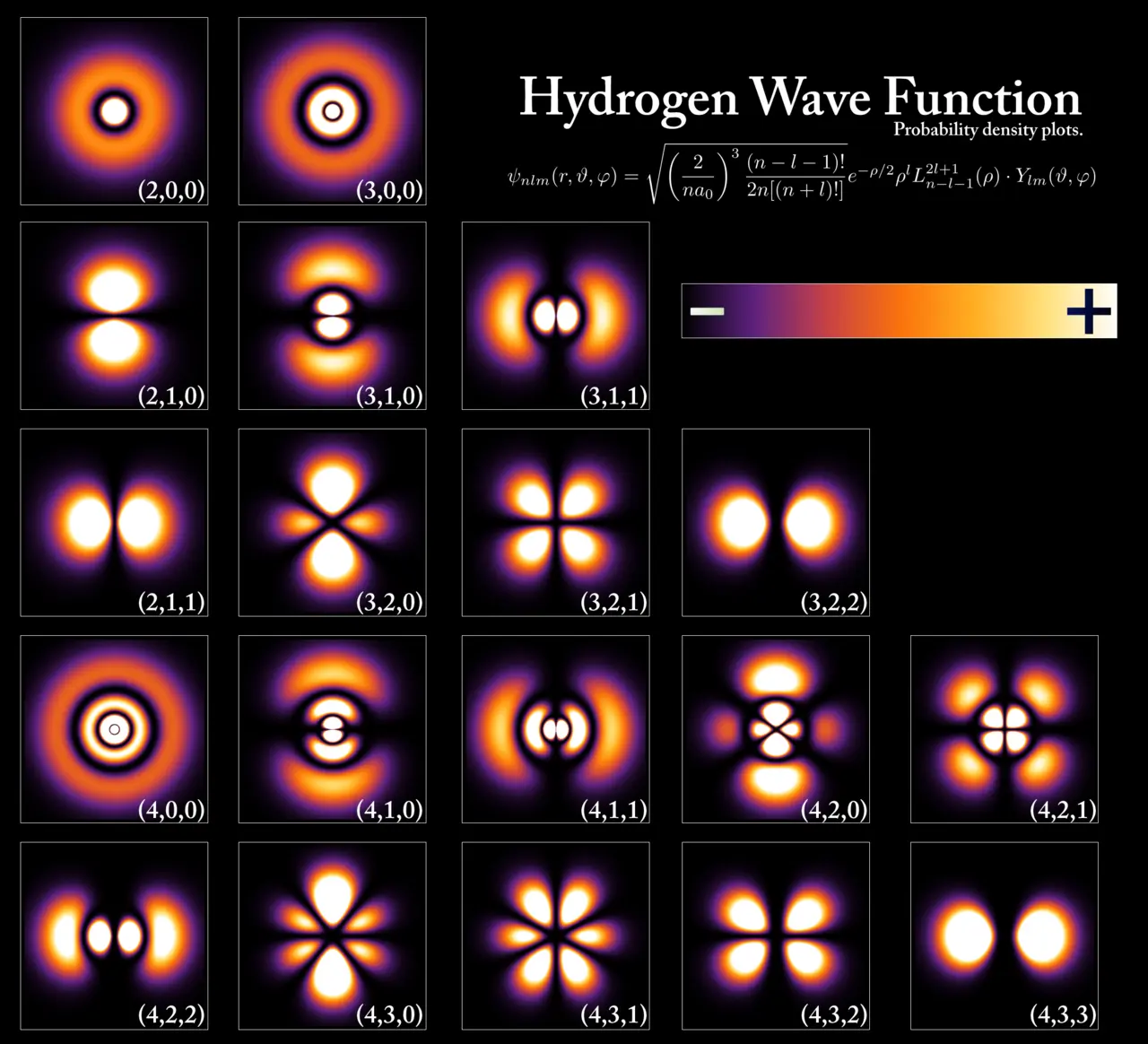
Not quite — the nucleus itself still had a secret. In 1932, James Chadwick, another Rutherford protégé, discovered the neutron, the neutral partner of the proton that accounts for roughly half the nucleus's mass. Rutherford had predicted something like it a decade earlier. And the electrons did not stay in their neat orbits either. Within a decade, Erwin Schrödinger and Werner Heisenberg replaced Bohr's planetary paths with the quantum model: electrons as probability clouds, smeared across regions of space, with no definite trajectory at all. Each picture — solid ball, plum pudding, miniature solar system — fell in turn to sharper evidence. That is the real discovery here. Not the nucleus, or the electron, or the orbit, but the pattern: every generation of physicists proved the previous one wrong, and each wrongness was productive. Today the atom is understood as mostly empty space around a nucleus that is itself divisible into quarks — and the quantum picture may yet be revised. The tissue paper held an artillery shell, and physics has been recalculating the ricochet ever since.
Frequently asked questions
Who discovered the structure of the atom?
No single person did. John Dalton proposed indivisible atoms in 1803, J.J. Thomson discovered the electron in 1897, Ernest Rutherford found the nucleus in 1911, and Niels Bohr added fixed electron orbits in 1913 — each discovery overturning the last.
What did the gold-foil experiment prove?
Geiger and Marsden fired alpha particles at thin gold foil under Ernest Rutherford's direction and found about one in 20,000 bounced straight back. This proved the atom's positive charge and nearly all its mass sit in a tiny central nucleus, while the rest is empty space.
Why is most of an atom empty space?
The nucleus is about 100,000 times smaller in diameter than the atom itself, yet it holds nearly all the atom's mass. If an atom were a football stadium, its nucleus would be a pea at the center — everything around it is vacuum where electrons reside.
Why did Bohr change Rutherford's model of the atom?
Rutherford's electrons should have radiated energy and spiraled into the nucleus, which would have made atoms unstable. In 1913 Niels Bohr proposed that electrons occupy only fixed, stable orbits, jumping between them by absorbing or emitting exact packets of light.