Marie Curie and the Discovery of Radioactivity
How Marie Curie coined the word radioactivity, proved that radiation comes from atoms themselves, and isolated two new elements from tons of pitchblende.
Marie Curie didn't just discover radioactivity — she named it. In 1898, a 30-year-old doctoral student working in a draughty Paris shed set out to study mysterious rays pouring out of uranium, and within two years she had found two brand-new elements hiding inside a common ore, shown that radiation comes from inside atoms themselves, and coined the word that describes the whole phenomenon.
A doctorate that began with someone else's discovery
In 1896, French physicist Henri Becquerel noticed something strange: uranium salts could fog a photographic plate even in total darkness. He had stumbled onto rays that passed straight through metal — a new kind of invisible radiation. The finding electrified physics, but nobody yet understood what the rays were or where they came from.
Marie Curie, born Maria Skłodowska in Warsaw in 1867, had moved to Paris in 1891 to study at the Sorbonne, earning degrees in physics and mathematics and marrying fellow physicist Pierre Curie in 1895. Searching for a doctoral thesis subject, she chose Becquerel's uranium rays. It was a bold pick. Almost nothing was known about the rays, and she would have to invent her own methods to study them.
Using a sensitive electrometer — a device for measuring tiny electrical charges that Pierre and his brother Jacques had developed — she found that uranium rays made the air around a sample conduct electricity, and the strength of that effect gave her a way to measure radioactivity precisely. Then came her first great insight: the rays did not depend on the arrangement of atoms in a molecule, but on the interior of the atom itself. Radiation was an atomic property, baked into the element. That single idea quietly rewrote what atoms were.
She also knew she had to publish quickly — and that being a woman in 1890s science carried a price. Fearing her results might not be taken seriously, she had her former professor Gabriel Lippmann present her first findings to the Académie des Sciences in April 1898. Around the same time, a German physicist named Gerhard Schmidt independently reported radioactivity in thorium, a result Marie had also found on her own. The race was on, and the young doctoral student was out in front of it.
The ore was stronger than its uranium — so what else was in there?
Marie then did what she did best: measured everything, systematically. She tested uranium minerals and noticed something the numbers would not let her ignore. Pitchblende — a uranium-rich ore also known as uraninite — was about four times as radioactive as uranium itself. Chalcolite was twice as active. And she found that thorium, another heavy element, emitted similar rays.
Think about that: if the ore's radioactivity came only from its uranium, it could not be more radioactive than pure uranium. There had to be something else inside, something far more active than uranium, present only in trace amounts. Most people would have called it experimental error. Marie Curie saw a hidden element.
At this point Pierre joined her research, and together they began chemically breaking pitchblende apart, fraction by fraction. In July 1898 they published a paper announcing polonium — named after Marie's native Poland, which was then partitioned and not an independent country. The new substance was roughly 300 times more radioactive than uranium. In December 1898 came the second paper, announcing radium, a glowing new element some 3,000 times as active as uranium. And in these very papers, the pair coined the term "radioactivity" itself.
A word about that word. Before 1898, scientists spoke vaguely of "Becquerel rays." Marie needed a noun for what she was measuring — the spontaneous emission of radiation from atomic decay — and "radioactivity" was it. The term first appeared in print in the couple's 1898 papers, and within a decade it had entered every language of science. She had not only discovered the phenomenon's inner workings; she had given the world its vocabulary.
Turning tons of rock into a pinch of radium
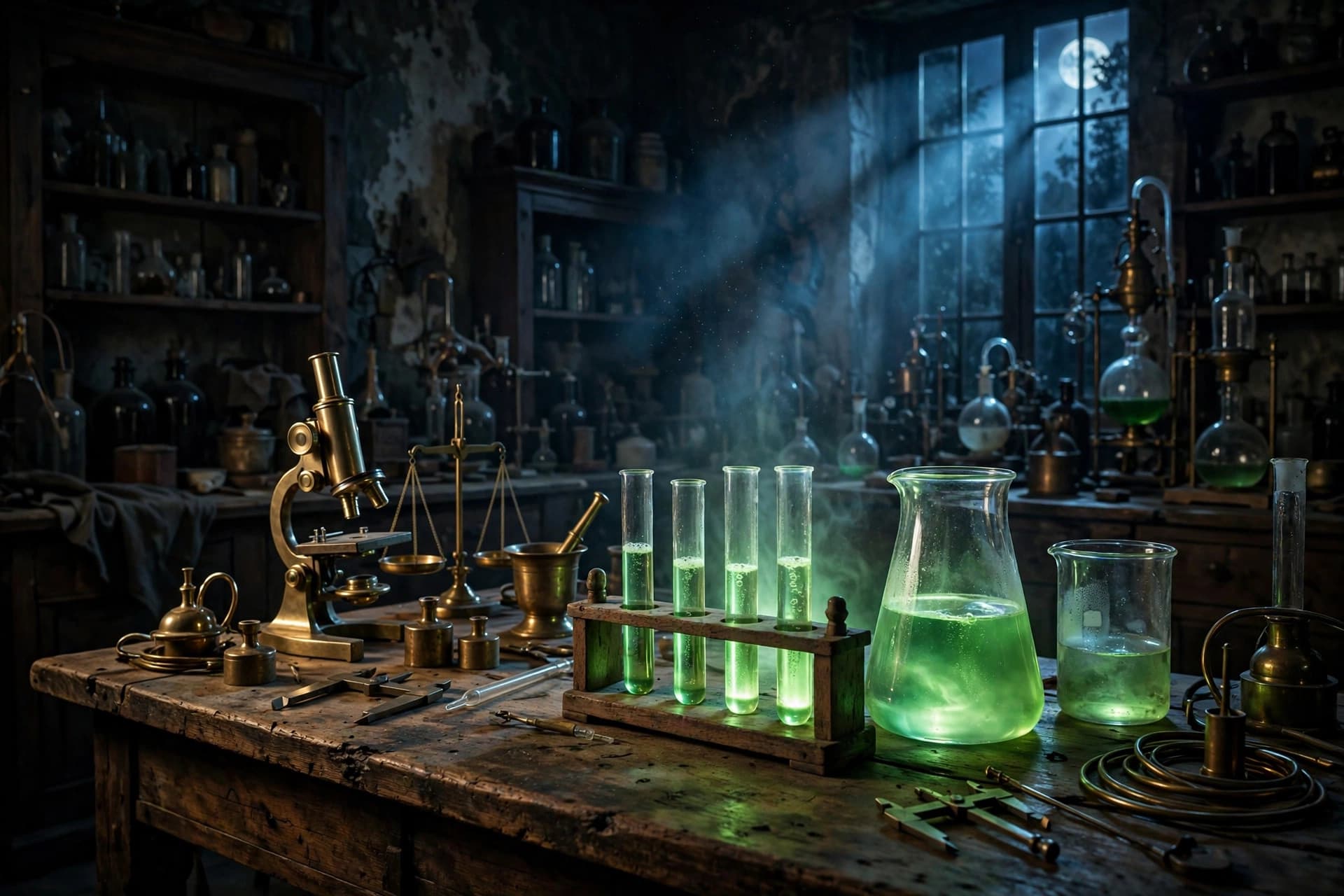
Announcing an element is one thing; isolating it is another. To prove radium was real and win over skeptics, Marie needed pure radium — not traces, a weighable sample. With help from chemist André Debierne, she set up an industrial-scale operation in a cramped shed on the grounds of the School of Industrial Physics and Chemistry, boiling, dissolving, and crystallizing enormous quantities of pitchblende in cauldrons over open fires.
The ore came as mining waste from Joachimsthal in Bohemia (today's Jáchymov in the Czech Republic). Ton after ton of it went into the vats; fraction after fraction of barium-like crystals came out, each batch a little purer. In 1902, after years of brutal, repetitive labor, Marie isolated one-tenth of a gram of pure radium chloride. She could weigh it, weigh its compounds, and fix radium's atomic weight. The hidden element was undeniable.
The recognition followed fast. In June 1903 she was awarded her doctorate — her thesis was titled Research on Radioactive Substances. Later that year she shared the Nobel Prize in Physics with Pierre and Becquerel, becoming the first woman ever to win a Nobel Prize. In 1911 she won the Nobel Prize in Chemistry for the isolation of pure radium and the discovery of polonium and radium — the only person in history to win Nobel Prizes in two different sciences.
That scientific dynasty did not end with her. Her elder daughter Irène and son-in-law Frédéric Joliot-Curie went on to win the 1935 Nobel Prize in Chemistry for their own discovery of artificial radioactivity — the Curies remain the most decorated family in Nobel history.
The invisible hazard she never saw coming
Here is the uncomfortable truth beneath the triumph: nobody knew radiation was dangerous. Marie carried test tubes of radioactive salts in her pockets, stored them in desk drawers, and worked for years with no shielding. Her fingertips were reportedly damaged; she suffered chronic fatigue. She died in 1934 of aplastic anemia — a failure of the bone marrow — almost certainly the long-term price of the very rays she had discovered.
Yet the discovery remade medicine. Radium quickly found uses in cancer treatment — as early as 1899, doctors reported that radioactive sources could destroy malignant skin tumors — laying the foundations for modern radiotherapy and nuclear medicine. The atomic theory she advanced also paved the way for the discoveries that followed, from Penicillin's accidental spore to careful bench-science triumphs like the isolation of insulin.
Her legacy runs in both directions: outward, through the physics and medicine built on radioactivity, and inward, as proof that one meticulous observer with a hand-built instrument can crack open the atom. And every time the faint afterglow of the Big Bang is studied — the cosmic microwave background — astronomers are chasing another kind of invisible radiation, one that Marie Curie taught us how to measure.
She named the phenomenon. She found the elements. And she paid for the knowledge with her health. Few discoveries in history have been so thoroughly hers.