
The Discovery of Insulin: From Dogs to Lifesaver
A 25-word midnight idea sparked a frantic year of dog experiments, a Nobel Prize, and a purified extract that turned fatal diabetes into a survivable condition.
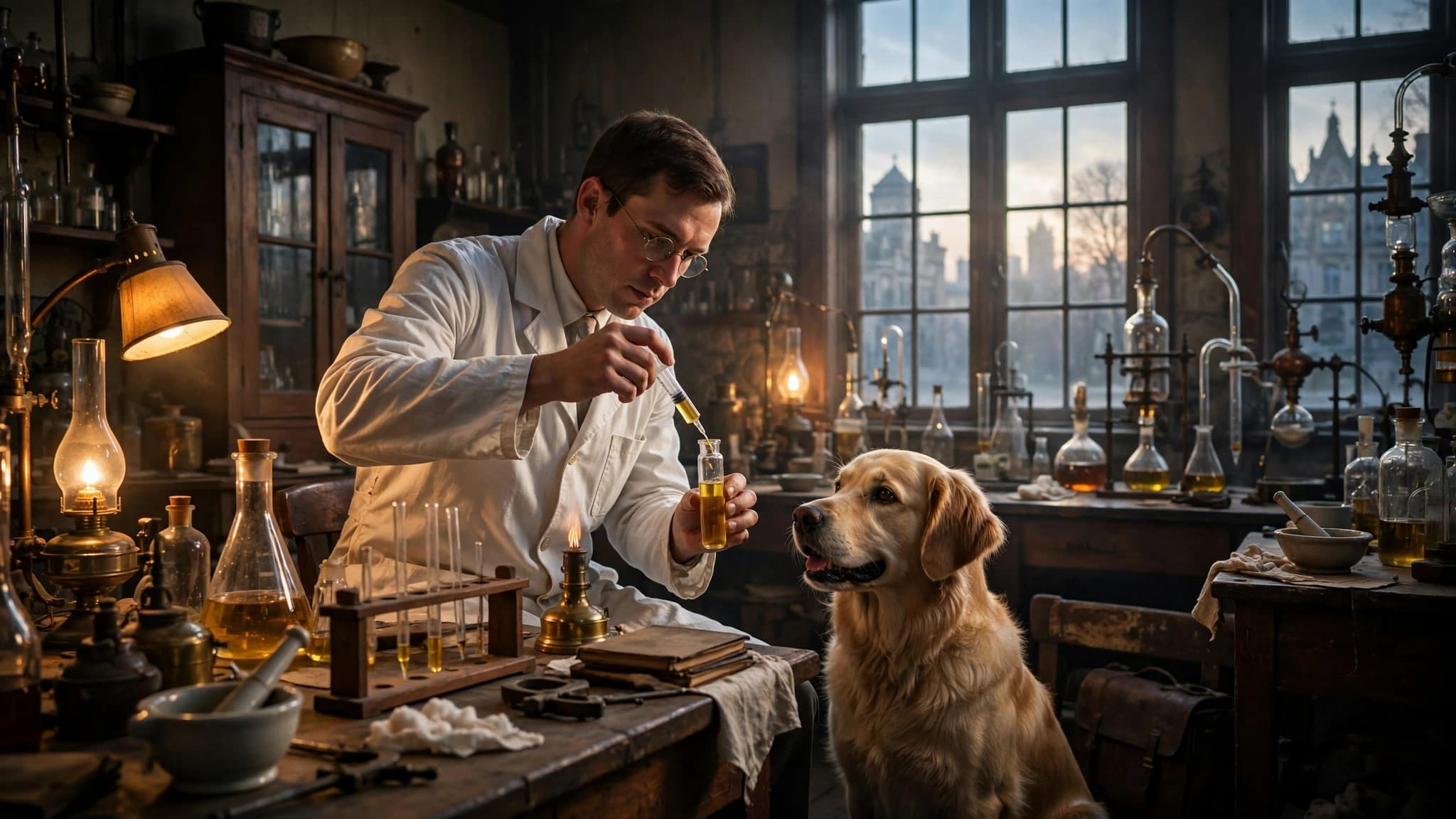
On October 31, 1920, in the small hours of the night, a failed surgeon woke from a fitful sleep and scribbled 25 words into his notebook: "Tie off pancreas ducts of dogs. Wait six or eight weeks. Remove and extract." Frederick Banting had never run a laboratory experiment. Within a year, that midnight note had turned one of medicine's most hopeless diagnoses into a treatable condition.
Before insulin, type 1 diabetes was a death sentence delivered in slow motion. Without the hormone that lets the body burn glucose, blood sugar climbed, the body began consuming itself, and patients — often children — wasted away. The only treatment on offer was a starvation diet that bought a few miserable months. As one medical museum notes, the disease was "usually fatal, particularly its Type I (juvenile) variant." The most important 25 words in Canadian medical research would change that within a single calendar year.
The Midnight Idea
Banting was not a researcher. He was a Canadian surgeon with no lab space, no research experience, and a struggling practice. But in October 1920 he read a journal article that caught his imagination: it suggested that the insulin-producing cells of the pancreas — the islets of Langerhans — deteriorate more slowly than the rest of the organ's tissue. Banting's leap of logic was simple and surgical: if you could let the digestive part of the pancreas wither away while preserving the islets, you could grind up what was left and extract the life-saving hormone from the wreckage.
On November 7, 1920, he knocked on the door of John Macleod, the University of Toronto's top physiology professor and an international authority on diabetes. Macleod was openly skeptical — the idea looked like a long shot — but he gave Banting a laboratory, a few dogs, research supplies, and an assistant: medical student Charles Best, who had won a coin toss for the job. Then Macleod went on summer vacation.
On May 17, 1921, Banting and Best began. Their plan was brutally literal: tie off the pancreatic ducts of dogs, wait six to eight weeks for the enzyme-producing tissue to atrophy, then remove the shrunken pancreas and extract the surviving islet cells. They then made other dogs diabetic by removing their pancreases entirely, and injected them with the extract to see if blood sugar fell.
The first trial was a disaster. In July 1921, after injecting the extract into a diabetic dog, blood sugar dipped slightly, then rose; the dog fell into a coma and died. But the pair kept refining the process — adjusting doses, improving the extract — and by August their notebooks were recording what every researcher dreams of seeing: repeated, measurable drops in blood sugar in diabetic dogs. The midnight idea was working.
From "Thick Brown Muck" to a Human Injection
There was still a chasm between a working dog extract and a medicine safe for children. The early pancreatic extract was, in one colleague's description, "thick brown muck" — crude, impure, and full of toxic contaminants. Injecting it into a person risked fever, abscesses, and worse.
That is where the third member of the team entered. Macleod recruited James B. Collip, a biochemist from the University of Alberta who was on sabbatical in Toronto, with a single job: purify the extract. Using alcohol-based extraction, Collip coaxed the active hormone out of the brown sludge and into something clean enough for human trials.
The team first reported its dog findings on December 30, 1921, at the American Physiological Society in New Haven — to a muted, skeptical reception. Two weeks later, they rolled the dice on a human being. On January 11, 1922, at Toronto General Hospital, 14-year-old Leonard Thompson became the first person to receive an insulin injection. He was 65 pounds, drifting in and out of consciousness, in the terminal stages of diabetes. Banting had first tested the extract on himself to check for danger. The injection caused abscesses; Thompson's blood sugar improved only slightly. The extract still wasn't pure enough.
Then Collip delivered. Within days he produced a dramatically purer preparation, and on January 23, 1922, Thompson received it. Within hours his blood sugar fell from 520 mg/dL to a near-normal 120 mg/dL, and the sugar vanished from his urine. For the first time in history, a case of diabetes had been treated pharmacologically. The team published in March 1922; in May, at the Association of American Physicians meeting in Washington, the Canadians were given a standing ovation. The boy who had weighed 65 pounds gained weight and strength. He lived to 27.
The Nobel Prize That Split Four Ways
In 1923, barely two years after the duct-ligation experiments began, the Nobel Prize in Physiology or Medicine went to Banting and Macleod. It was one of the fastest Nobel recognitions in the prize's history — and one of the most controversial.
Banting was furious. He believed the prize belonged jointly to him and Charles Best, his student partner in the laboratory trenches — not to Macleod, the department head who had been openly skeptical and spent that first summer on vacation. In protest, Banting shared his half of the prize money with Best. Macleod, for his part, split his half with Collip, the purifier. So the Nobel, nominally awarded to two men, was effectively split four ways — a quiet admission that the discovery had been a relay, not a solo sprint.
The team also made a decision that still echoes through medicine: they sold the patent rights for insulin to the University of Toronto for one dollar, so the drug could be mass-produced affordably and reach patients quickly. The university partnered with the drug maker Lilly, and by the end of 1923 commercial insulin was available. What had taken decades of failed attempts — doctors had even tried feeding patients fresh pancreas — was now manufactured from the pancreases of slaughtered cattle and pigs, and soon saved millions of lives.
Why the Story Still Matters
Insulin was not, and is not, a cure. It is a treatment: type 1 diabetes still demands daily management, careful dosing, and vigilance. But the discovery turned a death sentence into a chronic condition — and its origin story carries a lesson about how science actually happens.
It was not a lone genius in a flash of insight. It was a surgeon with a midnight note, a student who won a coin toss, a vacationing professor who supplied the dogs, and a visiting biochemist who cleaned up the brown muck. It involved a dead dog in July 1921, an impure first injection that nearly derailed human trials, and a prize committee that got the credit wrong enough that the winners had to fix it themselves.
A century on, insulin is made in bioreactors rather than slaughterhouses, and the discovery is counted among the greatest medical breakthroughs in history. But the heart of the story is still those 25 words — scribbled in the dark, tested on dogs, refined in months of failure — that taught a failing pancreas's hormone to a waiting world.
Like discoveries born from unlikely accidents? Read about Fleming's moldy petri dish and the invention that came from a melting chocolate bar — and see how the molecule of life was itself unraveled just decades later.