Lucy: The Fossil That Rewrote Human Origins
In 1974 a forearm bone from an Ethiopian gully became Lucy — a 3.2-million-year-old skeleton proving our ancestors walked upright long before brains grew large.
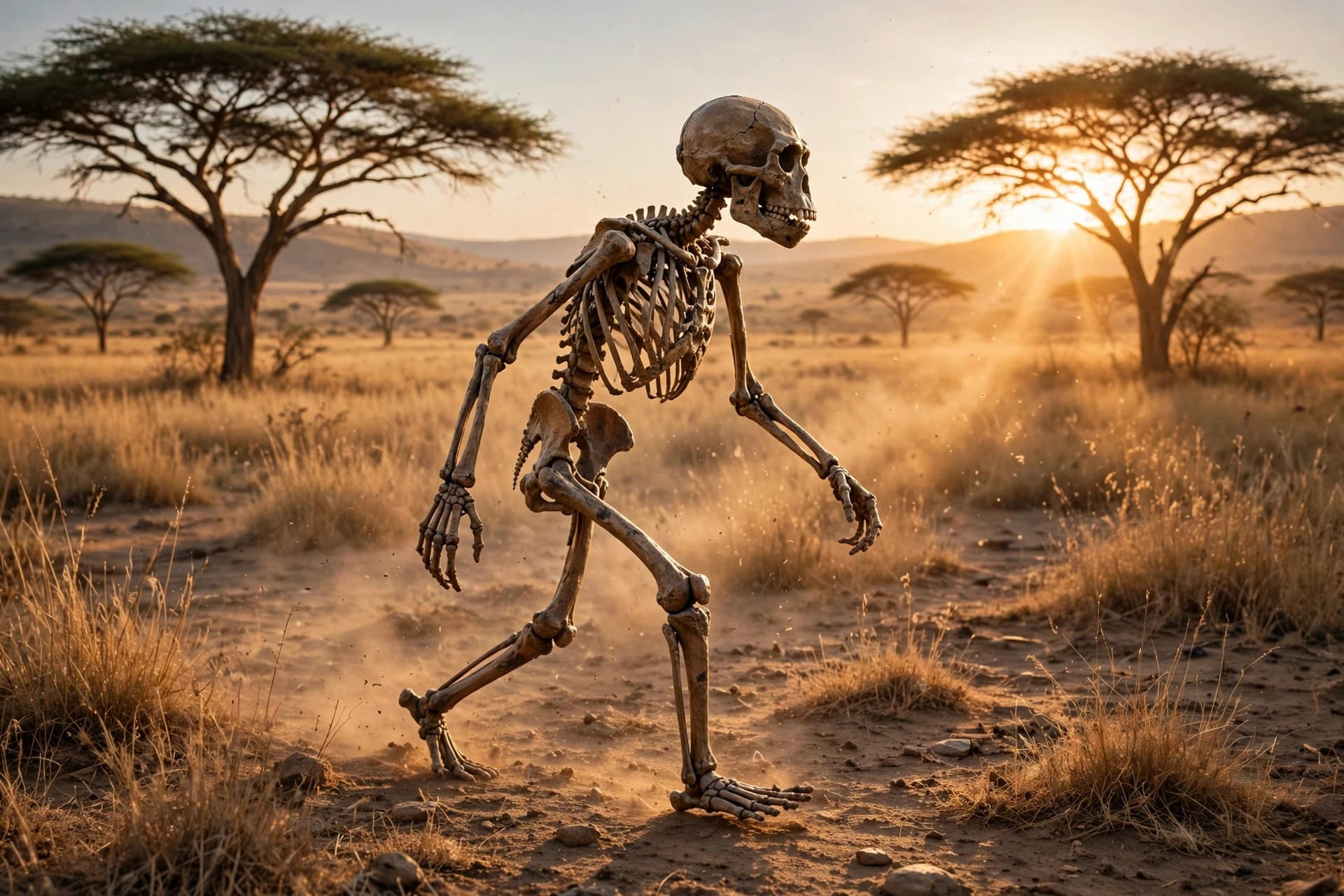
On November 24, 1974, paleoanthropologist Donald Johanson spotted a small forearm bone eroding from a hillside in Ethiopia's Afar Triangle. Three weeks of excavation recovered some 47 bones — about 40 percent of a single skeleton, 3.2 million years old, a female of the species that would be named Australopithecus afarensis. Nicknamed Lucy after the Beatles song playing at the expedition camp that night, she rewrote the story of human origins by proving the unthinkable: our ancestors walked upright long before their brains grew large.
Until Lucy, most researchers assumed the human brain led the evolutionary parade — that a swelling intellect came first and upright walking followed. Lucy flipped the sequence. Her skull was small and apelike, but her pelvis, knees, and feet were built for walking on two legs. Thinking came later; walking came first.
A Forearm Bone in a Dry Gully
Johanson was not digging that day — he was surveying. Working with his graduate student Tom Gray at Hadar, in the Afar Triangle of the Awash Valley, he noticed a right proximal ulna (a forearm bone) protruding from the sediment. He recognized it immediately as hominin. That evening the team celebrated; according to expedition lore, the fossil was nicknamed Lucy when Pamela Alderman suggested naming it after "Lucy in the Sky with Diamonds," the Beatles song playing loudly and repeatedly on the camp's tape recorder.
Over the next three weeks, in searing heat, the team recovered several hundred bone fragments — skull pieces, ribs, vertebrae, a pelvis, arm and leg bones, a lower jaw — with no duplication of parts, confirming they belonged to one individual. The find, catalogued as AL 288-1, was dated to about 3.2 million years ago using volcanic ash layers in the Hadar formation. For paleoanthropology, it was staggering: the oldest, most complete early human skeleton ever found, in an era when the next-oldest skeletons dated to only around 100,000 years ago.
Johanson identified the skeleton as female from the shape of the pelvis. In Ethiopia she is also known as Dinkinesh — Amharic for "you are marvelous."
The Brain That Didn't Matter Yet
Lucy was a full-grown adult, yet she stood just over a meter tall — about 1.1 meters, roughly three feet six — and weighed around 29 kilograms. Her brain was about a third the size of a modern human's, no bigger in spirit than an ape's. If human evolution had been led by intelligence, Lucy should not have existed: here was a creature with an ape's brain and a human's walk.
And she walked. Her short, broad pelvis, her angled thigh bones, her human-like knee joint — all of them said bipedalism, plainly and certainly. The curvature of her hip bones put her leg muscles in exactly the configuration needed to pull a femur forward in an upright stride. Modern computer models of her leg muscles have since shown she could stand and walk upright as proficiently as we do. Like the famous finds at the Terracotta Army site, where fragments assembled into an astonishing whole, Lucy's scattered bones assembled into a complete and unexpected picture of our past.
Footprints in Volcanic Ash
Lucy's claim was so bold that it needed independent proof — and it arrived a few years later, a thousand kilometers away. In 1978, Mary Leakey's expedition at Laetoli, Tanzania, uncovered a 70-meter trail of footprints pressed into wet volcanic ash some 3.6 million years ago and hardened like concrete as the ash set. The prints showed a pronounced arch, a well-defined heel, and a big toe aligned with the others — a foot built for upright walking, with the heelstrike-and-toe-off pattern of modern humans.
The Laetoli tracks, attributed to Australopithecus afarensis — Lucy's own species — were the oldest unequivocal evidence of hominin bipedalism at the time. Two independent lines of evidence, bones and footprints, told the same story: by more than three million years ago, our relatives were striding across Africa on two legs with brains no larger than an ape's. Bipedalism, not brains, was the first great human innovation.
Selam and the Tree Question
Lucy's story kept growing. In 2000, Ethiopian paleoanthropologist Zeresenay Alemseged discovered "Selam" in Ethiopia's Dikika region — an astonishingly complete skeleton of an A. afarensis child, some 3.3 million years old, that took eleven years to free from its sandstone tomb. When her shoulder blades were finally analyzed, a 2012 study in Science revealed they were strikingly apelike, angled like a climbing ape's. Lucy and her kind, it turned out, lived in two worlds: upright walkers on the ground, skilled climbers in the trees, gathering fruit and sleeping beyond the reach of predators.
This is what makes Lucy more than a museum icon. A partial fossil can tell you what a creature looked like; a 40-percent skeleton lets you reconstruct how it lived. Her long, curved fingers, her climbing shoulders, her walking hips — together they describe a species that was genuinely at home in both the woodland canopy and the open savanna. She was not a halfway failure between ape and human. She was a complete, successful animal in her own right.
Why Lucy Still Matters
Half a century after her discovery, older human relatives have been found — Ardipithecus ramidus ("Ardi," 4.4 million years old) and others — and Lucy's exact place on the family tree is debated. But no find has displaced her significance. She is the fossil that fixed the order of events: first walking, then thinking. She nearly doubled the known age of our upright ancestors in a single stroke, and she remains one of the most complete early hominin skeletons ever recovered.
The originals are kept safe at the National Museum of Ethiopia; museums worldwide display casts. But the real Lucy lives in a single rearranged sentence of human history: we did not stand up because we got smart. The Rosetta Stone decoded a lost language; Lucy decoded the order of our own becoming. We got smart, perhaps, because we stood up — freeing our hands, changing how we moved through the world, and beginning a long walk that led, eventually, to us. She remains, five decades on, the fossil that taught us the order of our own making.