What Is a Fog Bow, the White Rainbow With No Colors?
What is a fog bow? Fog droplets about 100 times smaller than raindrops smear sunlight into a white arc. The science of the white rainbow, and how to spot one.
Key takeaways
- A fog bow is a rainbow formed in fog droplets about 50 micrometers wide, roughly 100 times smaller than raindrops.
- Diffraction smears sunlight's colors together, so the bow looks white instead of showing a spectrum.
- You need thin fog with the sun low at your back; look toward mountain valleys, snowfields or cold sea mist.
- It is a primary rainbow, not a halo: halos come from ice crystals, fog bows from water droplets.
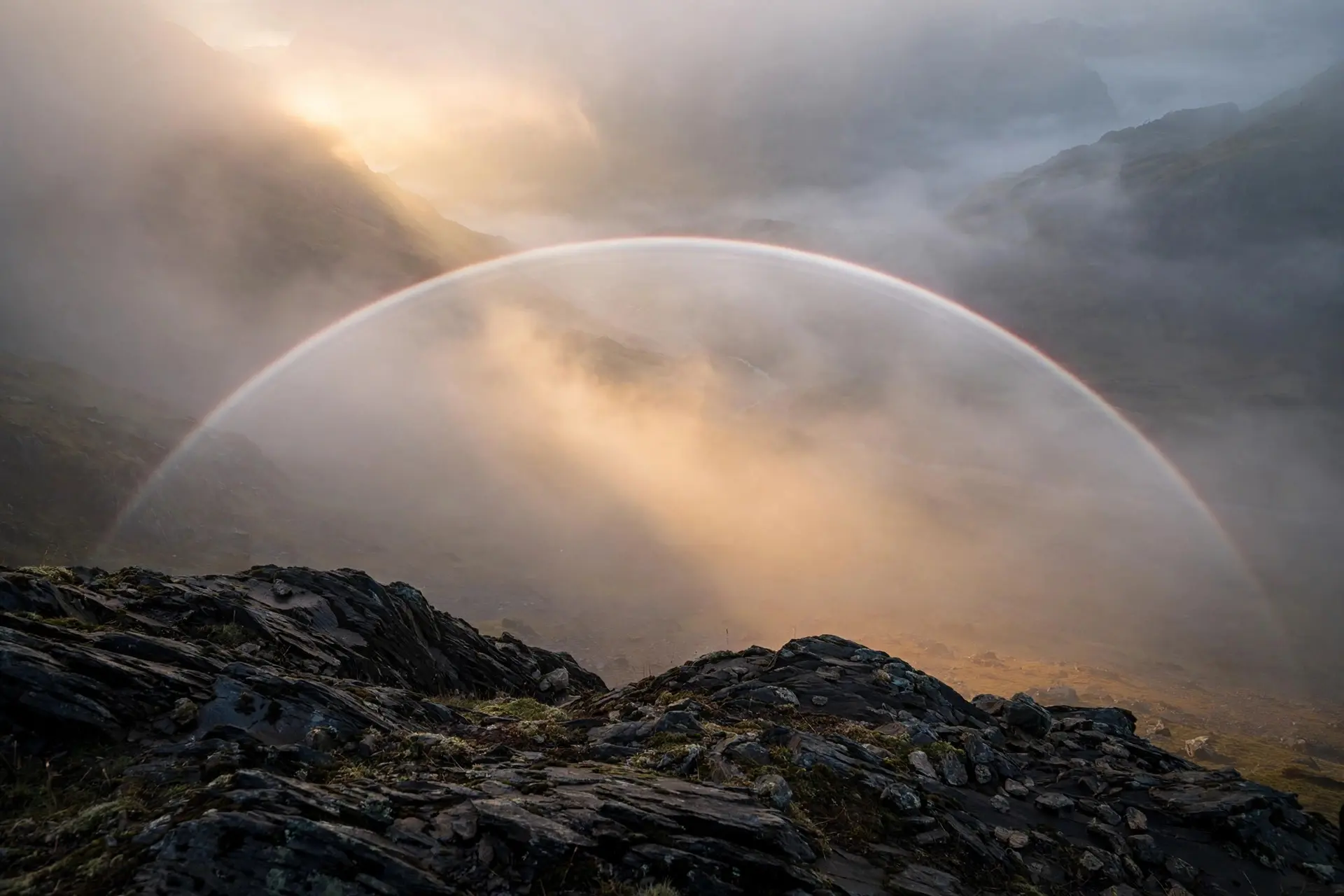
A fog bow is a rainbow with its colors washed out. Sunlight striking fog droplets roughly 100 times smaller than raindrops gets smeared by diffraction instead of split cleanly, so all the colors overlap into white. The result is a pale, ghostly arc that appears in fog when the sun sits low behind you.
What is a fog bow?
A fog bow is the same optical trick as a rainbow, performed in fog instead of rain. Sunlight enters the tiny suspended droplets, bends, reflects off their inner walls, and heads back toward your eyes. The geometry is identical to a rainbow's: the sun behind you, the bow ahead, the whole display centered on the point exactly opposite the sun. What changes is the size of the stage. A fog bow goes by many names (mistbow, cloudbow, Bouguer's halo, Ulloa's ring, sea-dog, or simply white rainbow), and all of them describe the same phenomenon, seen most often from mountaintops or aircraft and only rarely in valley fog (Mount Washington Observatory). Ordinary rainbows get their colors because larger drops act like prisms: each wavelength of light exits at a slightly different angle, spreading sunlight into its spectrum. The full mechanics of that process are covered in our rainbow explainer. In fog, the droplets are too small to pull this off. Fog droplets are about 100 times smaller than plump raindrops, as National Weather Service meteorologist Brian Jackson told Popular Science, and the colors never separate cleanly. "Due to the small size of the droplets, the light waves don't spend enough time within the droplet to refract enough to separate cleanly and focus into colors," Jackson said. "So, they mostly continue to overlap, and appear white." (Popular Science) Fog itself has its own recipe, too: still air, a cooling ground, moisture pooling near the surface. Why fog hugs the ground on still mornings explains the part before the optics begin.
How does a fog bow differ from a regular rainbow?
The difference is entirely a matter of droplet size. The brightest rainbows form in drops between 300 and 1,000 micrometers across, according to atmospheric scientist Keith Heidorn. Shrink the drops below 300 micrometers and the red bands start to weaken in favor of the blues; below 30 micrometers the bow becomes faint and almost white. Fog droplets sit right in that last range, and clouds do too, which is why bows seen in fog or cloud are called fogbows or cloudbows (The Weather Doctor). Mount Washington Observatory staff meteorologist Ryan Knapp, who has watched fog bows from the summit for years, puts the typical fog droplet at about 50 micrometers, thousands of times thinner than a human hair, against raindrops of a few millimeters or more. The larger drops of a rainstorm refract and reflect light into a spectrum; the smaller droplets diffract and reflect it instead. Diffraction bends the light waves inward so they interfere with each other, creating bands of bright white and dark white rather than bands of color: a "false spectrum," as Knapp calls it (Mount Washington Observatory).
| Rainbow | Fog bow | Glory | |
|---|---|---|---|
| Water droplets | Raindrops, 300-1,000+ micrometers | Fog droplets, about 50 micrometers | Fine mist or cloud droplets |
| Colors | Full spectrum, red outside | White, with a faint red or bluish tinge at the edges | Pale colored rings |
| Main process | Refraction and internal reflection | Diffraction smears the colors together | Backward scattering and diffraction |
| Shape | Arc up to 42 degrees from the antisolar point | Broader, larger, brightest at a slightly different angle | Tight rings around the observer's own shadow |
| Fog bows tend to be larger than rainbows and reach maximum intensity at a different angle, which is one reason they catch you off guard: you expect a rainbow's tight arc and get something wider and paler instead. |
Where can you actually see a fog bow?
The checklist is strict. The fog must be thin enough for bright sunlight to pierce it, and the sun must be at your back and fairly low. The Royal Meteorological Society notes that fog bows show up most often over snow, in mountains, and in cold sea mists, and they can be hard to see even then, so look closely (Royal Meteorological Society).
That is why mountaintops and aircraft dominate the sightings. Knapp's fog bow over Mount Washington in October 2010 is typical: cold air, thin fog, and a bright sun all arriving at once. Aircraft passengers get the best view of all, because from altitude you can sometimes see the complete circle instead of just the arc the horizon cuts off. One of the best-known modern photographs came from Rannoch Moor in Scotland, where photographer Melvin Nicholson watched a white rainbow form as the rising sun burned off the morning mist. He had spent 10 years photographing landscapes around the world and had never seen one (Popular Science). His story is a useful warning for hunters: fog bows are not rare in nature, but they are rare in human experience, because you have to be in thin fog, facing the right direction, at the right sun angle, and actually looking.
What do people get wrong about fog bows?
The most common mistake is calling a fog bow a halo. They are different machines. The World Meteorological Organization's International Cloud Atlas describes the fog bow plainly as a primary rainbow, just one that "typically appears as a white band, lacking the spectrum of colours since it is formed by very small water droplets." Halos come from ice crystals, and you can read about glories, halos and sun dogs for the ice-crystal side of the family. A fog bow is water all the way down. A second mistake is treating the bow as an object fixed in the sky. Like every rainbow, a fog bow is personal. Stand side by side with a friend and you are looking at two different bows, because each set of eyes gets its light from a different collection of droplets. The bow also appears to move with you when you walk, which has fooled generations of hikers into chasing it. A third mistake is assuming thick fog is better. It is the opposite: the fog must be thin. If the sun cannot burn through the mist, there is no bow. Thin sea mist at sunrise, snowfields clearing after a cold night, a mountain ridge poking through a valley inversion: those are the hunting grounds. A fog bow rewards patience and punishes expectations. Go out looking for a rainbow and you will walk past a dozen fog bows without registering them. Learn to spot the white ghost, and suddenly foggy mornings get interesting. How we made this article: FactSpire researched and drafted it with AI assistance and checked every fact against the sources listed above.
Frequently asked questions
Is a fog bow the same as a glory?
No. A fog bow is a primary rainbow stretched wide and drained of color, while a glory is a tight set of pale rings centered on the antisolar point. The two often appear together, which causes the confusion, but the glory comes from backward scattering and diffraction, and a fog bow is simply the rainbow's arc seen in tiny droplets.
Can I see a fog bow from my backyard?
Only in the right fog. The mist must be thin enough for sunlight to pierce it, and the sun must be low behind you. Valley fog rarely cooperates, which is why most sightings happen on mountaintops, in aircraft, or along coastlines where cold sea mist meets morning sun.
Why does a fog bow look bigger than a rainbow?
It reaches its maximum brightness at a slightly different angle than a rainbow and spreads wider across the sky. The smaller droplets scatter light over a broader band, so the bow looks chunky and diffuse. The full ring, which the ground cuts off, is sometimes visible from an airplane.
Does a fog bow show any color at all?
Sometimes a faint red edge or bluish tinge survives at the rim, and when the droplets are nearly identical in size, stronger colored rings called supernumeraries can appear inside the main bow. Most of the time, though, the colors overlap so completely that the human eye reads the result as plain white.
Sources
- Fogbow!, Mount Washington Observatory
- What the heck are white rainbows, and where do they come from?, Popular Science
- Weather Elements: Rainbows, The Weather Doctor
- Weather Photographer of the Year: Setting the scene - optical phenomenon, Royal Meteorological Society