What Are Gravitational Waves, and How Were They Found?
Ripples in spacetime, predicted by Einstein in 1916 and caught by LIGO in 2015 — by sensing a 4-km arm change less than a proton's width. A new cosmic sense.
Key takeaways
- Gravitational waves are ripples in spacetime itself, caused by massive objects moving with extreme acceleration.
- Einstein predicted them in 1916; LIGO made the first direct detection on September 14, 2015.
- LIGO's 4-km arms change length by less than 10,000 times a proton's diameter — like measuring an Earth-to-Alpha-Centauri shift by a hair's width.
- The 2015 signal came from two black holes, 36 and 29 solar masses, merging 1.3 billion light-years away.
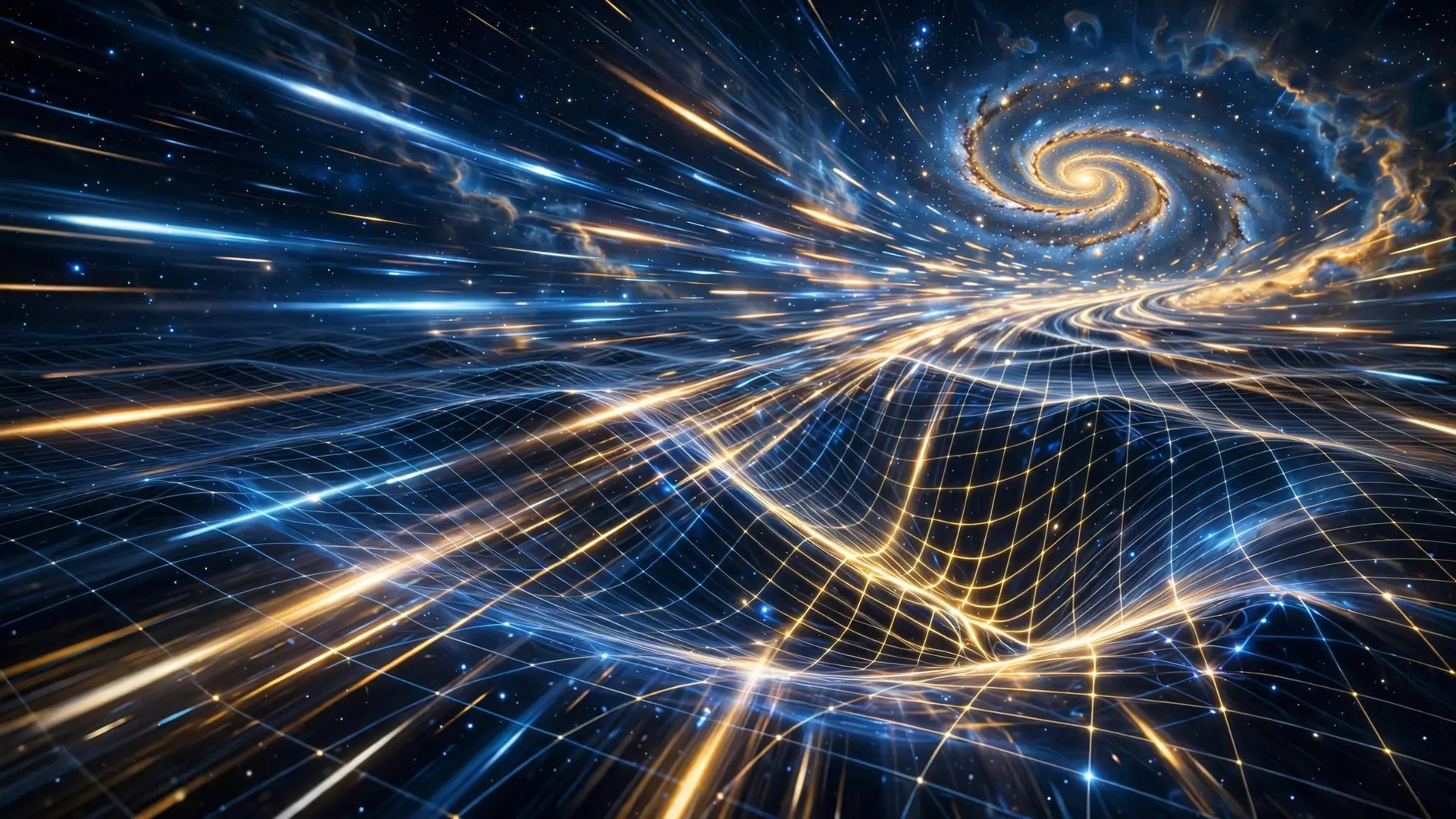
On September 14, 2015, two detectors 3,000 kilometers apart twitched in unison. The twitch was absurdly small: each machine's 4-kilometer arm changed length by less than ten-thousandth of a proton's diameter. But the pattern matched a century-old prediction, and the source was two black holes merging 1.3 billion light-years away. For the first time, humanity had felt a ripple in spacetime itself. Gravitational waves are exactly that: ripples in the "fabric" of the universe, caused by massive objects moving with extreme acceleration — black holes or neutron stars spiraling together and colliding, lumpy rapidly rotating neutron stars, supernovae. They travel at light speed in all directions, weaken with distance, and pass through everything in their path. Nothing blocks them, which is precisely what makes them so hard to catch and so valuable once caught.
What did Einstein actually predict in 1916?
Einstein's general relativity describes gravity not as a force but as curvature in spacetime. If spacetime can curve, Einstein realized, it can also ripple — and accelerating masses should radiate those ripples outward like a stone dropped in a pond. The math was clear. The catch was scale: the ripples from ordinary events would be so faint that detecting them seemed impossible for generations. He was right about the wait. Direct confirmation took nearly a century. Astronomers found indirect evidence first — a 1970s binary pulsar system whose orbit was decaying exactly as gravitational-wave energy loss predicted — but nobody had ever sensed a wave itself.
How do you measure something smaller than a proton?
LIGO — the Laser Interferometer Gravitational-Wave Observatory — works by splitting a laser beam down two 4-kilometer vacuum tubes arranged in an L, bouncing the light between mirrors, and recombining it. A passing gravitational wave stretches one arm and squeezes the other by a minuscule amount, shifting the light's interference pattern.
The sensitivity is the story. The detectors sense changes 10,000 times smaller than a proton's diameter — the National Science Foundation's own figure, deliberately rounded. The classic analogy: it is like measuring a change in the distance from Earth to Alpha Centauri as small as the thickness of a human hair. Nothing in human engineering had ever been measured this finely — and the machines had to hold that precision for years, waiting for a signal that might arrive once a month, or once a year. The two observatories — Hanford, Washington and Livingston, Louisiana — operate in unison precisely so that a local disturbance (a truck, a tremor) cannot fake a signal: only a wave arriving at both, milliseconds apart, counts.
Why is detecting them so hard?
The universe is loud in gravitational waves — black holes merge regularly — but each signal is absurdly faint by the time it reaches Earth, because the waves weaken with distance. By the time GW150914's ripples arrived, they were changing the length of LIGO's 4-kilometer arms by less than ten-thousandth of a proton's diameter. Detecting that is not a measurement problem; it is a noise problem. Everything shakes the detectors: trucks on nearby roads, ocean waves pounding distant shores, tiny thermal vibrations in the mirrors, even the quantum graininess of the laser light itself. LIGO's engineers spent decades building systems to subtract all of it — seismic isolation, ultra-stable lasers, mirrors polished to atomic smoothness. The two observatories operate in unison precisely so that a local disturbance cannot fake a signal: only a wave that arrives at both sites, milliseconds apart, traveling at the speed of light, counts as a detection. That discipline is why the first detection was so convincing. The signal swept upward in frequency exactly as two spiraling black holes should sound — a "chirp" lasting a fraction of a second — and it appeared in both detectors with the right time delay. When Virgo joined the network later, three-detector observations began pinning down where in the sky the waves came from.
What was the first signal, GW150914?
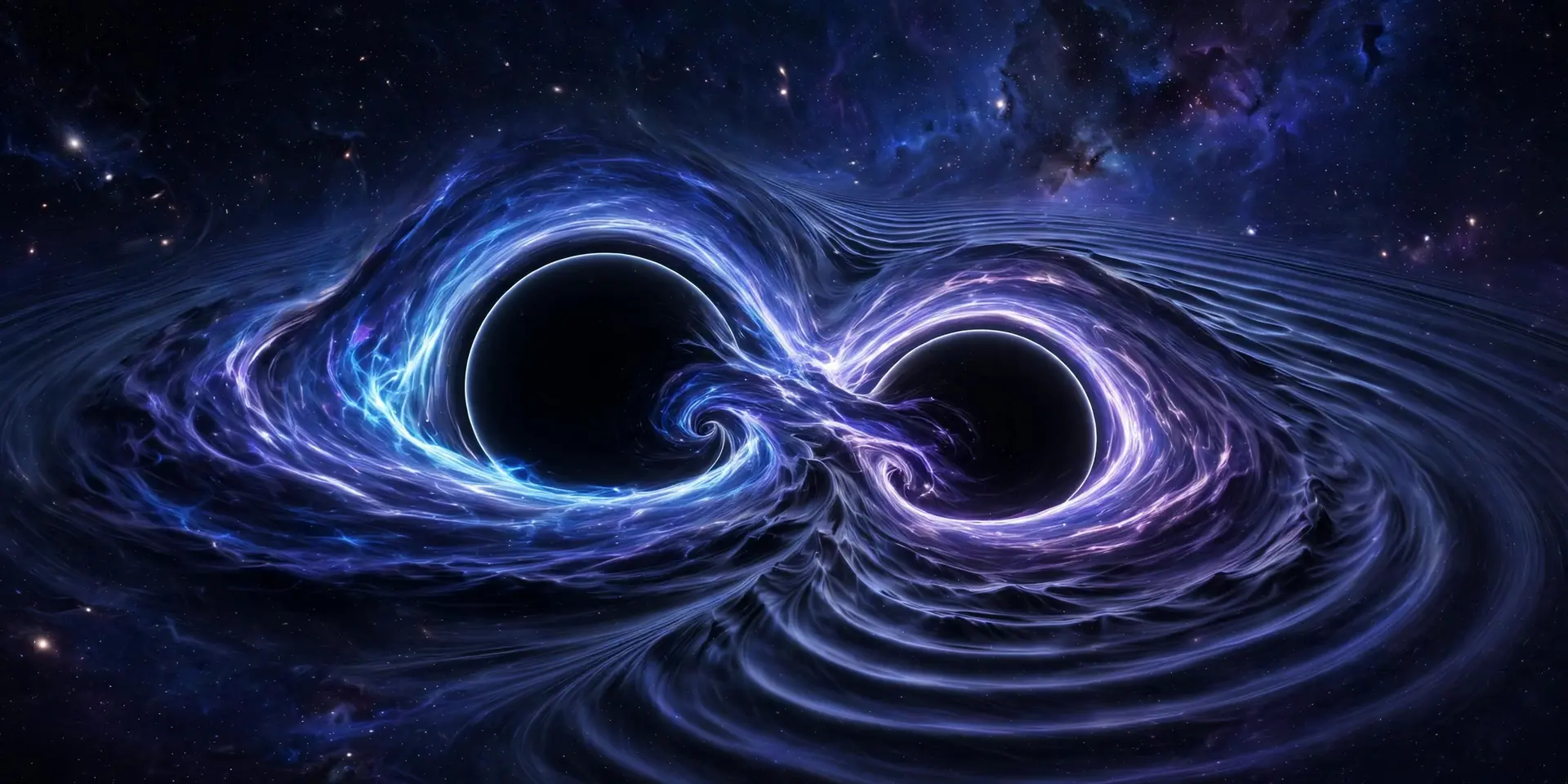
The first direct detection arrived on September 14, 2015, and was announced on February 11, 2016. Designated GW150914, it was the merger of two black holes — about 36 and 29 times the mass of the Sun — forming a single remnant of about 62 solar masses, some 1.3 billion light-years away. The numbers strain comprehension. In under 20 milliseconds, the merger radiated more energy than roughly three suns emit over billions of years — as gravitational waves, carrying away the three solar masses of difference between the two parent black holes and the 62-solar-mass remnant. Three suns' worth of mass, converted in a blink into pure shaking of spacetime. No light, no heat — just ripples, spreading at the speed of light through a universe that barely noticed them passing. The event was also the first observed binary black-hole merger, confirming that such systems exist and collide. Europe's Virgo detector later joined the network; the 2017 neutron-star collision was caught with Virgo's help — the young network's first big catch after the black-hole debut. The 2017 Nobel Prize in Physics went to Rainer Weiss, Barry Barish, and Kip Thorne for the LIGO detector and the observation — three scientists who had spent decades, essentially their careers, building the case that such a detector could work at all.
Why do gravitational waves matter?
Because they are a new sense. Everything astronomers knew before came from light — electromagnetic waves that can be blocked, scattered, or drowned out. Gravitational waves pass through everything, carrying information from places light cannot reach: the inside of a supernova, the final inspiral of two black holes, the first fractions of a second of the universe. Like dark energy's hidden push on the cosmos, gravitational waves reveal a universe that behaves on scales our instincts cannot touch. A century after Einstein's prediction, we have finally started listening to the part of the universe that moves instead of shines — and the first thing it told us was that black holes collide, in the dark, more often than we ever guessed.
Frequently asked questions
What are gravitational waves?
Ripples or vibrations in spacetime — the 'fabric' of the universe — caused by massive objects moving with extreme acceleration, such as black holes or neutron stars spiraling together and colliding. They travel at light speed in all directions and pass through everything in their path.
When were gravitational waves first detected?
On September 14, 2015, by the LIGO detectors in Hanford, Washington and Livingston, Louisiana. The discovery was announced on February 11, 2016. Einstein had predicted the waves in 1916 — direct confirmation took nearly a century.
How does LIGO detect gravitational waves?
Each LIGO detector is an L-shaped pair of 4-kilometer vacuum tubes. A passing wave stretches and squeezes the arms by an almost unimaginably small amount — less than 10,000 times a proton's diameter — and the detectors sense that change with laser interferometry.
Who won the Nobel Prize for gravitational waves?
The 2017 Nobel Prize in Physics went to Rainer Weiss, Barry Barish, and Kip Thorne for the LIGO detector and the observation of gravitational waves.