Why Is the Speed of Light the Universe's Speed Limit?
Light's 299,792,458 meters per second is more than a velocity — it's the universe's top speed. Here's the physics that keeps everything, always, below it.
Key takeaways
- Einstein's special relativity (1905) rests on the postulate that light speed in vacuum, c, is the same for every observer.
- Accelerating an object with mass toward c demands ever more energy; reaching c itself would need infinite energy, which is impossible.
- Light travels exactly at c because photons are massless — that is the only speed a massless particle can have in vacuum.
- Since 1983, c is defined as exactly 299,792,458 meters per second, and the meter is defined from it.
The speed of light is not just fast — it is the fastest anything can ever go, full stop. Einstein's special theory of relativity showed that light's velocity, about 299,792,458 meters per second in empty space, is the same for every observer in the universe. And because anything with mass would need infinite energy to reach that speed, nothing material ever can.
What did Einstein actually claim about light?
In 1905, Albert Einstein built his special theory of relativity on two postulates, or starting assumptions. The first says the laws of physics are the same for all observers moving at steady speeds — there is no special "resting" vantage point in the universe. The second, the famous one, says the speed of light in a vacuum has the same value for every observer, no matter how the observer or the light source is moving. That second claim defies everyday intuition. If you shine a flashlight from a speeding train, you might expect the beam to travel at light speed plus the train's speed — the way a ball thrown from a train moves faster than one thrown from the platform. But careful experiments say otherwise: everyone, from the passenger to a bystander on the platform, measures exactly the same value, c. Einstein accepted this as a bedrock fact about reality and asked what else would have to be true if it were. The answers — time slowing for fast-moving objects, lengths shrinking in the direction of motion, and the equivalence of mass and energy in E=mc² — fell out of that single assumption. Einstein was not the first to notice light's strange speed. In the 1860s, James Clerk Maxwell's equations of electromagnetism predicted that electromagnetic waves propagate through empty space at one fixed speed — roughly four decades before Einstein's paper. The implication that light speed was special was already sitting in the mathematics; Einstein's leap was to trust it completely.
Why can't anything with mass reach light speed?
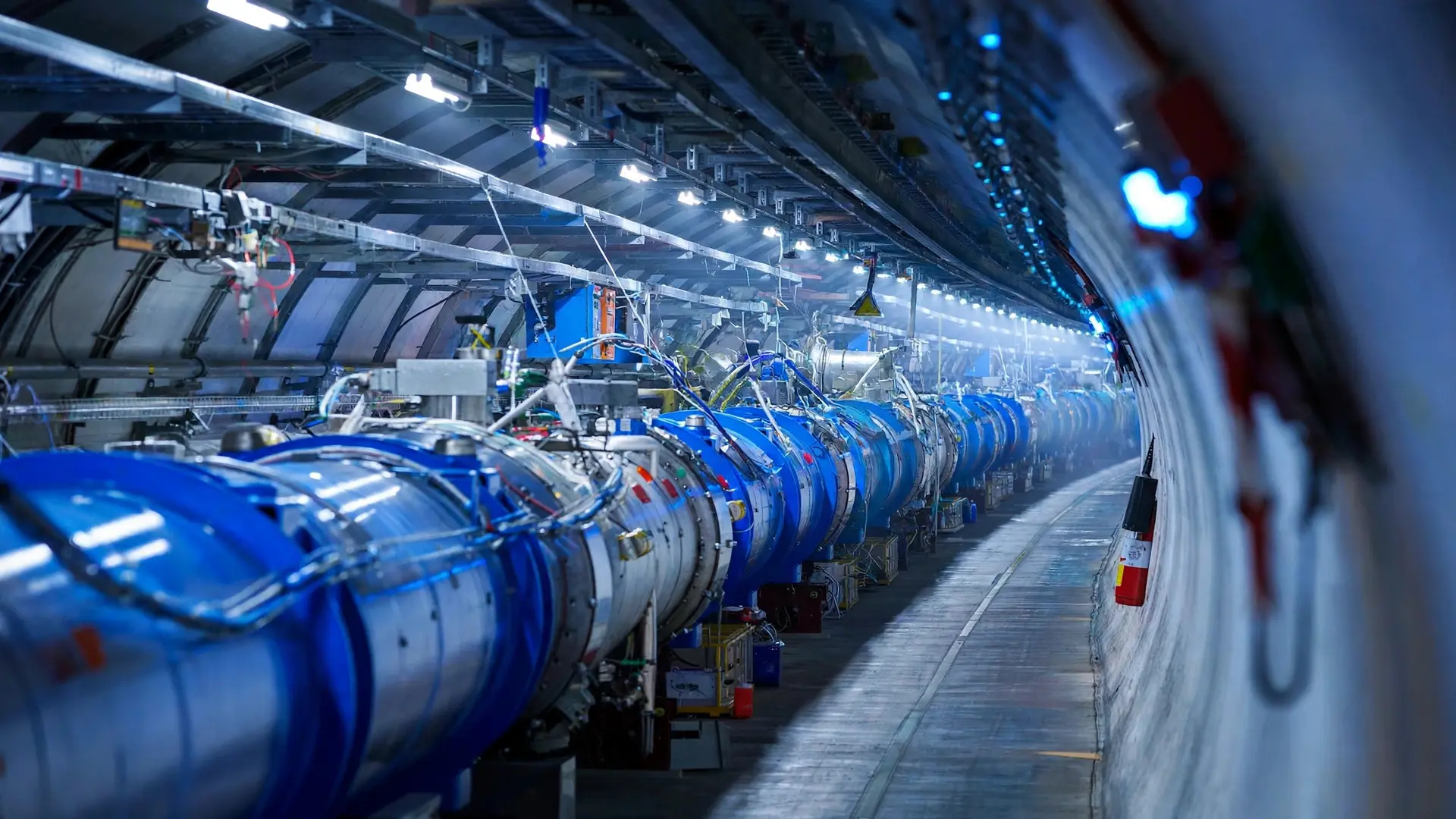
The barrier is not a wall in space but a rule about energy. The closer an object with mass gets to c, the more energy it takes to accelerate it further, and that energy shows up as added inertia — the object resists further pushes ever more strongly. Push toward c and the price of each extra increment of speed keeps rising. To actually arrive at c would require an infinite amount of energy, which the finite universe cannot supply. So massive particles can approach c as closely as their energy budgets allow — the protons at CERN's Large Hadron Collider reach 99.9999991 percent of light speed — but they can never reach it, let alone exceed it. This is why the limit is often phrased as a rule about information as well as matter: nothing carrying a signal can outrun light, which keeps cause and effect in their proper order. In relativity, that order — the arrow of time — depends on the limit holding. Even the strangest real objects obey it: a black hole's gravity is strong enough to trap light itself, yet it does so without anything crossing the barrier.
Why does light itself move exactly at c?
Because it has no choice. A photon, the quantum of light, is a massless particle, and traveling at c is simply the only speed available to something with zero mass in a vacuum. An everyday analogy: the less weight you carry on a bicycle, the faster you can ride, and with zero load you would instantly be at your maximum. A photon starts with no load at all. Crucially, a photon never speeds up or slows down in empty space — it is simply born moving at c. Its energy can vary (a high-energy gamma-ray photon and a faint radio-wave photon both travel at precisely c), but its speed cannot. That is what distinguishes light from everything else in the universe: massless things must move at the speed limit, and everything else must stay below it.
How did we learn the exact number?
Measuring something this fast took centuries of ingenuity. One of the great measurers was Albert A. Michelson, who made the speed of light a lifetime project. His early 1879 experiment at the U.S. Naval Academy used rotating mirrors and a carefully surveyed baseline to get about 299,940 kilometers per second. In 1926, between Mount Wilson and Mount San Antonio in California, he bounced light off an eight-sided spinning mirror across some 22 miles of terrain that surveyors had measured down to the millimeter — and reached 299,796 kilometers per second, astonishingly close to today's value. His famous 1887 experiment with Edward Morley failed to detect any "ether wind" — light's speed proved identical in every direction — and that null result was one of the sparks that made Einstein's 1905 leap possible. Then, in 1983, science did something unusual: it stopped measuring. The General Conference on Weights and Measures defined the speed of light in vacuum as exactly 299,792,458 meters per second, and turned the definition around — the meter is now the distance light travels in vacuum in 1/299,792,458 of a second. The value is exact by international agreement, not by experiment. Improving our instruments no longer refines the number; it refines the length of the meter itself.
What would breaking the limit even mean?
Here is a common misconception: the speed limit applies to light in a vacuum, not everywhere. Light genuinely slows down in water and glass — it moves through window glass at roughly two-thirds of c — and that changes nothing about the universal barrier. Some exotic effects, like the quantum vacuum around antimatter experiments or the expansion of space itself, can look faster-than-light at first glance, but none of them carries matter or a signal past c. Space expanding faster than light between distant galaxies is allowed because the galaxies are not moving through space at that speed — no information crosses the barrier. Breaking the barrier for real would break something deeper than speed records: causality. If a signal could arrive before it was sent, causes could follow their effects, and physics has no framework for that. The speed of light is therefore better thought of not as a velocity but as the conversion factor between space and time — the fixed exchange rate of spacetime itself. Light travels at c because it is massless; everything else travels below c because energy is finite; and the universe's story, from the light of the Sun reaching your eyes eight minutes after it left to the oldest starlight arriving from billions of years ago, is written in the delay that c enforces. The speed limit is not a rule someone imposed on the cosmos. It is the shape of the cosmos.
Frequently asked questions
What exactly is the speed of light?
In vacuum it is exactly 299,792,458 meters per second — about 300,000 kilometers per second. Light travels more slowly through materials like water or glass, but its vacuum speed never changes.
Does anything in the universe travel faster than light?
No known matter, energy, or information does. Faster-than-light travel would break causality — the rule that causes must come before effects — so physics treats the barrier as absolute.
How long does light take to reach Earth from the Sun?
About eight minutes. That means you always see the Sun as it was eight minutes ago; light from the Moon takes about 1.3 seconds to arrive.
Who first proposed that light speed is a universal limit?
Albert Einstein, in his 1905 special theory of relativity. Maxwell's equations had already implied light's fixed speed decades earlier, but Einstein elevated that constancy into a law of nature.