How Coral Atolls Form: Darwin's Sinking-Island Theory
A coral atoll is the ghost of a volcano: the island sinks, the reef keeps growing upward, and a ring of coral is left behind. Darwin worked it out in 1842.
Key takeaways
- Charles Darwin proposed in 1842 that atolls form when a volcanic island slowly sinks while its surrounding coral reef keeps growing upward.
- Reefs pass through three stages — fringing reef, barrier reef, then atoll — as the island subsides over millions of years.
- Drilling at Enewetak Atoll in 1952 struck volcanic basalt 4,000 feet down, confirming Darwin's theory over a century later.
- Modern atolls face a new threat: if sea level rises faster than coral can grow upward, the reef drowns.
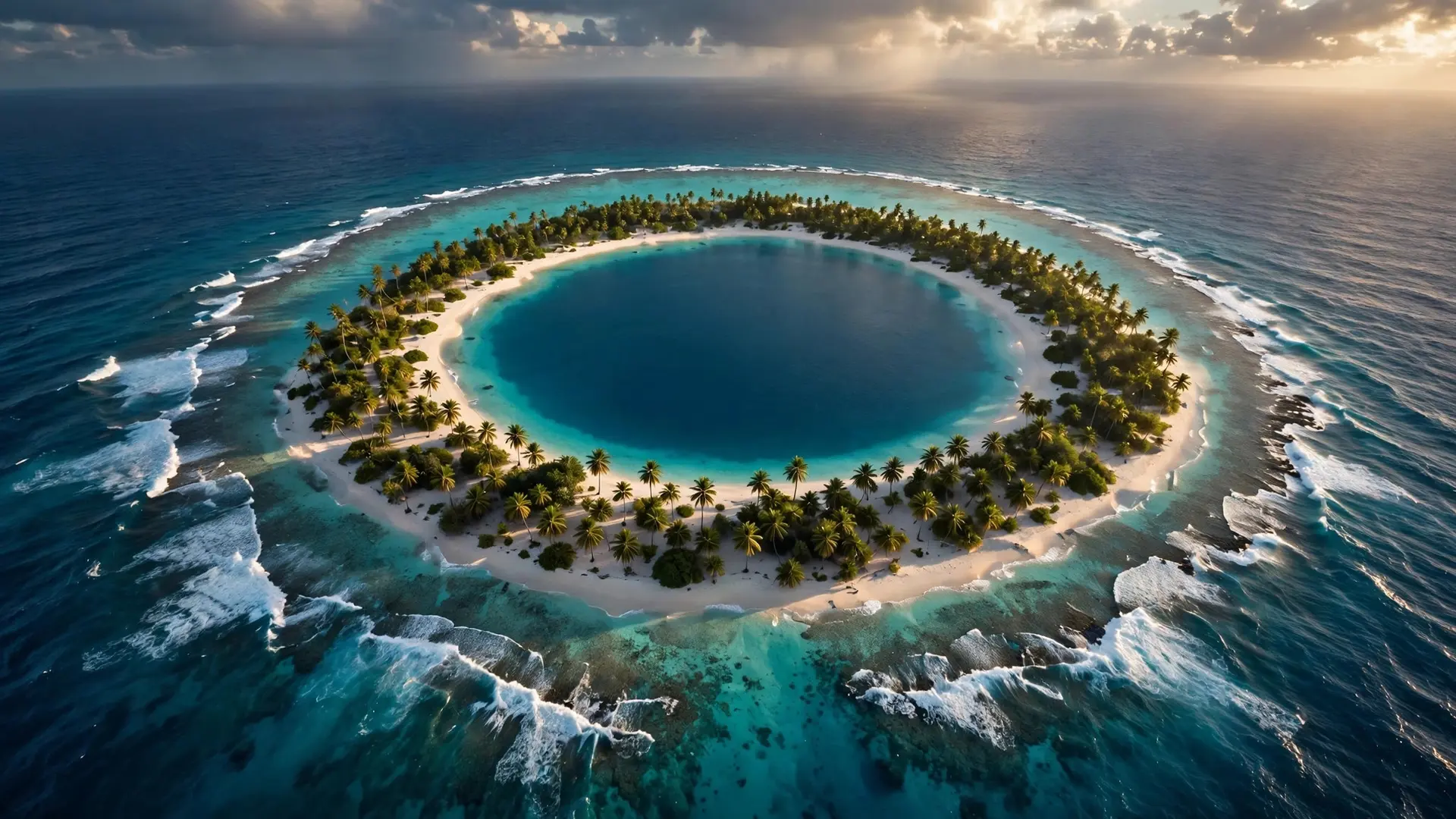
Seen from the air, a coral atoll looks impossible: a near-perfect ring of white sand and palm trees floating in the open ocean, enclosing a calm turquoise lagoon — with nothing underneath but deep water. There is no island at its center. The explanation is one of the great detective stories in science: every atoll is the ghost of a volcano, and the man who worked it out was Charles Darwin, years before he published a word about evolution.
What exactly is a coral atoll?
Atolls are, in NASA's description, long thin bars of white sand rising just a few meters above sea level, surrounding a hollow center where a volcanic peak once stood. The sand gets its pale color from the calcium-rich skeletons of coral and other reef creatures, ground down by waves over millennia. On top of that thin soil grows a spare cast of vegetation — coconut palms, taro, breadfruit trees — the classic tropical-island look. The key feature is the lagoon: a shallow, sheltered bowl of water where an island used to be. Most atolls are found in the warm tropical Pacific and Indian Oceans, and they sit so low that a person standing on one can barely see over the palms. They look delicate, and geologically speaking, they are — the whole structure is a living veneer of coral balanced on a drowned mountain.
How did Darwin solve the puzzle from a ship's deck?
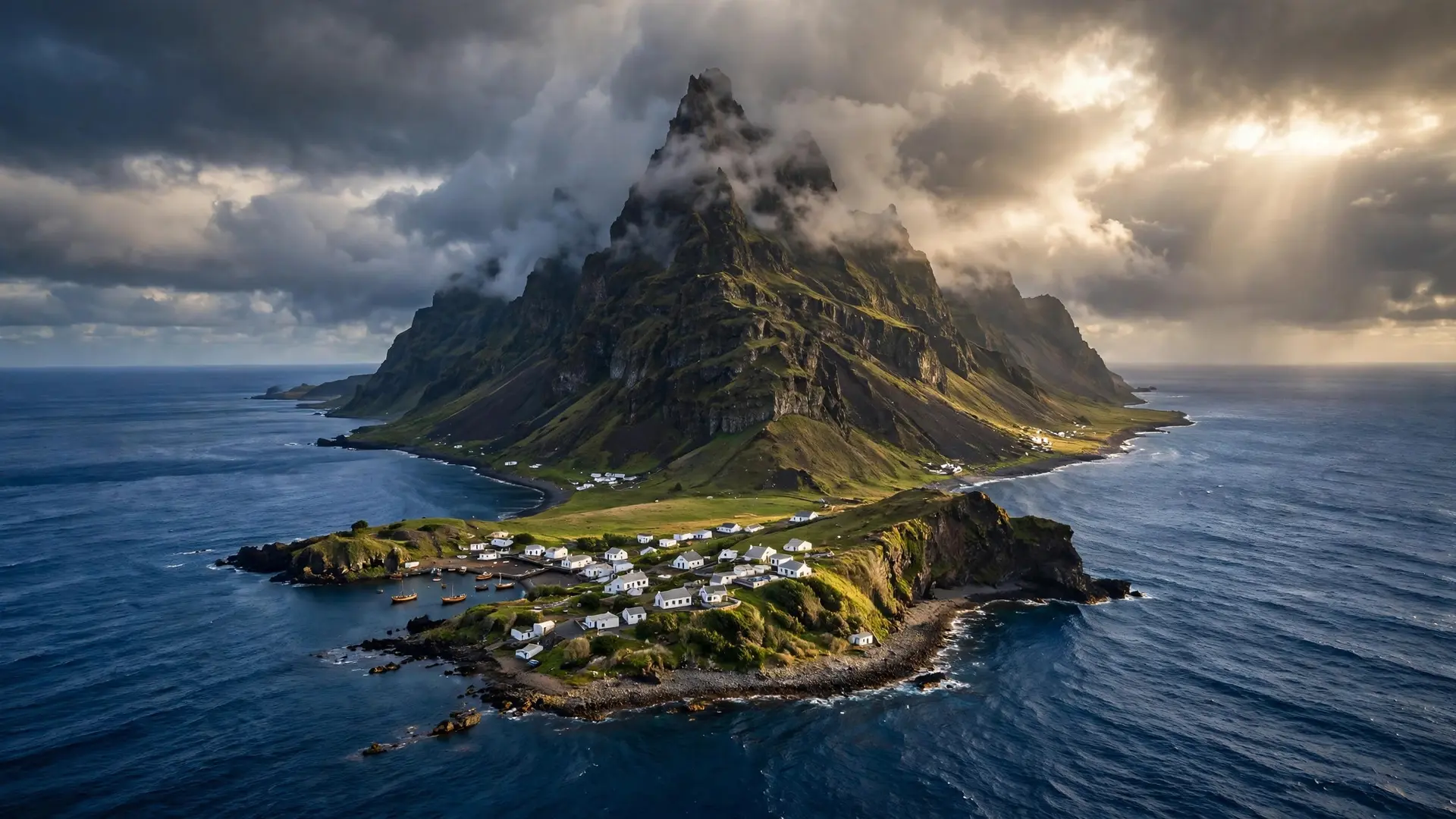
During the Beagle's five-year voyage in the 1830s, Darwin kept encountering three kinds of reefs that seemed oddly related. Some volcanic islands, like Tahiti, wore a fringing reef hugging their shores. Others, like Moorea, had a barrier reef separated from the island by a calm lagoon. And then there were the atolls — rings of reef with a lagoon and no island at all. Same materials, same tropical seas, three different shapes. Darwin's leap was to see them not as three types, but as three ages.
His theory, published in 1842 as "The Structure and Distribution of Coral Reefs," runs like this. A volcano erupts from the seafloor and builds an island; corals colonize its sunlit shallows, forming a fringing reef. Then the island begins to sink — as young volcanic rock cools and tectonic plates carry it away from the volcanic hotspot, it subsides a few millimeters per year. The coral, which can only live in sunlit shallow water, grows upward to stay in the light. A lagoon opens between the shrinking island and the rising reef: now it is a barrier reef. Given enough time, the island sinks beneath the waves entirely, and only the ring of reef remains — an atoll, keeping pace with the sea above a mountain nobody can see anymore. A complete atoll can take up to 30 million years to form. It was Darwin's first great scientific triumph, worked out from observations made with a notebook and a ship's log, and it is still broadly accepted today. The mechanism has a beautiful symmetry: two motions in opposite directions — island down, reef up — producing one of nature's most perfect shapes.
How was the theory actually proven?
Darwin's idea had a testable prediction buried in it: if you drilled straight down through an atoll, you should eventually hit volcanic rock, far below the coral. For a century, nobody could check. Then the atomic age provided, of all things, the drill rigs. In the 1940s and 1950s, survey teams preparing Pacific atolls for nuclear weapons tests drilled deep into the reef to understand its structure. At Enewetak Atoll in the Marshall Islands, drillers bored through roughly 4,000 feet of coral limestone before striking the underlying basaltic foundation — the drowned volcano Darwin's theory demanded. British scientists had found similar results decades earlier in the Pacific, and the U.S. Geological Survey's account of atoll development treats the subsidence sequence — fringing reef to barrier reef to atoll — as confirmed. Darwin would have been pleased: his armchair geology, deduced from the deck of a sailing ship, was vindicated by machines drilling through a mile of dead coral.
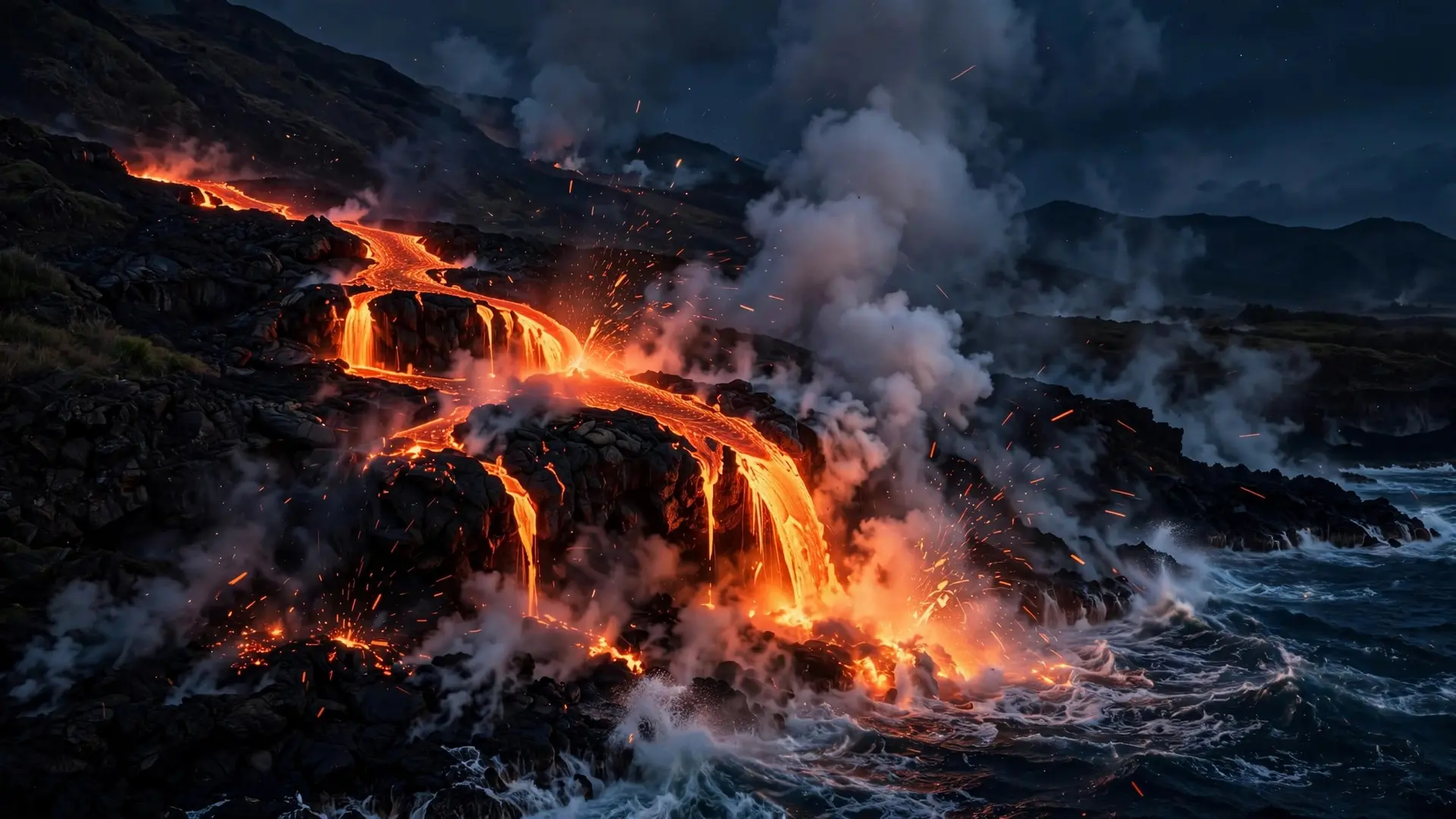
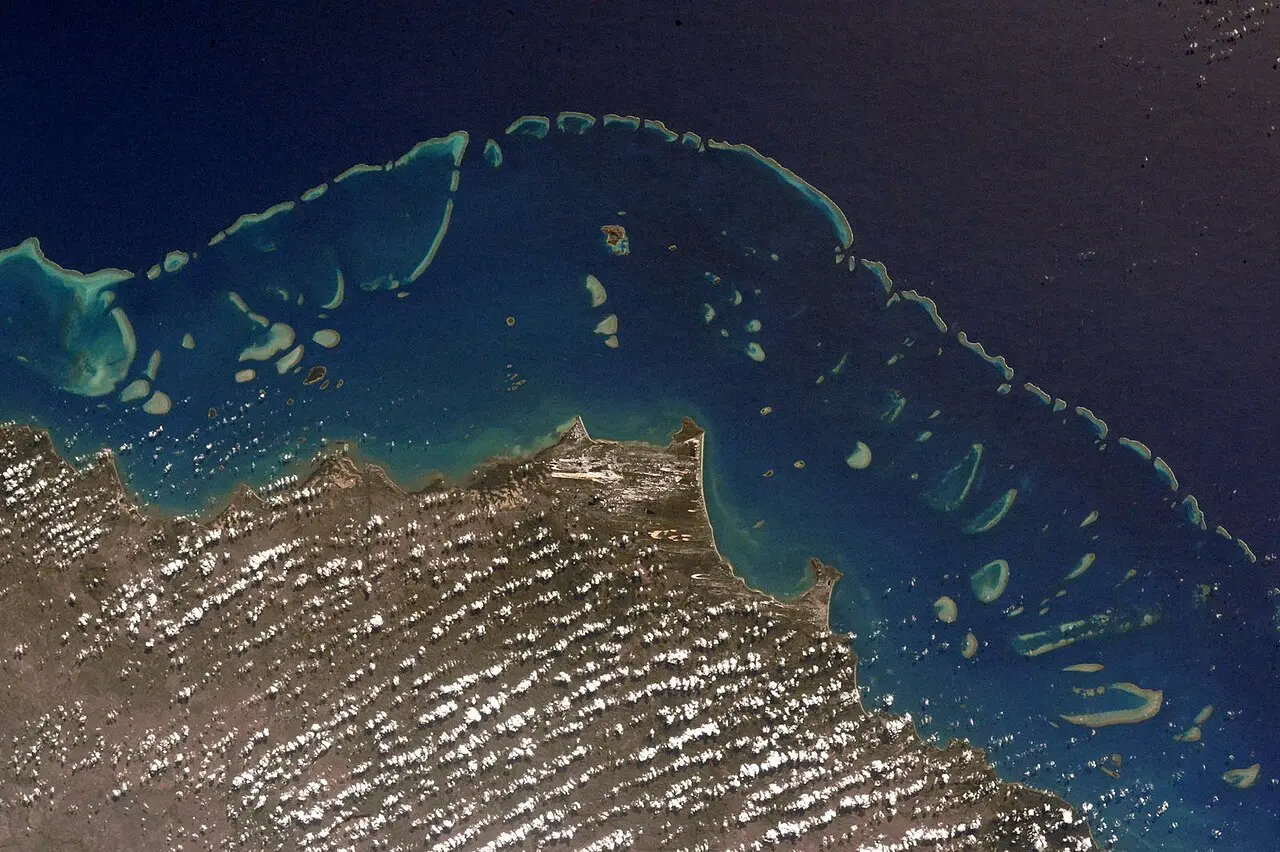
Modern measurements fill in the pace of the race. At Enewetak, drill cores show Holocene reef growing upward at about 5 to 10 millimeters per year during rapid sea-level rise — easily outpacing the millimeter-scale subsidence of the island below. The coral wins the race comfortably, which is why atolls exist at all. The story begins, of course, with fire: the volcanic islands that start the whole sequence form the way volcanic islands always do, and the reefs that crown them belong to the same living architecture as the Great Barrier Reef.
Is Darwin's theory the whole story?
Mostly — but with a modern footnote. Some geologists argue Darwin missed a co-author: the ice ages. Sea levels have risen and fallen by more than 100 meters across glacial cycles, and those swings also shaped reef architecture — exposing reefs, drowning them, and forcing corals to recolonize. The current view is that subsidence sets the stage over millions of years while sea-level fluctuations edit the details. That editing is now accelerating in the wrong direction. Coral can grow upward fast enough to track gradual sea-level rise, but if the water rises too quickly — or the reef is weakened by warming and bleaching — the coral falls below its sunlit depth zone and drowns. Researchers warn that many atolls face exactly this race in the coming century: reef growth versus rising seas, with entire nations' territory at stake. The Maldives, a country built entirely on 26 atolls formed by this very process, is the world's most vivid example of what is on the line.
So an atoll is a volcano's afterlife?
Exactly that. A volcano is born in fire, spends a few million years as an island, then sinks slowly into the dark — but the coral it hosted refuses to go down with it, building upward generation after generation until the mountain is gone and only the reef's ring remains. Darwin saw the whole life cycle in three snapshots scattered across the Pacific and correctly ordered them in time, one of the boldest inferences in the history of geology. Every atoll lagoon is a kind of memorial: calm water where a mountain used to be, held in place by some of the smallest architects on Earth.
Frequently asked questions
What is the difference between an atoll and a regular island?
A regular island is solid land; an atoll is a ring of coral reef enclosing a shallow lagoon, with no central island — just low sand strips built on the reef, usually only a few meters above sea level.
How long does it take for an atoll to form?
The full sequence from volcanic island to atoll can take up to 30 million years, as the island sinks only millimeters per year while the coral grows upward at the same slow pace.
Where are the most famous atolls?
The Maldives in the Indian Ocean is a nation built entirely on atolls, and the Pacific holds thousands more, including Tureia in French Polynesia and the atolls of the Marshall Islands.