What Is the Most Remote Inhabited Island on Earth?
Tristan da Cunha sits thousands of kilometres from inhabited land, with no airport and only a handful of ships a year. This is how its isolation works.
Key takeaways
- Tristan da Cunha is widely regarded as the most remote inhabited island, with St Helena about 2,400 kilometres away.
- Its only settlement, Edinburgh of the Seven Seas, held about 216 people in May 2026.
- With no airstrip, the island is reached only by sea, on ships from Cape Town roughly ten times a year.
- A 1961 eruption evacuated the whole community, yet most islanders returned home in 1963.
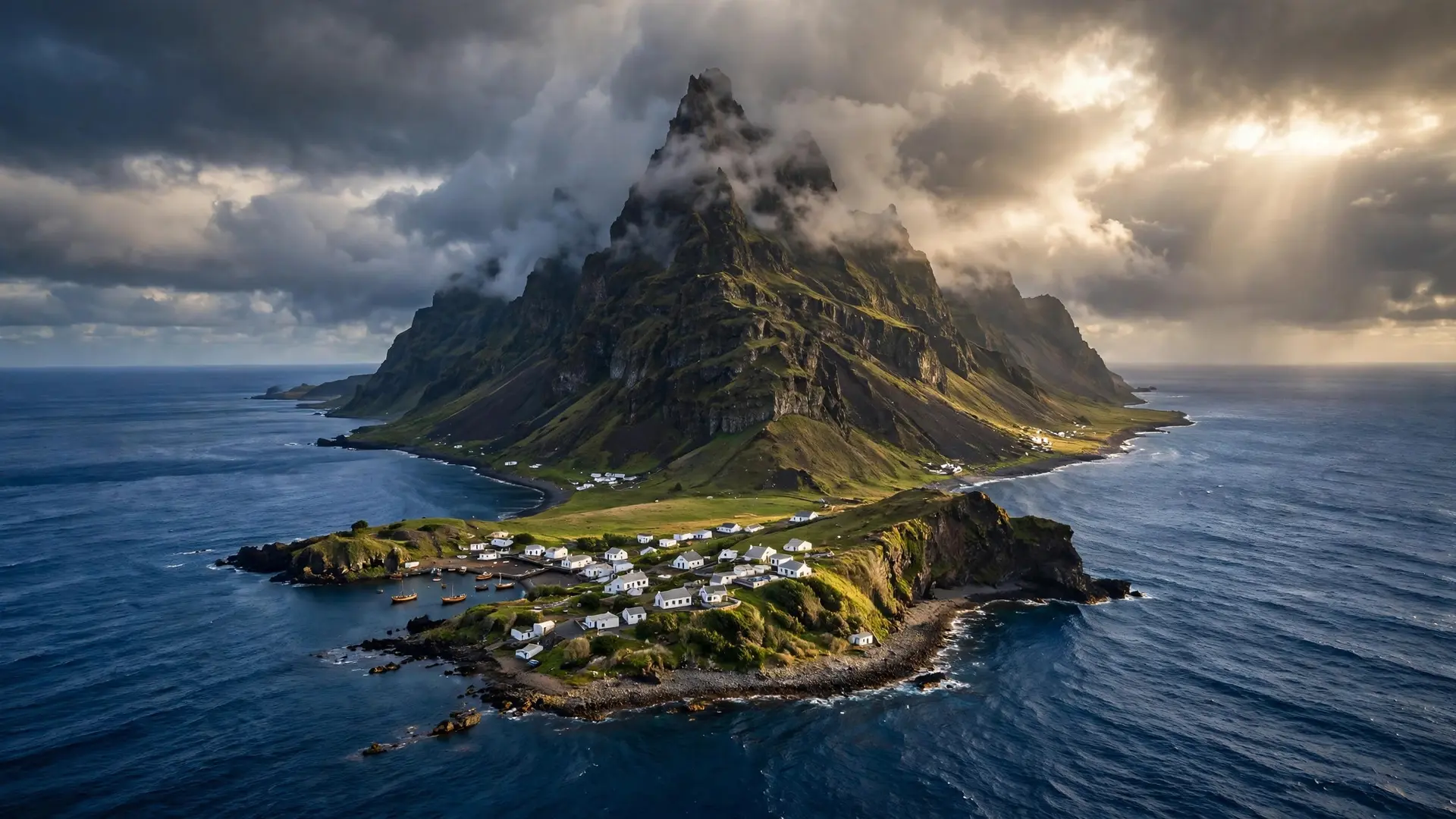
Tristan da Cunha, a volcanic island in the South Atlantic, holds the title of the most remote inhabited island on Earth. Its only settlement, Edinburgh of the Seven Seas, sits about 2,400 kilometres from St Helena, the nearest inhabited land, and roughly 2,800 kilometres from South Africa. With no airstrip and only a handful of ships each year, distance here is not an abstract number: it shapes food, medicine, schooling, and every plan a resident makes. Remoteness, in this case, is best measured in three ways at once. The first is straight-line distance. The second is access: how often transport arrives, and how easily it can actually land. The third is self-reliance: how much a community must provide for itself when the next delivery may be weeks away. Tristan da Cunha scores at the extreme end of all three, which is why its claim survives challenges from other lonely islands. A research station with a rotating crew does not count in the same way, and neither does an island with an airport, however far it sits from a continent.
How far away is Tristan da Cunha, really?
Picture the South Atlantic with Africa on one side and South America on the other. Tristan da Cunha sits roughly midway between the two continents, a speck formed by a volcano rising from the ocean floor. The island itself covers about 98 square kilometres, and its central volcanic cone reaches about 2,060 metres, often hidden by cloud. Steep cliffs ring much of the coast, leaving only a narrow lowland strip on the north-west side where the settlement stands. That geography matters because it turns a long journey into a difficult arrival. Ships from Cape Town make the crossing in roughly six days, but they cannot simply dock. Tristan has no deep harbour for large vessels, so passengers transfer to smaller local boats in open water, and a rough sea can postpone a landing altogether. Reuters reported in May 2026 that ships depart from Cape Town roughly ten times a year, which means a missed sailing is not a minor inconvenience. It can mean waiting weeks for the next chance, in either direction. The contrast with the nearest point of emptiness is instructive. The ocean's loneliest coordinate has no permanent residents at all, so it wins a different contest: the farthest spot from land anywhere. Tristan wins the inhabited version, because people do not merely visit it. They live there year-round, raise children there, and bury their dead there.
How did a community take root in such a place?
Tristan was first sighted by Europeans in 1506, when the Portuguese navigator Tristão da Cunha gave the island group his name. For centuries afterwards it remained uninhabited, visited by passing ships but claimed by no settled population. Two attempts to settle it in the seventeenth century, and another in 1810, came to nothing.
The turning point arrived in 1816, when Britain stationed a garrison on the island and formally annexed the group. The garrison was withdrawn the following year, but three of its members chose to stay. Over time they were joined by shipwrecked sailors, settlers of European origin, and women from St Helena. By 1886 the population had reached 97 people. The settlement took its name, Edinburgh of the Seven Seas, and it remains the island's only permanent town. Life there grew around what the island itself could supply. Potatoes became the main crop, and shore-based fishing for lobster and crawfish became the main industry, with the catch exported. Sales of postage stamps and coins added further income. Land, crucially, is held communally rather than privately, and outsiders cannot simply buy land or move in permanently. That rule, together with the small founding population, has kept the community tight-knit and strikingly stable in size: Britannica gave a 2014 estimate of 269 people, while Reuters reported about 216 residents in May 2026.
What does everyday isolation actually feel like?
On Tristan, the ordinary rhythms of mainland life arrive in compressed form. A single shop, a school, a hospital, and a handful of public buildings serve everyone. Supplies arrive by ship, so a delayed vessel affects the whole island at once rather than a single household. Medical care is the sharpest illustration. The island has a small hospital team, but serious or specialist treatment requires evacuation, and evacuation requires either a ship or extraordinary measures. In May 2026, that logic played out in public. After a suspected hantavirus case strained the island's small hospital, with medical oxygen running low, Britain sent military personnel and supplies by air. Because Tristan has no airstrip, the team had to parachute in, and cargo was dropped in batches. The island government itself described Tristan as famously the remotest inhabited island in the world, noting that the nearest airport, on St Helena, lies 2,430 kilometres away. The episode was unusual, but it revealed the normal rule: when Tristan needs help from outside, help must cross an ocean and then find a way to land without a runway. Weather sharpens the effect. Britannica describes a wet, windy, and mild climate, with about 1,675 millimetres of rain a year on the north coast at Edinburgh. Storms can damage homes and cut the island off further, as a hurricane did in May 2001, when aid flowed in from abroad to pay for rebuilding. Yet the same weather also protects the island's wildlife. Gough and Inaccessible, two uninhabited islands in the group, form a wildlife reserve recognised as a World Heritage site, and seabirds nest in huge numbers on the cliffs.
Why did the islanders leave, and why did they come back?
The most dramatic test of the community came in October 1961, when a volcanic eruption directly threatened the settlement. The inhabitants were evacuated, travelling via Nightingale Island to England. It would have been understandable if the story had ended there. Instead, the main body of 198 islanders returned in November 1963, and a new harbour was built in 1965–67, followed by roads, a hospital, and water, electricity, and sewerage facilities. That return says something important about how remoteness is experienced from the inside. To an outsider, Tristan can look like a place people are stuck in. To its residents, it is home, with family ties stretching back to a handful of founding surnames and a way of life organised around shared land, shared work, and shared risk. The 1961 evacuation did not break that attachment; it confirmed it, because the community chose, collectively, to go back to the same narrow coastal plain beneath the same volcano. It is also a reminder that volcanic islands are never finished landscapes. The volcano that built Tristan could stir again, and the island's future will always involve that bargain: fertile soil and rich fishing grounds on one side, and a restless geology on the other.
Is Tristan really the most remote, or just the most famous?
Sceptics sometimes point to other candidates: tiny Pacific atolls, Antarctic stations, or islands closer to a continent but harder to reach in practice. The distinction turns on permanence. Antarctic bases host rotating staff, not a self-sustaining town. Some Pacific islands are farther from a continent, yet have airstrips and regular flights. Tristan combines a permanent, multi-generational community with no air link, rare shipping, and a nearest neighbour more than 2,000 kilometres away. The UK government itself calls it the world's most remote inhabited island, and that wording is careful: it is the inhabited part that makes the record meaningful. There is also a quieter kind of distance at work. A place can be far away yet well connected, if flights arrive daily and the internet is fast. Tristan's connection to the wider world has improved over time, but it still runs through ships, weather, and a single settlement's capacity to absorb a delay. When a ship is late, the island waits together. When a storm hits, it repairs together. Remoteness, in that sense, is not only measured in kilometres. It is measured in how many links must all work at once for ordinary life to continue, and on Tristan, every link is long. Tristan da Cunha endures because its people have turned isolation into a system: communal land, local food and fishing, a small but complete set of public services, and a habit of looking after one another when the outside world cannot reach them quickly. The island is remote by every measure that matters, and that is precisely why a community of just over 200 people, on a volcanic rock in the middle of an ocean, still counts as one of the most remarkable settlements on Earth.
Frequently asked questions
How far is Tristan da Cunha from anywhere else?
The nearest inhabited land, St Helena, lies about 2,400 kilometres away, and South Africa is roughly 2,800 kilometres to the east. That distance is only part of the story, because reaching the island also depends on rare ships and workable seas.
Can tourists simply book a trip to Tristan da Cunha?
No. There is no airport and no regular ferry, so visitors must join a ship from Cape Town, wait for a landing window, and accept that bad weather can delay or prevent arrival altogether.
Why did the islanders leave in 1961?
A volcanic eruption in October 1961 directly threatened the settlement, so the community was evacuated. The main body of islanders returned in November 1963 and rebuilt their home.
Sources
- Tristan da Cunha, Encyclopaedia Britannica
- Factbox-What to know about Tristan da Cunha, the island with a suspected hantavirus case, Reuters via SRN News
- Details of the Daring Airdrop at Tristan da Cunha, 9th May 2026, Tristan da Cunha Government
- Marine research expedition heads to two remote UK Overseas Territories, GOV.UK