
How Lithium-Ion Batteries Actually Store Energy
A lithium-ion battery stores energy as chemical potential, shuttling lithium ions between graphite and metal oxide. Here is how that migration powers your phone.
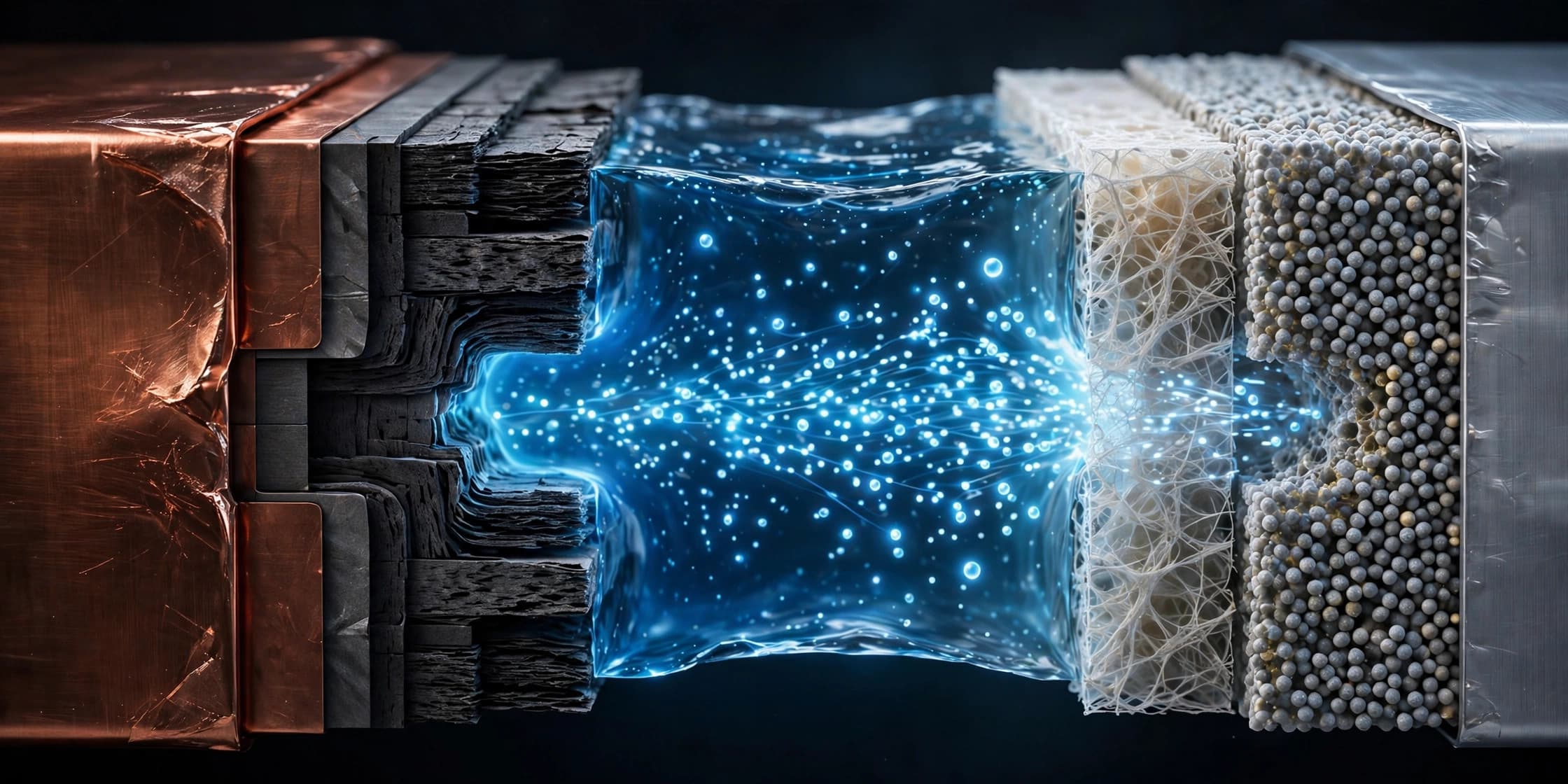
A lithium-ion battery never stores electricity. It stores chemical potential: when you charge your phone, you force lithium ions out of the cathode's metal-oxide layers and wedge them into the carbon sheets of a graphite anode. When you unplug, those ions rush back toward the cathode, and the chemistry pushes electrons through your phone's circuits to get there. Every charge cycle is that migration, played forward and backward, until the chemistry quietly wears out.
The Shuttle: Ions Inside, Electrons Outside
The core trick is a separation of labor. Inside the cell, positively charged lithium ions (Li+) migrate through a liquid electrolyte between the two electrodes. Outside the cell, electrons travel the long way around through your device's wiring. Both move, but they never take the same path — and that forced detour is what gives you usable current.
During discharge, the ions travel from the anode to the cathode. The classic textbook pair is graphite and lithium cobalt oxide, and the full reaction reads: LiC6 + CoO2 ⇄ C6 + LiCoO2. Read left to right, that is discharging; read right to left, it is charging. The electrolyte — typically a lithium salt like LiPF6 dissolved in organic carbonate solvents — is deliberately choosy: it conducts ions freely but blocks electrons, because an internal electron shortcut would be a short circuit.
Here is the part that surprises most people. In the electrolyte, a lithium ion never travels alone. It drags a shell of solvent molecules with it, like a celebrity with an entourage. To enter the graphite anode, it must shed that bulky shell at the electrode surface — a desolvation step that is often the limiting factor for how fast a battery can charge. Fast charging is not just about pushing more current; it is about how quickly ions can undress at the door.
The Four Residents of a Battery Cell
Open any lithium-ion cell and you will find the same four characters, rolled up in layers like a pastry. The anode is usually graphite, chosen because lithium ions can slip between its carbon sheets in a process called intercalation — no breaking and rebuilding of the material, just orderly parking. The cathode is a lithium metal oxide: lithium cobalt oxide in phones and laptops, or formulations like NMC (nickel-manganese-cobalt) and LFP (lithium iron phosphate) in electric vehicles, trading energy density for longevity and cost.
Between them sits the separator, a porous polymer film that lets ions pass but keeps the electrodes from touching. And the electrolyte, the liquid medium carrying the ion traffic, must survive contact with both a fiercely oxidizing cathode and a fiercely reducing anode. The anode's operating potential actually sits outside the electrolyte's stability window — meaning the electrolyte should decompose on contact. That it does not destroy the battery is the subject of the next section, and it is the most interesting accident in the whole story.
The idea began in the 1970s, when British chemist M. Stanley Whittingham showed that lithium could serve as an anode material. Early lithium-metal versions had safety problems, until Akira Yoshino's work in the 1980s replaced lithium metal with carbon-based anodes, making the cell stable and practical. Sony commercialized Yoshino's design in 1991, and the rechargeable world has run on it ever since.
The First Charge Leaves a Scar That Never Heals
Because the charged graphite anode sits outside the electrolyte's stability range, the electrolyte genuinely does decompose on contact with it — it "burns" chemically. This happens during the battery's very first charging cycle, the so-called formation cycle. But the decomposition products form a thin solid crust on the anode: the solid electrolyte interphase, or SEI.
The SEI is a paradox. It is electrically insulating, which stops further decomposition and saves the battery from digesting itself. At the same time it remains ionically conductive, so lithium ions can pass through on every cycle. Without this self-forming skin, lithium-ion batteries simply could not exist. It is formed once, in the first hours of a battery's life, and it governs everything that follows.
That same skin is also the beginning of the battery's death. Every subsequent cycle thickens the SEI slightly, like plaque narrowing an artery. Each thickening permanently traps a few lithium ions and adds resistance. The protective layer is real, and so is the slow toll it takes.
Why Batteries Fade: Three Slow Killers
Capacity fade is not one process but three, all running at once. The first is SEI growth itself, the steady consumption of lithium inventory and electrolyte with each cycle. Heat makes it worse: a battery cycled at high temperatures ages dramatically faster than one kept cool, which is why a phone baking on a car dashboard loses capacity so quickly.
The second is lithium plating. When you charge very fast — or charge in the cold, where ion movement slows — lithium ions arrive at the anode faster than the graphite can absorb them. Instead of intercalating, they deposit as metallic lithium on the surface. This "dead" lithium cannot rejoin future cycles, and in the worst case it grows into dendrites that pierce the separator and cause micro-shorts. Below about 5 °C, plating becomes hard to prevent even at low charging currents, which is why good battery management systems throttle charging in winter.
The third is mechanical damage to the cathode. The active materials expand and contract with every cycle, and over time the cathode particles develop microcracks. Cracked particles expose fresh surfaces to the electrolyte, triggering more side reactions, while some fragments disconnect from the conductive network entirely. In nickel-rich cathodes, deep discharge can even collapse the layered crystal lattice as transition metals migrate into the vacated lithium sites.
Most commercial cells are engineered to retain around 80 percent of their capacity after several hundred to a thousand cycles, depending on chemistry. LFP cathodes trade some energy density for cycle lives in the thousands, which is one reason they are taking over electric vehicles and home storage.
The 20-to-80 Rule and Other Half-Truths
Old nickel-based batteries suffered from a "memory effect" that punished partial charging. Lithium-ion cells have no such memory — topping up is fine, and deep discharging is what actually hurts. The real enemies are voltage and heat extremes. High states of charge push cathode voltages into ranges that accelerate electrolyte decomposition, which is why staying roughly between 20 and 80 percent slows aging. Modern phones do some of this automatically, slowing the final stretch of charging or holding at 80 percent overnight until you wake.
Adaptive charging exists for the same reason: a charger that slows down when it detects the voltage signatures of lithium plating can meaningfully extend a battery's life. None of this stops the three killers — it only slows them. A lithium-ion battery is a controlled, reversible chemical migration with an expiration date built into its very first charge.
That is the honest beauty of the device in your pocket. Energy is stored as lithium ions parked in graphite, released as those ions stream home through a film that was born scorched on day one. It works brilliantly for years — and every full cycle, the shuttle run leaves a few ions behind. The tiny batteries inside your noise-cancelling headphones and the remote sensors of a smart city all share the same bargain: reversible chemistry, irreversible aging.