How a Microwave Oven Actually Heats Your Food
A microwave doesn't heat like an oven — its magnetron shakes water molecules with an electric field until friction makes heat. Physics and quirks explained.
Key takeaways
- A magnetron generates microwaves at about 2.45 GHz; their alternating electric field spins polar water, fat, and sugar molecules, and friction between them becomes heat.
- The waves penetrate only about 25 to 38 millimeters, so thick food heats in its outer layer first and conducts heat inward — it does not literally cook inside out.
- Metal walls bounce microwaves around the cavity, and the door's mesh holes are far smaller than the 12 cm wavelength, so light passes through but waves cannot escape.
- Lower power settings don't weaken the waves; they cycle the magnetron on and off, giving heat time to spread between bursts.
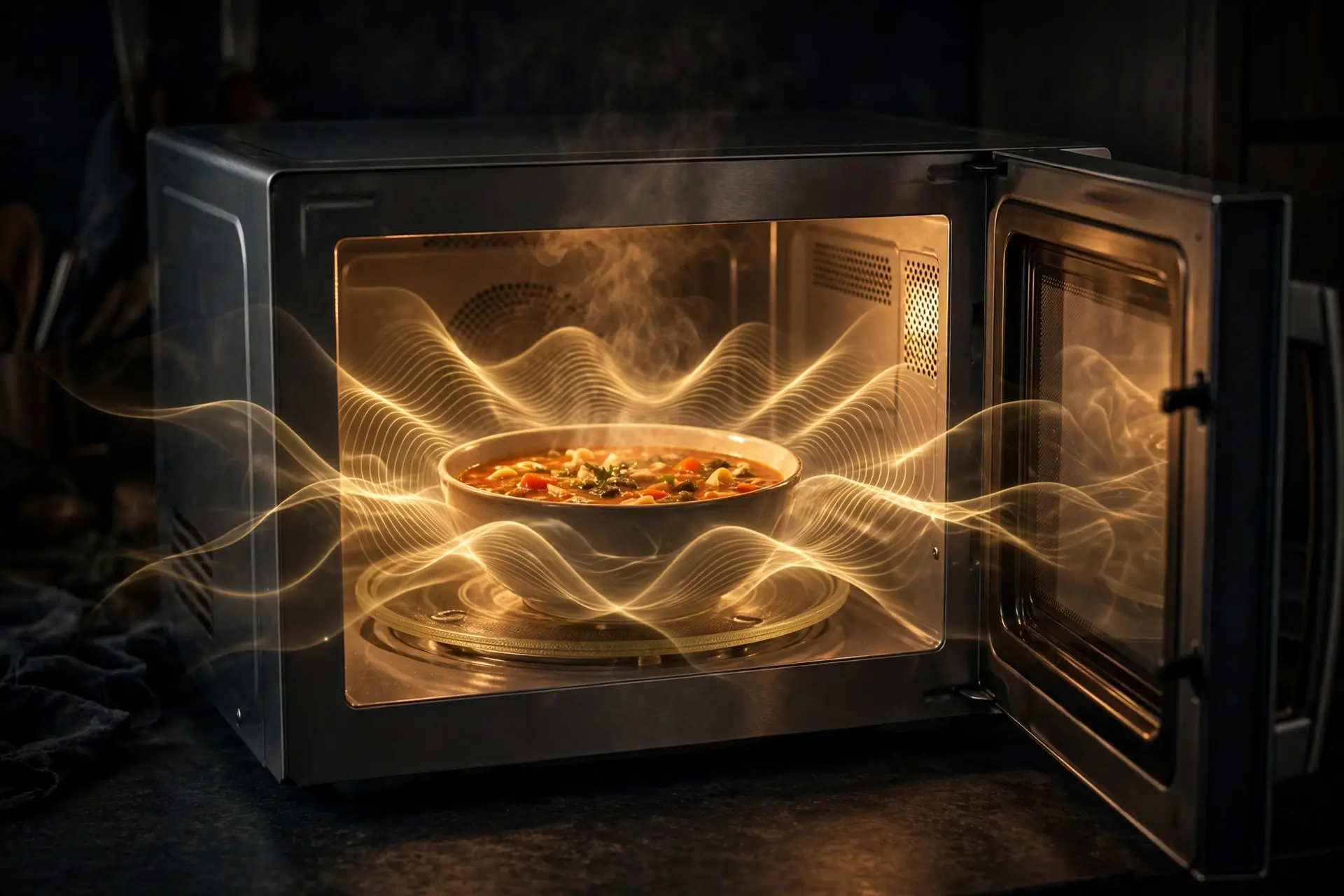
Your microwave does not cook your food the way an oven does. An oven surrounds food with hot air; a microwave shoots invisible waves into it that grab water molecules and shake them billions of times per second. That shaking — molecular friction — is the heat. There is no flame, no glowing element, nothing getting hot except the food itself. The waves come from a device called the magnetron, a vacuum tube that converts ordinary household electricity into electromagnetic radiation at about 2.45 gigahertz, with a wavelength of roughly 12 centimeters. These waves sit between radio and infrared on the electromagnetic spectrum, and they travel through a channel into a metal box — the cooking cavity — where they bounce off the reflective walls and pass through your food from many angles.
What is the microwave actually doing to your food?
The trick is a process physicists call dielectric heating, and it works because water molecules are polar. Each water molecule is slightly V-shaped, with a partial positive charge on one side and a partial negative on the other — a tiny electric dipole. When the magnetron's alternating electric field sweeps through the food, these dipoles try to line up with it, flipping back and forth billions of times per second as the field reverses. Water molecules are not alone in a bowl of soup. They are crowded shoulder to shoulder with neighbors, and spinning in place means bumping into them constantly. Each collision scrambles the orderly rotation into random jitter — and random molecular motion is exactly what temperature is. The field's energy becomes heat, distributed through the liquid as the agitation spreads. Fats and sugars absorb microwave energy too, but less eagerly, because their dipole moments are smaller. Frozen food heats stubbornly for a different reason: in ice, water molecules are locked in a crystal lattice and cannot rotate freely, so far less of the field's energy gets converted. This is why a microwave thaws the outside of a chicken while the middle stays stubbornly frozen.
Why 2.45 gigahertz — and is it a water resonance?
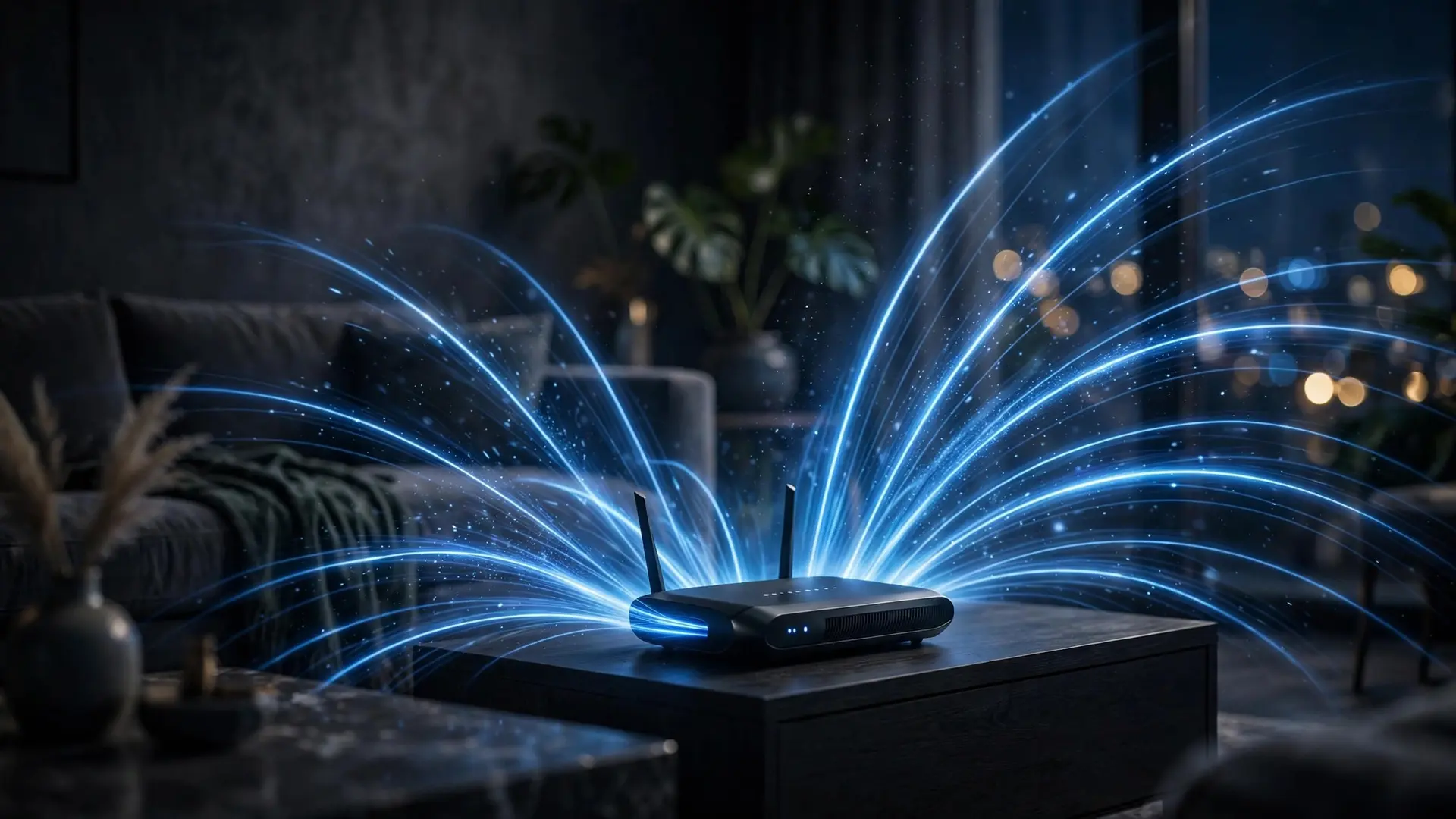
You may have heard that 2.45 GHz was chosen because it matches the "natural frequency" of water. It is a tempting story and it is wrong. Water vapor resonates around 20 GHz, far above a microwave oven's frequency. And big industrial ovens running at 915 megahertz heat food perfectly well — no resonance required. The real choice was practical. At 2.45 GHz, the waves penetrate moist food a useful depth — roughly 25 to 38 millimeters — and are absorbed efficiently along the way, rather than passing straight through or reflecting off the surface. The frequency also sits in an internationally reserved band for industrial, scientific, and medical use, so ovens do not jam radio communications — it is, in fact, the same slice of spectrum that Wi-Fi routers use, which is why a leaky oven can interfere with your wireless connection. The door's mesh screen is part of the same engineering: its holes are far smaller than the 12-centimeter wavelength, so visible light passes through for you to watch your soup while the waves are reflected back inside. Door interlocks cut the magnetron the instant you open it. That limited penetration depth explains the most familiar microwave quirk: the cold center. The waves do not cook "from the inside out" in any literal sense. They heat the outer inch or so directly, and the rest warms by ordinary conduction — the same way heat travels through food on a stove. Thick foods heat unevenly because the surface reaches temperature long before the middle does, which is why recipes nag you to stir halfway through.
Why do some spots stay cold while others burn?
Inside the metal cavity, the bouncing waves form standing patterns: some regions get strong fields, others nearly none. Without help, you would get bullseye zones of scorching soup next to pockets of icy peas. This is why nearly every microwave has a turntable or a fan-driven stirrer — moving the food through the pattern smears the hot and cold spots across the plate. Even so, covering food helps: trapped steam carries heat across the surface and evens things out.
The same field physics answers why "50 percent power" is gentler on custards and eggs. The magnetron has essentially one setting: full blast. A lower power level simply cycles it on and off across each minute. During the pauses, conduction redistributes heat from the hot spots into the cooler regions, which is why a sauce stays smooth at half power instead of splitting at full power. And metal? The cavity walls are metal precisely because microwaves bounce off it. But thin metal with edges and points — a fork, crinkled foil — concentrates the field until it arcs as sparks. It is the same principle that makes the box work, just pointed at the wrong place.
Where did this strange box come from?
Nobody set out to invent the microwave oven. In 1945, Raytheon engineer Percy Spencer was working on radar magnetrons when he noticed a candy bar melting in his pocket; follow-up experiments with corn kernels and an egg showed microwaves could cook food. Raytheon patented microwave cooking that same year, and the first commercial Radarange arrived in 1947 — a water-cooled cabinet over five feet tall, weighing more than 750 pounds, and costing about $5,000. It belonged in commercial kitchens, not homes. The full story of the accident, the popcorn, and the egg is told in the accidental 1945 discovery. The path to the countertop took decades. Tappan introduced a household model in 1955, but it was still large and expensive and sold poorly. The breakthrough came in 1967, when Raytheon-owned Amana released the first countertop model at around $495. By the mid-1970s, microwave ovens were as common in American kitchens as gas stoves — a radar weapon's side effect, domesticated. A microwave, then, is a machine that cooks with motion rather than temperature: it injects energy straight into the molecules of your food and lets friction do the rest. It is faster because it skips the slow business of heating air and passing heat through surfaces — and it is quirky for exactly the same reason. Every cold spot, every spark warning, every instruction to stir halfway is the physics of dielectric heating announcing itself. The magnetron does not know what dinner is. It only knows how to make water molecules dance.
Frequently asked questions
Why can't you put metal in a microwave?
Metal reflects microwaves instead of absorbing them, so thin edges and points concentrate the electric field and can spark. Smooth, thick metal can arc too, which is why manufacturers warn against it.
Is the food heated by some special water resonance?
No. Water's true resonant frequencies are far higher, around 20 GHz in vapor form. The 2.45 GHz choice is a practical sweet spot that penetrates food a useful depth and is absorbed well.
Does microwaving make food unsafe or radioactive?
No. Microwaves are non-ionizing radiation, so they cannot alter food's chemistry the way ionizing radiation can. The food is simply heated by molecular friction — plain heat, delivered directly into the molecules.