How Hubble Discovered the Expanding Universe
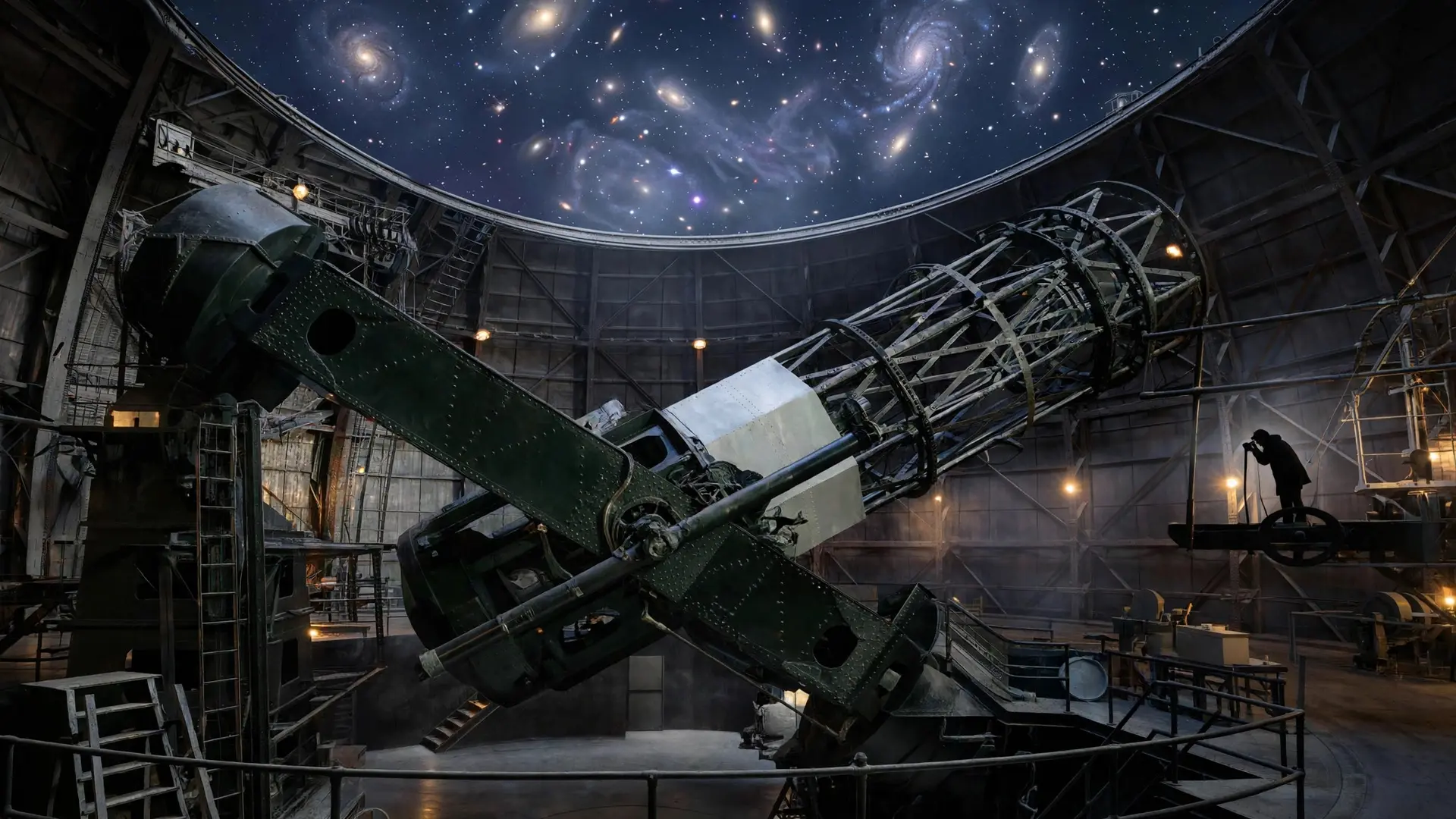
Edwin Hubble used the 100-inch Hooker telescope to show that spiral nebulae were distant galaxies — and that the farther they are, the faster they recede.
Key takeaways
- In 1924 Hubble used Cepheid variable stars to prove the Andromeda nebula was a separate galaxy far beyond the Milky Way, announced on January 1, 1925.
- With Milton Humason he measured distances and redshifts for two dozen nebulae and found a simple rule: the farther a galaxy, the faster it recedes.
- His 1929 paper in the Proceedings of the National Academy of Sciences stated the distance-velocity relation without claiming the universe was expanding.
- Theorists Alexander Friedman and Georges Lemaître had already derived expanding universes from Einstein's equations but lacked data until Hubble's.
- Hubble's distances were miscalibrated — he didn't know there are two kinds of Cepheid variables — but the relationship he found still holds.
Edwin Hubble discovered the expanding universe the way a surveyor discovers a landscape: by measuring distances until the map demanded a bigger world. Using the 100-inch Hooker telescope at Mount Wilson, he first proved that the faint spiral smudges in the sky were entire galaxies far beyond the Milky Way — and then, with his colleague Milton Humason, that the farther a galaxy lies, the faster it races away from us. Here is the twist that rarely makes it into textbooks: Hubble himself never fully believed the universe was expanding. He supplied the evidence; the verdict belonged to others.
What did astronomers believe before Hubble?
Until the mid-1920s, the respectable scientific position was small and still. Most astronomers held that the Milky Way was the entire universe, and that the universe was static and unchanging. The fuzzy spirals catalogued as "nebulae" were, on this view, nearby clouds of gas inside our own galaxy — though a minority argued they were "island universes," whole galaxies in their own right. The two camps had their famous showdown in 1920, when Harlow Shapley and Heber Curtis debated the question publicly. Hubble arrived at Mount Wilson just as the observatory's 100-inch Hooker telescope — then the largest in the world — was completed. He was an unlikely revolutionary: a former athlete known for boxing and basketball, a University of Chicago graduate who had studied law at Oxford on a Rhodes scholarship at his father's urging, joined the Kentucky bar, taught high school Spanish for a year, and only then returned to astronomy for his doctorate. After serving in the Army in the First World War, he took up his post in southern California and began measuring the distances to the disputed nebulae. His ruler came from a discovery he hadn't made. Henrietta Leavitt, a "computer" at the Harvard College Observatory, had found in 1908 that a class of stars called Cepheid variables pulse with a rhythm that reveals their true brightness: time the pulsation, and you know how bright the star really is; compare that with how bright it looks, and the difference tells you the distance. It was the first reliable cosmic yardstick.
How did he prove those smudges were other galaxies?
In 1924 Hubble managed to pick out individual Cepheid variables inside the Andromeda nebula — and later the Triangulum nebula too. The distances he calculated placed these objects enormously far beyond the Milky Way's edge. They could not be gas clouds inside our galaxy. They were galaxies, full stop.
He let the newspapers have it first: his findings appeared in The New York Times in November 1924, and he unveiled them formally at the American Astronomical Society's New Year's Day 1925 gathering in Washington, D.C. The universe, overnight, became vastly larger than anyone had imagined. The expansion discovery that would follow in a few years was even more radical — but it started here, with a bigger map.
How did he find the universe was expanding?
The second clue was already on the table, and it belonged mostly to other men. As early as 1912, Vesto Slipher at the Lowell Observatory had been recording the spectra of spiral nebulae and finding their light stretched toward the red end of the spectrum — redshifted, meaning the sources were receding at high speeds. Nearly all of them were moving away from us, and nobody knew why everything would be fleeing in every direction. Hubble set out to marry Slipher's speeds to his own distances. He teamed up with Milton Humason, whose career is one of astronomy's great side stories: Humason had begun at Mount Wilson as a janitor and climbed, night by night, to night assistant and then assistant astronomer. In their division of labor, Humason measured the spectra — the recession speeds — while Hubble measured the distances. NASA's account of the work describes what happened next: measuring speeds and distances for twenty-four nebulae, the two men found that the farther a nebula was, the larger its redshift. The dimmer, more distant objects were rushing away faster than the nearer ones — some at thousands of miles per second — and the relationship was strikingly simple: recession speed grew in direct proportion to distance. In January 1929 he sent the paper to the Proceedings of the National Academy of Sciences; it appeared in print that March, and the first plot used 46 galaxies, with more data added in the following years. Here is where the story usually skips a beat. Hubble's paper stated the pattern and stopped. As the American Physical Society's history of the discovery puts it, he "didn't discuss the implications of what he had found, perhaps preferring to leave the interpretation to theorists. He simply presented the empirical law relating galaxies' distance to their velocity." The theorists needed no invitation. Alexander Friedman had derived expanding-universe solutions from Einstein's equations in 1922; Georges Lemaître, a Belgian priest and astronomer, had published a similar result in 1927, even describing a universe swelling outward from an initial single point. Both had been largely ignored for lack of data. Hubble had just supplied the data, and his observations became the first observational support for what would grow into the Big Bang theory — a thread that runs straight through to the discovery of the cosmic microwave background, the afterglow of that ancient expansion.
Why didn't Hubble believe his own discovery?
This is the strangest part of the story. The man whose name is attached to the expanding universe spent the rest of his life keeping the interpretation at arm's length. In 1931 he wrote to the Dutch cosmologist Willem de Sitter explaining that he and Humason said "apparent velocities" on purpose, to stress that the correlation was an observed fact — and that working out what it meant was a job for theorists, not for them. To the end of his writings, Hubble kept the door open to models in which no true expansion was happening at all, suggesting the redshift might reflect some unknown principle of nature instead. There was also an awkward technical truth: his distances were badly miscalibrated. He hadn't realized there are two distinct kinds of Cepheid variables, so every distance in his 1929 paper was too small — by a large factor. The scale of his universe was wrong even though the shape of the relationship was right. Hubble's law survived; Hubble's distances did not. Einstein, meanwhile, had the opposite journey. He had once inserted a "fudge factor" — the cosmological constant — into his equations precisely to keep his universe static, and when Hubble's results showed expansion after all, he called the constant the greatest blunder of his life. In 1931 Einstein visited Mount Wilson and met the astronomer whose measurements had undone his fix.
How did a miscalibrated measurement still change cosmology?
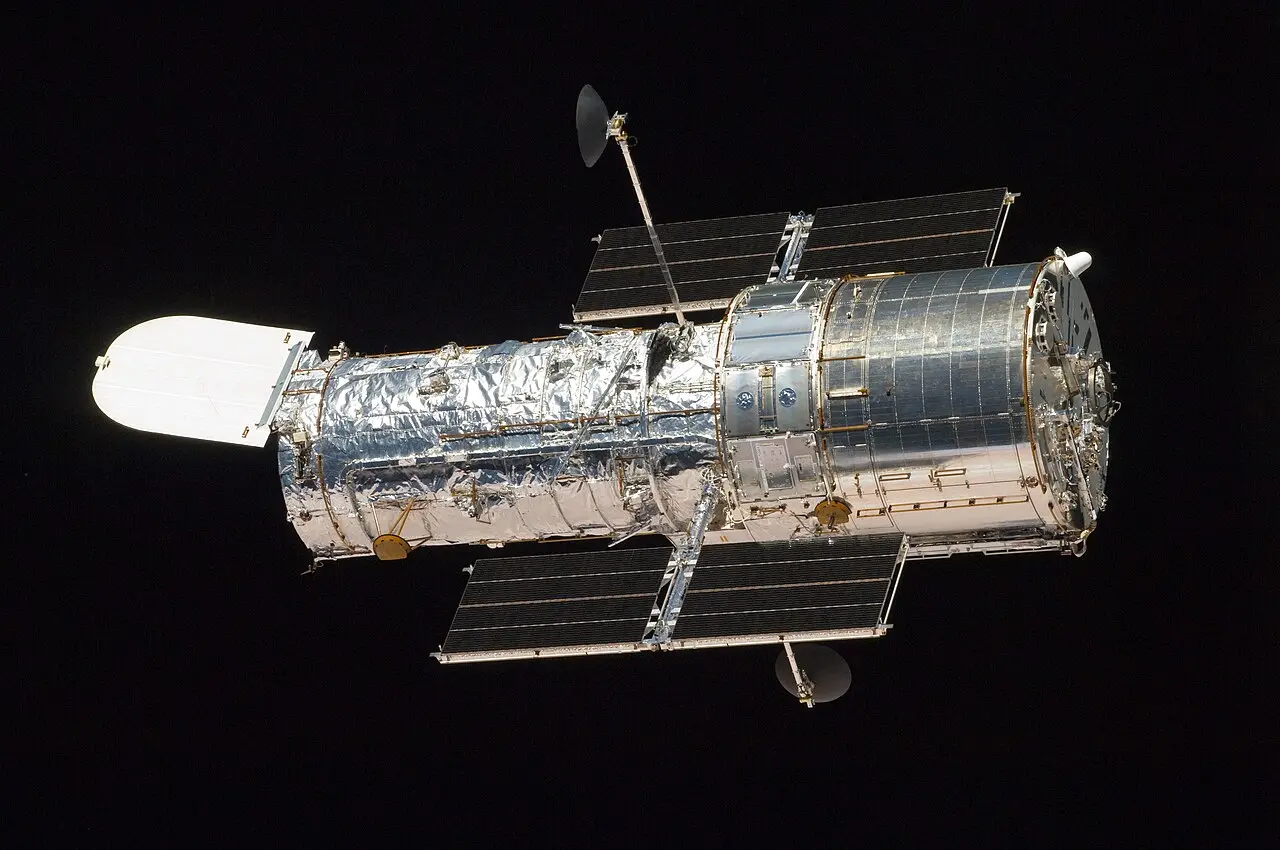
Because the pattern was real, and patterns outlive their first measurements. Hubble went on measuring for the rest of his life, helped build the 200-inch Hale telescope at Palomar — becoming the first astronomer to use it — and died in 1953, still bothered that astronomy's exclusion from physics made him ineligible for a Nobel Prize. The telescope that now bears his name, the Hubble Space Telescope — the instrument behind the most detailed views of distant galaxies we have — orbits as a monument to the measurer. The lesson is worth more than the biography. Hubble's great discovery wasn't a theory or an explanation; it was a graph, a straight line drawn through two dozen smudges of light. Two theorists had the right idea years earlier and were ignored; one observer had the right data and was believed, even as he doubted his own conclusion. In science, the person who changes the world isn't always the person who understands what they've done — sometimes they're just the person who measured carefully enough that the universe couldn't be argued with anymore. The remaining puzzles their work left behind, from the invisible mass bending those galaxies' paths to the acceleration of the expansion itself, are still being measured today.
Frequently asked questions
How did Hubble prove the universe is expanding?
He didn't prove it directly — he measured that galaxies' recession speeds increase in proportion to their distance, a pattern now called Hubble's law. Others recognized this as the signature of an expanding universe, the foundation of Big Bang cosmology.
What were the 'spiral nebulae' Hubble studied?
Fuzzy spiral smudges in the sky that astronomers argued about: nearby gas clouds inside the Milky Way, or entire galaxies far outside it. Hubble's Cepheid measurements showed they were galaxies — island universes of their own.
Did Hubble believe the universe was expanding?
Not fully, and not at first. He presented his 1929 findings as a purely empirical relation and wrote that interpreting the 'apparent velocities' should be left to theorists, keeping non-expansion models open for the rest of his life.
Who helped Hubble make his discovery?
Milton Humason, who started at Mount Wilson Observatory as a janitor and worked his way up to assistant astronomer; he measured the galaxy spectra while Hubble concentrated on measuring distances.