How Did Knossos Palace Get Running Water and Drains?
Knossos had running water and flush-style toilets nearly 4,000 years ago. Gravity, tapered clay pipes and stone sewers made it work — without a single pump.
Key takeaways
- Knossos drew its first water from the Mavrokolymbos spring about 500 metres away, later adding springs near Mount Juctas roughly 10 kilometres off.
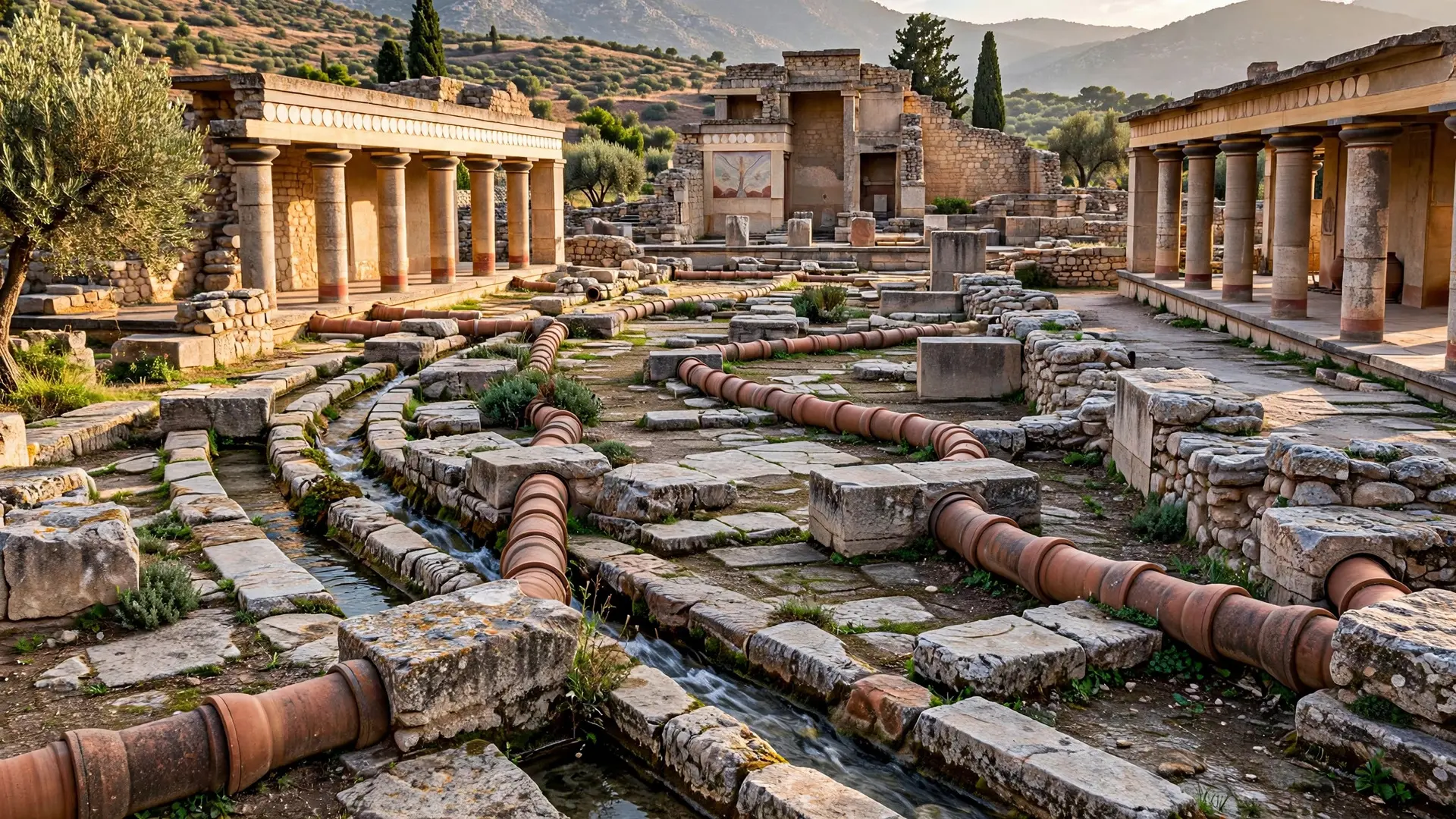
- Its closed pipe system used tapered terracotta sections that locked together, carrying water under low pressure by gravity alone.
- The palace drainage network ran for more than 150 metres, with stone sewers 79 by 38 centimetres, manholes for cleaning and vents for air.
- Palace toilets flushed by pouring water into a conduit, not with a tank and lever, and roof rainwater was routed through the same drains.
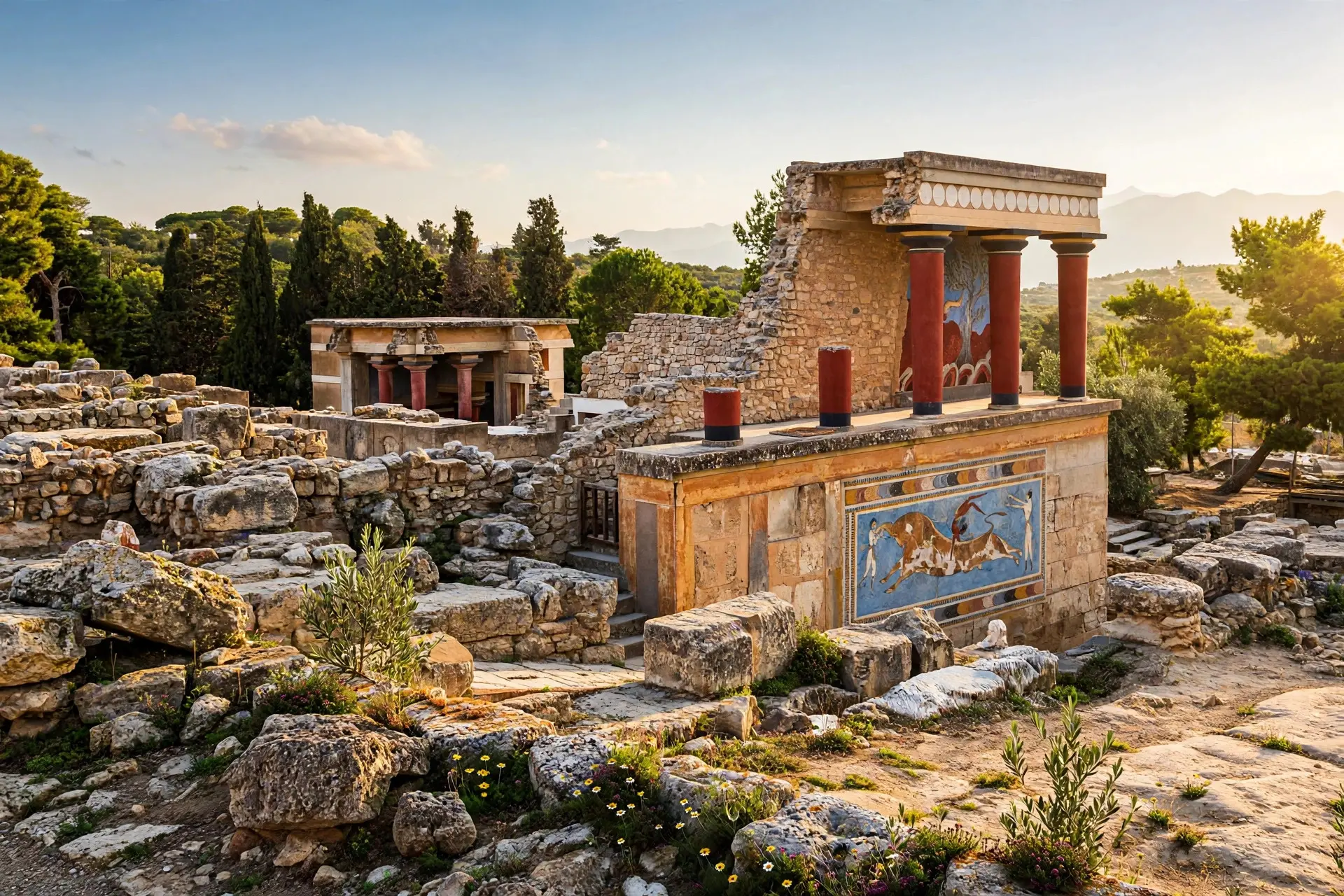
Roughly 3,800 years ago, the palace of Knossos on Crete already had water arriving through pipes and waste leaving through sewers. No pumps were involved. Springs above and around the palace fed the system, gravity carried the water downhill, and a network of clay pipes and stone drains distributed it and took it away again. The Minoans, the Bronze Age people of Crete, flourished from about 3200 to 1100 BC, and Knossos was their largest palace. When the British archaeologist Arthur Evans excavated the site in the early 1900s, he was struck above all by its waterworks. He wrote that nothing in the whole palace was more remarkable than the drainage system running through its domestic quarter and adjoining halls, and the admiration stuck: later writers compared the palace's sanitation favourably with anything Europe managed again before the nineteenth century.
Where did the palace's water come from?
Knossos did not rely on a single source. Its earliest supply came from the Mavrokolymbos spring, a limestone spring roughly 500 metres south-west of the palace. Later, water was also brought from springs at Karidaki and Funtana, and from the mountainous area of Mount Juctas, about 10 kilometres away. Wells played a part too: at least six wells have been reported from the palace area, dating to the period of the first palaces, around 1900 to 1700 BC. Cisterns stored rainwater as well, a habit that survived in rural Crete into modern times. That mix of sources mattered. Crete's rain falls unevenly, and a palace town needed water through the dry summer as well as the wet winter. Springs gave a steady base supply, wells gave a backup close at hand, and cisterns banked the rain. The supply was never generous by modern standards, though: the narrow pipes could only carry a limited volume, so the aqueducts were best understood as an auxiliary system feeding fountains and important rooms, not a mains network for an entire city.
How did the pipes and drains actually work?
The signature Minoan invention was the tapered terracotta pipe. Each section was roughly 60 to 75 centimetres long, narrow at one end and widening markedly toward the other, so that consecutive sections slotted together and were sealed with plaster into a continuous run. The taper is still something of a puzzle: one older explanation held that it sped the flow and helped flush sediment through, while later studies suggest the shape may have owed more to how the pipes were made and fitted than to deliberate hydraulics. Either way, the pipes could run under low pressure, which meant water could dip down and rise again — for example, where the supply to the palace guest house crossed a small valley on a bridge. The Minoans used two kinds of aqueduct. Open channels carried water downhill by gravity, as at the palaces of Malia and Tylissos. Knossos used the closed, pressurised pipe system, which shows a working grasp of a basic hydraulic fact: water seeks its own level. A famous hint of that knowledge is a fresco from Knossos showing a jet of water, a fountain effect that is only possible under pressure. Getting rid of water took just as much engineering as bringing it in. The best-explored part of the Knossos sewerage system runs beneath the inhabited parts of the palace in one great loop. Its highest point sits at a light well near the grand staircase, and from there a conduit follows the slope eastward out of the palace. Wastewater from the Hall of the Double Axes, the Queen's Hall and their side rooms reached the system through at least five light wells, and the Queen's toilets discharged into it as well. The main sewers were built of stone, plastered with mortar, and measured about 79 by 38 centimetres — roomy enough, the excavators noted, for a person to climb in and clean them. Manholes were provided for exactly that purpose, and openings at intervals let air in. Including its secondary pipes and drains, the whole network stretched beyond 150 metres. Rain was part of the same system rather than a separate problem. Roof runoff came down through the palace and joined the drains, and the excavators found two independent sewage networks at Knossos: one of terracotta pipes, canals and large collectors, and another of smaller underground conduits. Manholes in the system doubled as traps for rainfall runoff, and the paved road that linked the palace to its surroundings carried drains along both sides. In a town built on a hill, every slope was put to work.
Did Knossos really have flushing toilets?
Yes — with an important qualification. Palace apartments were equipped with running water and the equivalent of flushing toilets, and some palace toilets flushed by pouring water into a conduit. That is not the same as a modern toilet. There was no raised cistern tank, no valve, and no lever to pull. A person poured water in, and gravity carried the waste into the drains below. The famous Queen's Hall toilet worked on this principle, and its waste joined the same loop of sewers that carried the palace's rainwater. The same honest qualification applies to the palace's bathrooms. Bathing rooms had portable terracotta bathtubs, and the guest quarters included a room where travellers could wash their feet in running water. But nobody turned a tap: water arrived by gravity, in modest quantities, and had to be managed. The best-preserved example of a Minoan-style flush toilet actually comes from Akrotiri on the island of Thera, a settlement buried around 1550 BC, which shared the same building culture as Crete. Knossos shows the system at palace scale; Akrotiri shows it in a town house.
Why does the system still impress engineers?
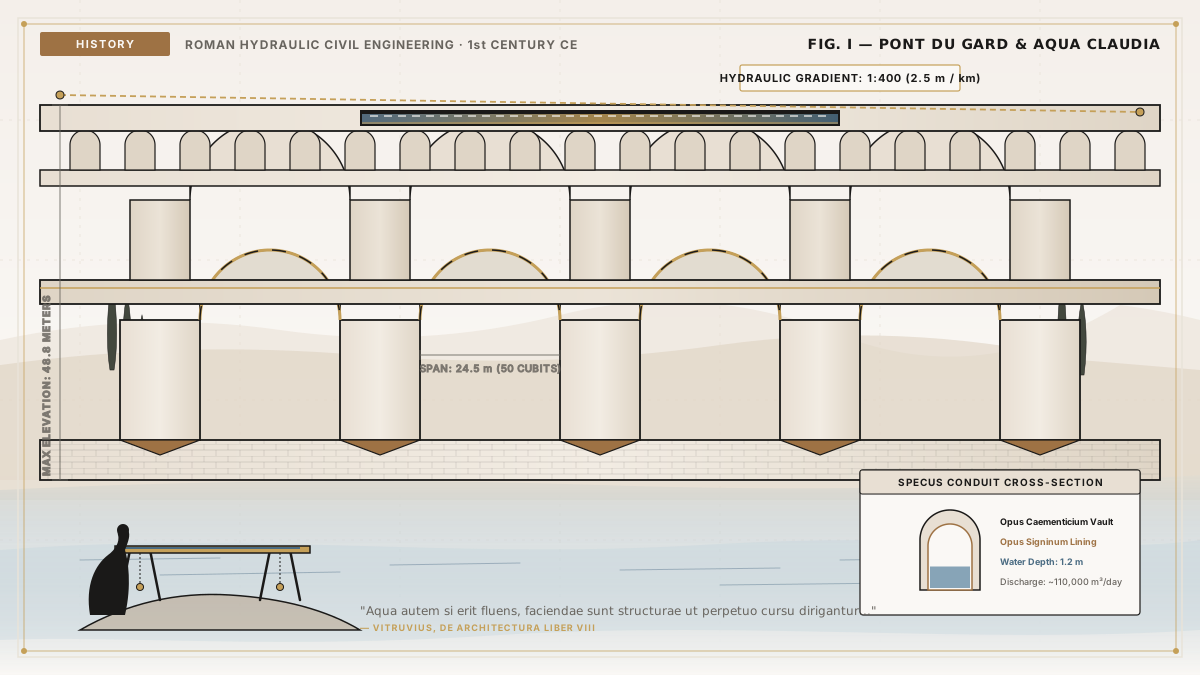
Three things stand out. First, the system was planned as a whole: supply, storage, distribution and disposal were designed together, with the palace's slope doing the work that pumps do today. Second, it was maintained: manholes, vents and accessible sewers show that the builders expected the network to need cleaning and repair, not just admiration. Third, it was durable in concept even where the pipes themselves were modest. The same ideas — spring capture, gravity supply, separate handling of stormwater and waste — reappear in Greek and Roman waterworks centuries later, on a far larger scale. There is a limit to the praise, though. The palace's water network served a palace, not a modern city, and its flow was small. When the Minoan palaces were shaken by earthquakes around 1700 BC and rebuilt, the water systems were rebuilt with them; when Minoan power faded after about 1450 BC, the networks fell out of use. What survives is the underground skeleton: pipes, channels, manholes and drains that still trace, stone by stone, how a Bronze Age palace kept itself watered and clean. For a civilisation that left no plumbing manuals, that skeleton is the manual. The Minoans were not the only ancient people to master water — the first civilisation of the Aegean built its wealth on the same island, and the aqueducts of Rome later carried the same ideas to an imperial scale. But Knossos got there first, and it did so with clay, stone, slope and patience.
Frequently asked questions
Did Knossos really have running water?
Yes, in the sense that water arrived through pipes rather than being carried in jars. The supply was gravity-fed from springs, and the flow through the narrow terracotta pipes was limited, so it served fountains and palace rooms rather than every household tap.
How did the Minoan toilets flush without modern plumbing?
Water poured into a channel beneath or beside the seat carried waste into the palace drains. There was no cistern tank or lever mechanism, so the flush depended on someone pouring water and on gravity doing the rest.
What happened to the Knossos water system?
The palace was rebuilt after earthquakes around 1700 BC, and the wider Minoan world faded after about 1450 BC. The pipes and drains survived underground as ruins, and later builders did not keep the system in use.
Sources
- Minoan and Etruscan Hydro-Technologies, MDPI
- The Cretan cities and palaces: urban hydraulics brought to perfection, Water Engineering in Ancient Civilizations
- Advanced water management and pioneer hydraulic technology in Minoan Crete (Bronze Age), NovoScriptorium