The Max Headroom Broadcast Hijacking of 1987
On November 22, 1987, a masked intruder hijacked two Chicago TV stations, the second for 90 surreal seconds. Nearly four decades on, nobody knows who did it.
Key takeaways
- On November 22, 1987, a figure in a Max Headroom mask hijacked two Chicago TV stations: WGN-TV for under half a minute, then PBS station WTTW for about 90 seconds.
- The pirates aimed a stronger microwave signal at the rooftop receivers that relayed each station's programs from its studio to its transmitter.
- WGN cut the first intrusion short by switching the frequency of its studio link; WTTW's technicians tried to stop the second one but could not.
- The FCC and the FBI investigated, but no one was ever identified, and the default five-year federal statute of limitations ran out in 1992.
- Doctor Who fans who taped the show that night preserved the WTTW intrusion, and a recording has circulated on YouTube since 2006.
On the night of November 22, 1987, someone in Chicago took over television twice and was never caught. A figure in a rubber Max Headroom mask broke into WGN-TV's evening news for less than half a minute, then, two hours later, hijacked a PBS broadcast of Doctor Who for about 90 seconds of garbled, bizarre performance before vanishing. Nearly four decades later, nobody knows who did it, and Motherboard has called it television's most infamous hack.
What did viewers see on November 22, 1987?
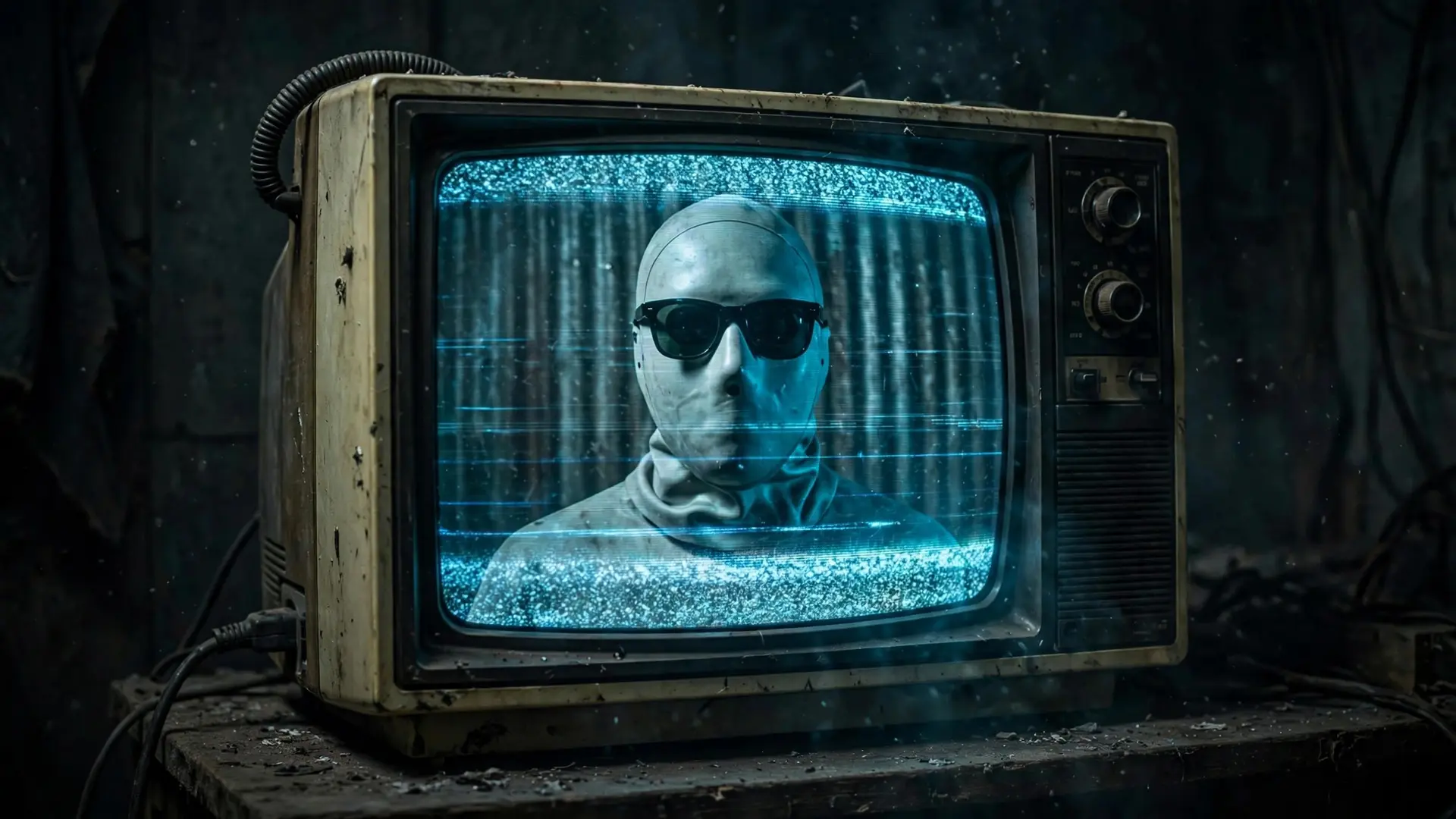
The first intrusion came at 9:14 p.m., while WGN's The Nine O'Clock News was showing taped highlights of a Chicago Bears game. The picture went dark. Then a man appeared wearing dark glasses and a Max Headroom mask, bobbing in front of what looked like a spinning sheet of corrugated metal, a cut-price copy of the geometric backdrop from the real Max Headroom show. There was no speech, only a harsh buzz. Chicago newspapers timed it at roughly 25 to 28 seconds. Then a WGN engineer moved the link that carried the newscast to the station's transmitter, on top of the John Hancock Center, onto a different frequency, and the pirate disappeared. Back on camera, sports anchor Dan Roan offered the only possible comment, recorded by Motherboard as: "Well, if you're wondering what's happened, so am I." The intruder's second appearance was longer and much stranger. Shortly after 11 p.m., WTTW, Chicago's public television station, was showing the Doctor Who story Horror of Fang Rock when the picture broke into wobbling lines and the masked figure returned, this time with a distorted voice. For about a minute and a half he lurched through a string of half-audible non sequiturs. He called someone a "frickin' nerd," said he thought he was "better than Chuck Swirsky," a WGN Radio sports host, and added "frickin' liberal." He waved a Pepsi can and said "Catch the wave," the slogan the real Max Headroom was then selling for Coca-Cola. He hummed the theme from the cartoon Clutch Cargo, shouted "I still see the X!", and bragged of a "giant masterpiece" for "the greatest world newspaper nerds," a jab at WGN, whose call letters stand for the Chicago Tribune's motto, World's Greatest Newspaper. He even held up a glove and announced that his brother was wearing the other one. The finale was cruder still. After a jump cut, "Max" was bent over with his bare buttocks exposed, the mask dangling near the lens, while a woman the Chicago Tribune described as standing off camera paddled him with a flyswatter and he screamed, "They're coming to get me!" The picture broke up, and Doctor Who came back. At the station's studios on the city's North Side, technicians had tried to take corrective measures and failed, WTTW told the Associated Press. "By the time our people began looking into what was going on, it was over," WTTW spokesman Anders Yocom told the Chicago Tribune. Like the Wow! signal picked up by an Ohio radio telescope a decade earlier, it was a brief, strange transmission that has never been fully explained.
How did the pirates take over the signal?
The trick was radio, not software. In 1987, Chicago stations sent their programs from their studios to transmitters on the city's tallest buildings over microwave links: narrow beams aimed at receiving antennas on downtown skyscrapers — on the Sears Tower (now Willis Tower) for WTTW's link, and a similar rooftop receiver for WGN's. The pirates fed those receivers a stronger signal than the stations' own. Michael Marcus, a former FCC official, told Motherboard in 2013 that he believed the culprit "got close to the receiving end" and simply outmuscled the more distant, legitimate feed. The receivers locked onto the pirate signal and passed it to the transmitters, so every set tuned to those channels showed the intruder's tape. It was a tape, too: Motherboard noted the scan lines that mark the start of a VHS recording. Where "close" was remains unknown. WGN's engineering director, Robert Strutzel, suggested a high-rise apartment or a rooftop somewhere between the station's Northwest Side studios and the Hancock antenna, and FCC searchers concentrated on the north and northwest of the city. How much skill and money it took is still argued over. Strutzel told the Chicago Sun-Times it was "not the kind of thing that's done by somebody in his basement," and put commercial-grade equipment at around $25,000, though he added that it could be rented. Marcus was less impressed: he thought secondhand gear from the amateur radio market and a dish about the size of a satellite-TV antenna might have been enough. That kind of hijack is much harder now. As television moved to digital and satellite transmission (full-power US stations ended analog broadcasting on June 12, 2009), signal piracy became far more difficult, though not impossible. In 2013, intruders broke into Emergency Alert System equipment and put fake warnings about zombies on the air at TV stations in Michigan and Montana.
Why was no one ever caught?
The FCC quickly opened an investigation, and agents from the FBI's Chicago office later joined it. An FCC spokeswoman told the Chicago Sun-Times that the culprits risked fines of up to $100,000 and a year in jail; the Chicago Tribune, quoting an unnamed FCC official the same day, put the maximum fine at $10,000. Neither mattered, because nobody was found. The same spokeswoman explained the problem: the FCC could usually trace a rogue signal only if it stayed on the air for several minutes, and these lasted less than two. Marcus later recalled that the agency's man in Chicago "didn't want to start knocking on doors," and he called the hacker "the one that got away." Theories have filled the gap. Chris Knittel, who investigated the case for Motherboard, has pointed to layoffs in the months before the incident as a possible motive for an insider, while stressing that there is no hard evidence. In 2010, a Reddit user named Bowie Poag wrote that he believed he knew who was behind it: two brothers, identified only as J and K, whom he had known through Chicago's computer bulletin-board scene. He offered no proof, and later posted that both had been ruled out and that his theory was wrong. No one has credibly claimed responsibility.
There is one final legal twist. With no specific limit set for this offense, the default federal statute of limitations of five years applied, so it ran out in 1992. The people responsible could now come forward without facing prosecution. None has. Even the man found on an Australian beach in 1948 eventually got a name, when DNA identified the Somerton Man in 2022. The Max Headroom pirates left no body and no DNA, only a tape.
Who do investigators think was behind the hijacking?
No suspect was ever charged, but the theories have names attached. Chris Knittel, who investigated the case for Motherboard, noted layoffs at Chicago stations in the months before the incident and raised the possibility of a disgruntled insider, while stressing there is no hard evidence for it. The technical skill on display — overpowering a microwave studio link — suggests someone who knew broadcast engineering, which keeps the insider theory alive. The most specific claim came in 2010, when a Reddit user writing as Bowie Poag said he believed two brothers, identified only as J and K, were responsible, men he had known through Chicago's computer bulletin-board scene. He offered no proof. Five years later he posted that both men had been ruled out and his theory was wrong. That is the entire suspect list: a motive without a person, and two initials that led nowhere. With the five-year federal statute of limitations expiring in 1992, even a confession today would carry no prosecution. The pirates could claim the stunt whenever they like. None ever has.
Why did the hijacker choose Max Headroom?
Part of what makes the incident endure is the disguise. Max Headroom began in a 1985 British TV film as a supposedly computer-generated presenter; in reality he was the actor Matt Frewer in latex makeup, with the picture treated to look digital. By 1987 he had his own US drama series on ABC, set in a future where television networks hold the real power, and he was the face of New Coke's "Catch the Wave" advertising. A pirate in a Max mask, waving a Pepsi on a hijacked channel, was mocking the character, the corporation and the medium all at once. The stunt also had a recent precedent. In the early hours of April 27, 1986, a Florida satellite-dish installer calling himself Captain Midnight overrode HBO's satellite feed for more than four minutes to protest its $12.95 monthly charge to dish owners. He was caught, fined $5,000 and put on probation. The Max Headroom crew brought the idea down to local television, added a costume and a script, and got away with it. The footage survived because Doctor Who fans routinely taped the show; WTTW said it had no trouble finding a copy, and Rick Klein, founder of the Museum of Classic Chicago Television, posted a recording to YouTube in 2006. Motherboard later called the hack a "cyberpunk hacking trope," and in November 2025 WGN staged a tongue-in-cheek re-run on its own morning news. Nearly forty years on, the Max Headroom hijacking remains unsolved in an age when almost nothing is. Analog microwave links left no server logs, no IP addresses, no digital trail, just a transmitter somewhere in Chicago, aimed at two towers on one Sunday night in November. Television's strangest ninety seconds were made with equipment that is long obsolete, in a broadcast system that has since changed beyond recognition, by people who were never found.
Frequently asked questions
How did the hijackers take over the TV signal?
They aimed a stronger microwave signal at the receiving antennas atop downtown skyscrapers, which normally picked up each station's programs from its studio. The receivers locked onto the pirate signal instead.
Were the Max Headroom hijackers ever caught?
No. The FCC and the FBI investigated, but no one was identified, and the five-year federal statute of limitations ran out in 1992, so the culprits could no longer be prosecuted.
Why did the first hijacking end so quickly?
An engineer at WGN switched the frequency of the link carrying the newscast to the station's transmitter, cutting the pirate off after less than 30 seconds. WTTW's technicians could not stop the second intrusion, which ran for about 90 seconds.
Sources
- Remember, Remember the 22nd of November, Damn Interesting
- Scare Yourself Silly..., The Toast
- When 'Captain Midnight' Hacked HBO, Mental Floss
- The Unsolvable Mystery of the Max Headroom Incident, Joe Scott
- The Mystery of the Creepiest Television Hack by Chris Knittel · Longform, Longform