The Somerton Man: Australia's Strangest Unsolved Case
In 1948 a well-dressed man died on an Australian beach with a coded note in his pocket and no name. DNA finally identified him in 2022 — but the mystery is not over.
A man died on a beach in December 1948 and carried nothing that could name him. Seventy-four years later, science finally gave him a name — Carl "Charles" Webb. But here's the strange part: knowing who he was barely dented the mystery at all.
The Somerton Man case is one of the great unsolved puzzles of the 20th century, a story with a spy-thriller surface and a heartbreakingly ordinary center. And even now, with the name revealed, nobody can say for certain how he died, why he was there, or what his final message meant.
The morning of December 1, 1948
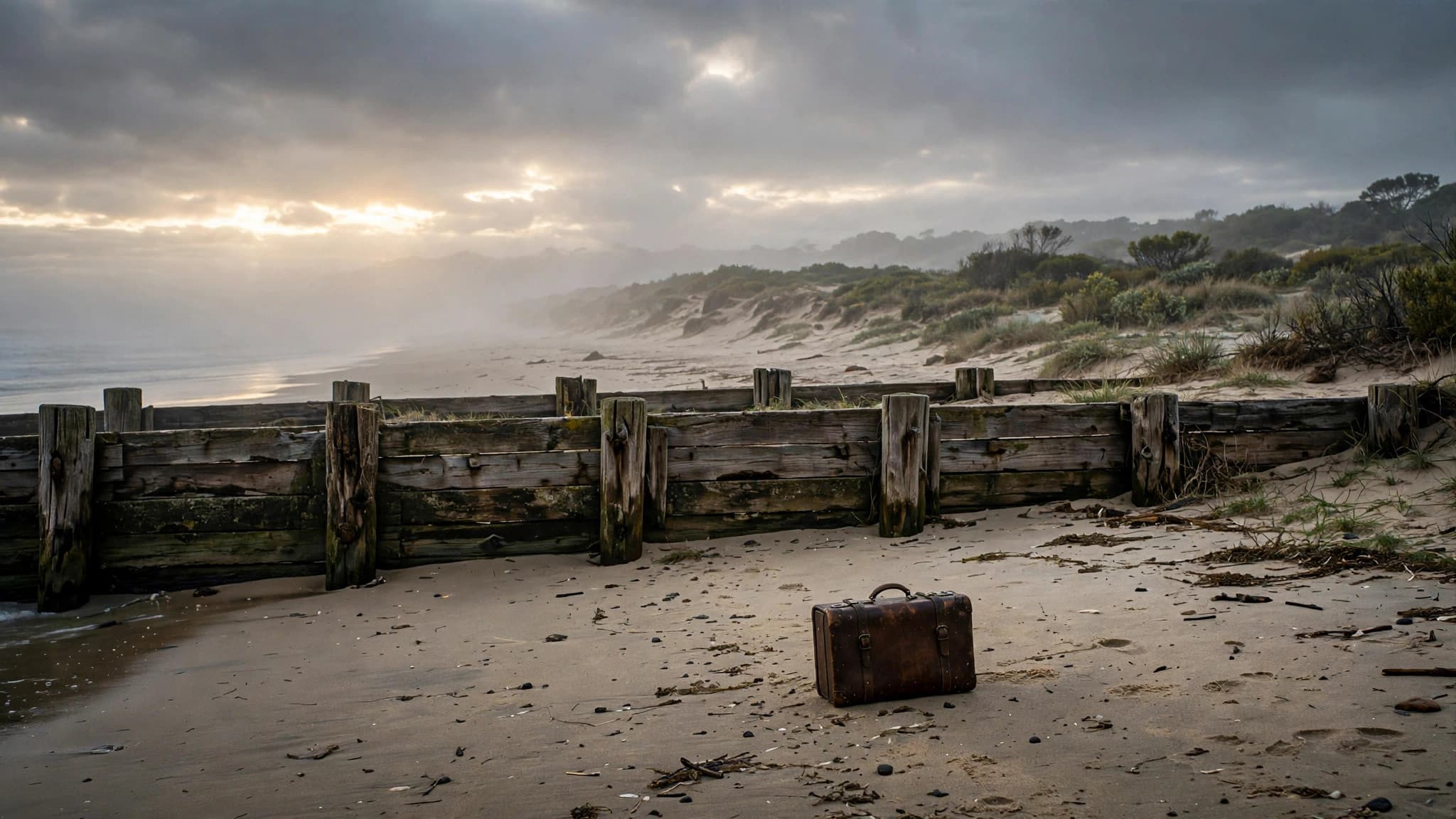
A well-dressed man was found slumped against the seawall at Somerton Beach, just south of Adelaide, in the early morning of December 1, 1948. There were no wounds, no signs of a struggle. His pockets held no wallet, no keys, no identification at all. And every maker's label had been carefully removed from his clothes.
That detail — the labels — is what turned an ordinary unexplained death into a national obsession. Someone had deliberately stripped this man of his identity. Investigators also noted the strange contents of a fob pocket in his trousers: a small scrap of paper, torn from a page, printed with the words Tamám Shud — Persian for "it is finished."
The phrase led police to a book: a rare 1941 New Zealand edition of Edward FitzGerald's translation of The Rubaiyat of Omar Khayyam, a collection of Persian poetry. The scrap had been torn from its final page. And on the book's back cover, someone had written a sequence of letters in pencil — a code that generations of amateur and professional cryptographers have tried and failed to crack. Inside the book, police also found a phone number that led them to a young nurse living just minutes from where the body was found.
That nurse, later identified as Jo Thomson, denied any knowledge of the man. But reports from the time said she seemed shaken when shown a bust made from his face. Her son would later be noted to share physical characteristics with the dead man, feeding decades of speculation that she knew far more than she admitted.
The autopsy deepened the enigma. The pathologist found organ damage suggesting poisoning, but no trace of any poison in the body. No cause of death could be established, and none ever has been. Theories blossomed: a Cold War spy assassinated with an undetectable toxin, a jilted lover staging a poetic suicide, a man living under a false identity who simply ran out of road.
A clue hiding in the clothes
For seven decades, the investigation stalled on the same set of clues. Then came an almost accidental breakthrough from an unexpected source: one of the man's clothing tags read "T. Keane."
In July 2022, Professor Derek Abbott of the University of Adelaide and American genealogist Colleen Fitzpatrick announced they had identified the Somerton Man through forensic genealogy. Working from DNA extracted from hairs preserved in a plaster cast of the man's face — made by police more than 50 years earlier — they built a family tree of roughly 4,000 people, narrowing branches by comparing genetic matches in public databases until one name remained: Carl "Charles" Webb.
Webb was born in Melbourne on November 16, 1905. He was an electrical engineer and instrument maker — an ordinary man, by all accounts, with no criminal record and no known intelligence connections. He had never been reported missing; his family had simply lost touch with him years earlier.
And the "T. Keane" tag? Webb had a brother-in-law named Thomas Keane. The most sinister clue of the original investigation dissolved into something utterly mundane: hand-me-down clothes and a relative's luggage. Many of the other "spy" flourishes, investigators now suspect, may have had equally ordinary explanations all along.
There was one more human detail. Webb had separated from his wife, Dorothy Robertson, and records showed she had moved to South Australia. The trip to Adelaide may have been an attempt to find her — to reconcile, or to confront her. Read in that light, Tamám Shud — "it is ended" — might have referred not to his life but to his marriage.
The identification that changed nothing — and everything
South Australia Police never formally and definitively certified Abbott's conclusion, though they found no evidence to disprove it. The identification rests on genetic genealogy rather than a direct body-to-family DNA match, and it was challenged by some researchers. But the DNA work also conclusively killed one beloved theory: it ruled out the possibility that the Somerton Man was the biological grandfather of Abbott's own wife, a connection she had long suspected.
More importantly, the case stands as a rare thing: a partially solved mystery. We know, with high confidence, that the man on the beach was Carl Webb. But we still don't know how he died. We don't know why he traveled to Adelaide, what the pencil-written code on the Rubaiyat says, or whether Jo Thomson was connected to him. The cause of death remains officially undetermined.
Like the great unsolved disappearance of the Mary Celeste or the riddle of the Voynich Manuscript, the case shows how a mystery can survive the answer. The facts got in; the meaning leaked out.
What the case really tells us
Strip away the spy fantasies and the Somerton Man becomes something sadder and stranger: a portrait of a man who erased himself before anyone else could. He removed his labels. He left no note, except a torn phrase from a book of Persian poetry about the end of things. Whether he meant to disappear or meant to die, he succeeded in one way for 74 years — nobody knew his name.
The forensic genealogy that finally named him belongs to the same revolution that caught the Golden State Killer: old evidence, new math, public databases. Cold cases everywhere are being reopened by the same tools, and the Somerton Man is their most poetic proof of concept.
But the DNA could only answer the easiest question. "Who was he?" turned out to be trivial next to "What happened to him?" — and that question is still sitting on the beach at Somerton, in the cold light of a December dawn, waiting.