Why Do We Say Cheese When Taking Photos?
The story behind 'say cheese': a 1943 Texas newspaper, mouth-shaping phonetics, and why Victorians said 'prunes' before smiling ever became standard.
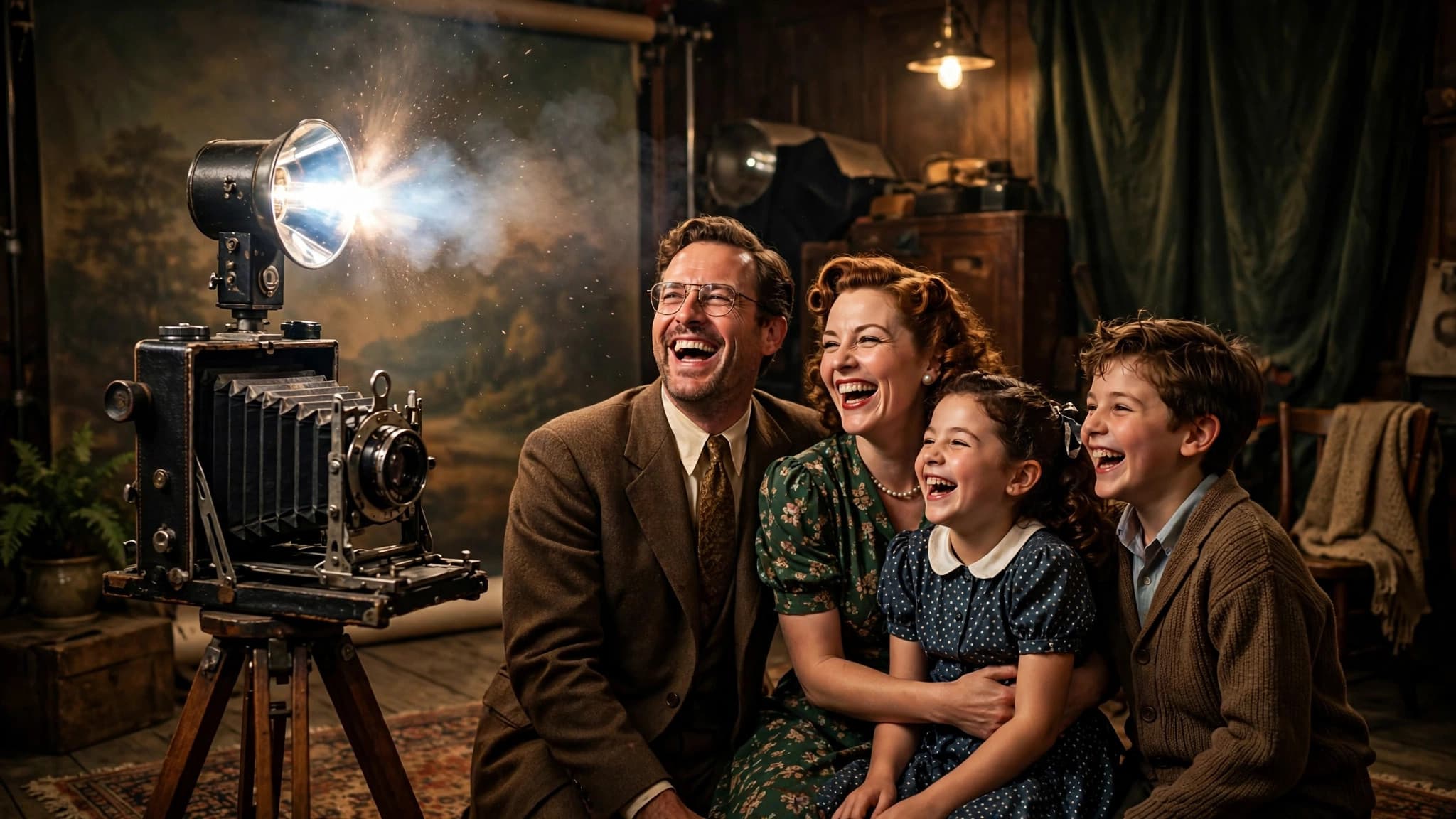
Say "cheese" and your mouth automatically forms a grin: the "ch" positions your teeth while the long "ee" pulls the corners of your lips back. The phrase was first recorded in an American newspaper in 1943, popularized as a smile trick by a former U.S. ambassador. So it is not about dairy at all — it is phonetic engineering.
The Phonetics of an Automatic Smile
The leading explanation for why "cheese" works is disarmingly mechanical. Say it out loud and feel what happens: the "ch" sound makes your teeth come together, and the long "ee" stretches your lips sideways. The combined shape is uncannily close to a smile, and the effect lands on everyone in the frame at the same time — which is exactly what a photographer needs with a group.
No one can say with absolute certainty who coined the phrase, but the "why this word" question has a strong leading theory. "Cheese" was not chosen for its meaning but for its mouthfeel. It is a piece of sound design: a two-syllable trigger that turns a room full of strangers into a chorus of matching grins without anyone having to think about what their face is doing. Try it in a mirror — the effect is instant, which is why the trick has survived eight decades without any improvement.
There is also a practical genius to its length. "Cheese" takes a fraction of a second to say, so a photographer can cue the smile and trip the shutter almost simultaneously. Longer phrases would let the expression collapse before the exposure. And because nearly everyone in an English-speaking crowd already knows the routine, it doubles as a countdown: the word itself tells people the photo is about to happen, reducing the startled, mid-blink faces that ruin group shots.
A 1943 Newspaper and a Former Ambassador
The earliest known printed reference appears in The Big Spring Herald, a Texas newspaper, in 1943. The article, titled "Need To Put On A Smile? Here's How: Say 'Cheese,'" described a formula for looking pleasant when your picture is taken — attributed to former U.S. ambassador Joseph E. Davies.
Davies reportedly called it "an automatic smile," explaining that he had learned it from a politician, though he declined to say who. Given that Davies served as ambassador to the Soviet Union under President Franklin D. Roosevelt — a leader famous for his camera-ready grin — many have guessed the unnamed politician was Roosevelt himself. Whether the president invented it or merely passed it along is lost to history — a linguistic puzzle with an anonymous author, much like the Voynich manuscript, one of history's most famous unsolved ciphers. But soon after, photographers everywhere were using it.
When Photographs Stopped Being Somber
To understand why the trick arrived in the 1940s, look at what came before. In the 19th century, almost no one smiled in photographs. Long exposure times made holding a grin impractical, and the expense of a portrait meant the result was treated like a formal painting — smiles were considered frivolous and unserious.
Photographers of the era reportedly used the opposite cue: "say prunes." The "pr" sound pulls the lips inward, producing the tight, small mouth that matched Victorian standards of dignity. Then cameras became cheap and fast — Kodak's introduction of the $1 Brownie camera around 1900 put photography in ordinary hands — and the snapshot era began. Casual, everyday moments replaced formal portraits, and the happy expression won. "Cheese" was simply the right word at the right moment in history, the way certain bizarre mass phenomena can only be understood as products of their own strange times.
"Say Cheese" Around the World
Other languages invented their own smile-triggering words, and they follow the same phonetic logic. In Korea, people say "kimchi" — pronounced "kim-chee" — because the "chee" ending stretches the mouth into a big grin, often paired with a V-sign. In China, the go-to is "qiezi" (茄子), meaning "eggplant," for similar mouth-shaping reasons.
Japan has a particularly charming variant: the photographer asks "ichi tasu ichi wa...?" — "one plus one is...?" — and the group responds "niiii!" ("twoooo!"), holding the "ee" sound for the camera. The universality of the trick suggests something deeper than fashion: human faces respond to sound the same way everywhere, and every culture has found a word that turns that quirk into a photograph.
Does It Actually Make a Better Photo?
Here is the twist: professional photographers are increasingly ambivalent about "cheese." The grin it produces is a forced, mouth-only smile. Researchers of facial expression distinguish this from the Duchenne smile — the genuine kind that engages the muscles around the eyes as well as the mouth. The "cheese" smile rarely reaches the eyes, which is why group photos can look oddly cheerful and slightly hollow at the same time.
Modern portrait photographers often avoid the word entirely, instead telling jokes or asking subjects to think of something they love, chasing a real expression rather than a triggered one. And the selfie era has complicated things further: with the photographer and the subject now the same person, the shouted cue has quietly given way to the silent, rehearsed "Instagram face." Still, the phrase refuses to die. It has become what linguists call a ritual utterance — valued less for its literal effect and more for the shared understanding it creates. When someone says "cheese," everyone in earshot knows exactly what is about to happen, and the moment becomes a tiny, synchronized performance. The word endures mostly as a social signal — a cue that the moment is happening, and that it is okay to be happy in it.
Takeaway: We say "cheese" because the word's sounds physically sculpt the mouth into a smile — a trick first printed in a 1943 Texas newspaper and attributed to an American ambassador. It caught on as cheap cameras made smiling in photographs normal, replacing the Victorian "say prunes" era. The dairy was never the point; the phonetics were.