
Why Do Onions Make You Cry? The Chemistry Explained
Slicing an onion releases a volatile gas that stings your eyes. Follow the chain reaction from soil sulfur to syn-propanethial-S-oxide — and how to cry less.
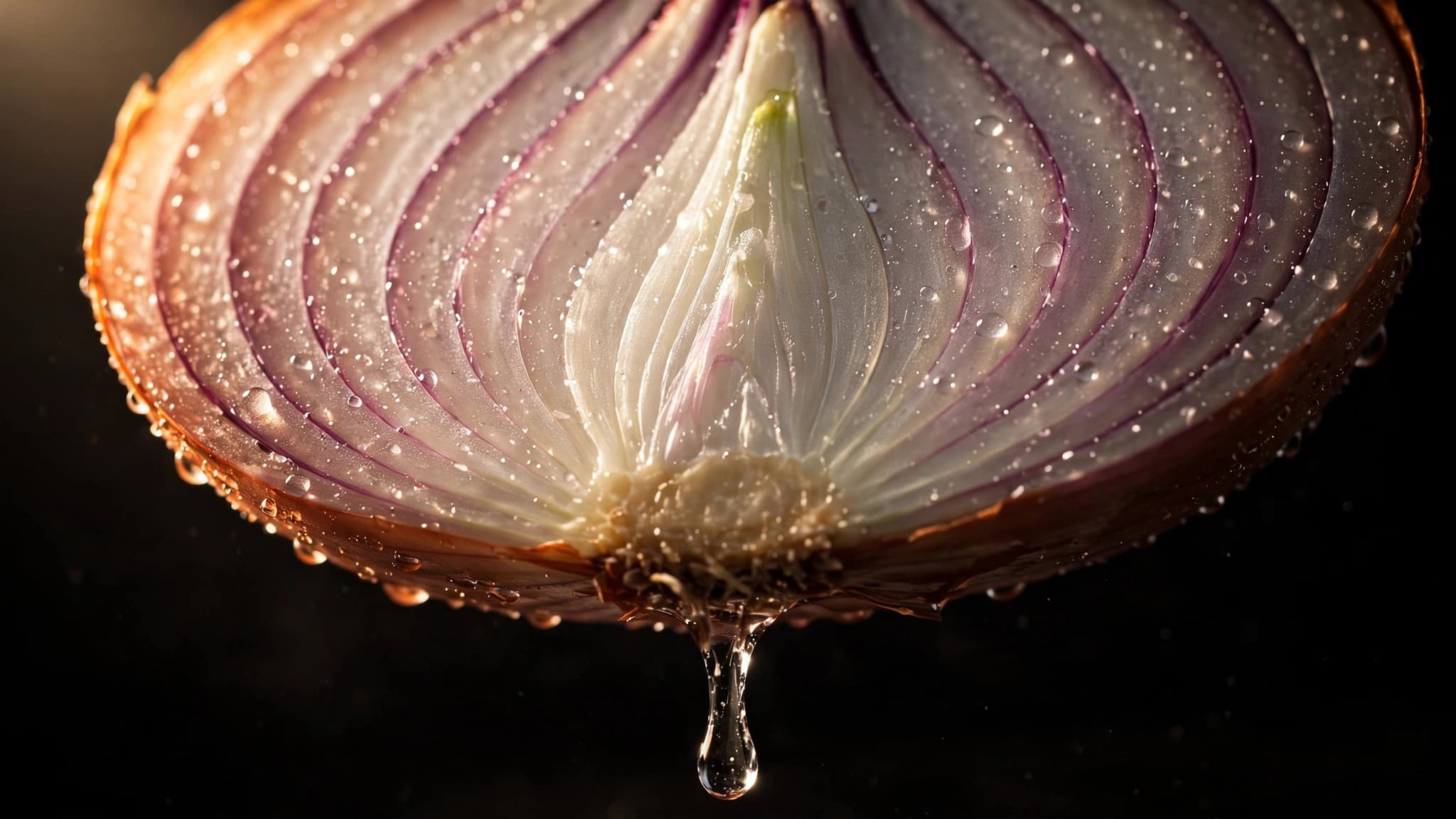
It is not emotion — it is chemical warfare. Slicing an onion breaks open its cells and triggers a cascade of reactions that release a volatile gas called syn-propanethial-S-oxide. That gas drifts up into your eyes, irritates the sensory nerves in your cornea, and your brain answers with tears. The onion, quite literally, is defending itself.
A Chain Reaction Inside Every Cut
Inside an intact onion, the ingredients for tears are kept carefully separated. Sulfur absorbed from the soil is stored in compounds called cysteine sulfoxides, while enzymes like alliinase sit apart from them in sealed compartments within the cells. Nothing happens — until your knife destroys the barriers.
The moment cells rupture, alliinase meets the sulfur compounds and converts them into sulfenic acids. Then a second enzyme unique to onions — lachrymatory factor synthase — rearranges those acids into the lachrymatory factor, known to chemists as syn-propanethial-S-oxide (or propanethial S-oxide). This is the compound that makes you cry, and producing it requires a remarkably precise sequence of events. A 2017 study in ACS Chemical Biology finally mapped how the synthase enzyme's active site repositions chemical bonds to manufacture it.
What makes the lachrymatory factor so effective is its volatility. It evaporates almost instantly from the cut surface, wafts upward, and dissolves into the tear film covering your eyes. It belongs to the same broad family of drifting molecules as the ones behind the unmistakable scent of old books — chemistry you can smell, or in this case, feel. The irritation triggers sensory nerves in the cornea, and your eyes water to wash the invader away. The amount is tiny — far too small to cause harm — but your eyes treat it as an emergency anyway. You may have heard that the gas turns into sulfuric acid on contact with your tears; while that vivid claim circulates widely, chemistry explainers more precisely describe the compound dissolving into the tear film as sulphenic acid, directly irritating the sensory nerves. Either way, the result is the same: your eyes water to flush the invader out. It is a beautiful bit of chemistry from the onion's perspective, and a minor tragedy from yours.
An Underground Defense System
Onions are bulbs that live in the soil surrounded by hungry creatures, and they cannot run. So, like many plants, they evolved chemistry instead of legs. Chemist Eric Block, author of the definitive scientific book on onions and their allium relatives, describes the design as ingenious: each cell contains sealed, enzyme-filled vacuoles that break open when the tissue is damaged, unleashing a cascade of reactions "within an instant."
The tears are collateral damage. The target was never the cook — it was the pests and grazing animals that would otherwise eat the bulb alive. Garlic, a close relative, uses a similar but simpler system: its sulfur compounds give it pungent flavor and smell without the tear gas. Onions went one step further, recruiting that extra synthase enzyme to build a weapon that floats — another case of everyday chemistry hiding in plain sight, like the reason flamingo feathers turn pink. That this microscopic defense system, tuned by evolution against soil-dwelling attackers, still works perfectly against a human in a kitchen millions of years later is strangely impressive.
Why Some Onions Are Crueler Than Others
Not all onions bring equal suffering. Yellow, red, and white onions carry high concentrations of the sulfur compounds and enzymes needed to make the lachrymatory factor, which is why they sting the most. Sweet onions, green onions, and scallions carry less of the necessary chemistry, so they burn your eyes far less. The difference comes down to sulfur: more sulfur in the growing conditions, more tear gas in the bulb.
Scientists have even bred the tears out entirely. The Sunion, developed over more than three decades of cross-breeding, produces almost no irritants when cut — no genetic modification involved. Its volatile compounds actually decrease during storage, making it milder and sweeter over time, the opposite of ordinary onions. Each harvest is even certified tearless and sweet by a trained sensory panel before shipping. It is proof that the tear factor is a dial the plant carries, not a fixed fate. For the rest of us chopping ordinary onions, the strategy has always been to outsmart the chemistry rather than remove it.
Tricks That Actually Work
The chemistry suggests the fixes. Cooling an onion before cutting slows the enzymes and changes the reaction chemistry, so refrigerating it for 30 minutes genuinely reduces tears. Cooking inactivates the enzymes entirely, which is why a pot of sautéing onions may smell strong but never stings your eyes. A sharp knife matters too: clean cuts rupture fewer cells than a dull blade's crush, releasing less gas.
Goggles or a fan work because they solve the real problem — the gas reaching your eyes. Cutting under running water traps the volatile compounds before they can evaporate. There is also a technique tip worth knowing: leave the root end of the onion intact until last. The root end holds the highest concentration of the sulfur compounds, so slicing through it first floods the air with the maximum dose. Halve the onion through the root, then work with the pieces root-side down.
What does not work as well? The folk remedies. Lighting a match, chewing bread, or breathing through your mouth are considerably less effective, if they work at all, according to chemistry explainers — desperation, as they say, is the mother of invention. The lit-match theory assumes the flame burns off the gas, but the amount of air a match can process is negligible next to what your chopping releases. The surest approach is the boring one: cold onion, sharp knife, leave the root for last, and keep the gas from reaching your eyes.
Takeaway: Onions make you cry because cutting them mixes separated enzymes and sulfur compounds into syn-propanethial-S-oxide, a volatile gas evolved as a defense against underground pests. Your tears are your eyes flushing out the irritant. Chilling the onion, using a sharp knife, and blocking the gas from reaching your eyes are the only tricks with real chemistry behind them.