Why Old Books Smell Distinctive: The Chemistry of Decay
That warm vanilla-and-almond scent of antique books is chemistry in action: degrading paper releases vanillin and other compounds that bibliophiles treasure.
Step across the threshold of an antique library, a centuries-old monastic archive, or a crowded secondhand bookshop, and your brain is greeted by an immediate, unmistakable sensory signature. Before your eyes adjust to the dim, amber lighting, and before your fingers brush the textured cloth bindings, your olfactory receptors register a warm, intoxicating fragrance: a rich, comforting bouquet of sweet vanilla, dried almonds, dusty parchment, damp autumn grass, and distant cedar smoke.
This nostalgic aroma possesses such cultural resonance that perfumers bottle it, candle makers market it as "Library Dusk," and bibliophiles revere it like vintage wine.
Yet in the dispassionate light of organic chemistry and material conservation, the romantic scent of old books is not an intentional creation of paper artisans. It is the chemical aroma of slow, irreversible mortality: a sweet sensory byproduct released as cellulose and lignin quietly self-destruct over centuries.
"The smell of an old book is the smell of a tree decomposing in slow motion inside your hands." — Matija Strlič, Professor of Heritage Science, University College London (2009)
The Paper Revolution: From Linen Rag to Ground Wood Pulp
To decode the fragrance of antique paper, one must understand the drastic technological transition in papermaking that transpired during the mid-nineteenth century.
Prior to 1845, European books were printed on rag paper manufactured from discarded linen textiles and cotton rags:
- Rag paper was composed of nearly pure cellulose fibers.
- It was chemically neutral or slightly alkaline.
- Books manufactured during the Renaissance and early Enlightenment were virtually odorless and remarkably resilient, surviving for half a millennium without significant yellowing.
The nineteenth century, however, brought the Industrial Revolution, high-speed steam printing presses, and the rapid expansion of mass literacy. The supply of cotton and linen rags could not meet the voracious demand for paper.
In the 1840s, German inventor Friedrich Gottlob Keller patented a process to manufacture paper from cheap, abundant ground wood pulp. Within decades, virtually the entire publishing industry transitioned to wood-pulp paper.
While wood pulp made mass-market newspapers, paperbacks, and Victorian novels economically accessible to the working class, it introduced an internal chemical time bomb: lignin.
Tree Wood -> High Lignin & Cellulose Pulp (1850s-1980s)
  └── Acid Sizing (Alum-Rosin Additives)
       └── Acid Hydrolysis + Oxidation
            └── Breakage of Polymer Chains
                 └── Volatile Organic Compounds (VOCs) Released:
                      - Vanillin (Vanilla scent)
                      - Benzaldehyde (Bitter almond scent)
                      - Ethyl Hexanoate (Floral apple hint)
                      - Furfural (Grassy, toasted bread aroma)
The Chemistry of Decay: Acid Hydrolysis and Oxidation
Lignin is the complex organic polymer that binds cellulose fibers together in vascular plants, giving tree trunks their rigidity. Chemically, lignin is an aromatic polymer composed of phenolic sub-units.
When untreated wood pulp is converted into paper, two destructive chemical reactions commence:
1. Acid Hydrolysis
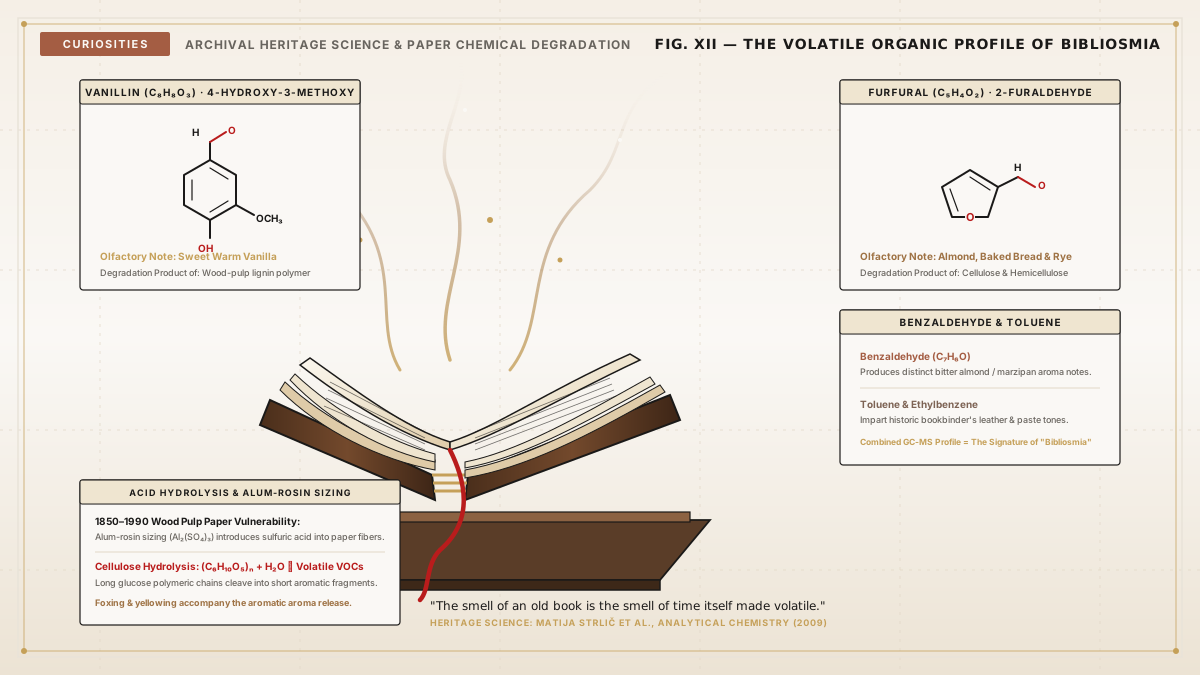
To prevent liquid ink from feathering and soaking into porous wood fibers, Victorian papermakers added sizing agents made of alum-rosin (aluminum sulfate). When exposed to ambient atmospheric moisture, aluminum sulfate dissociates, forming sulfuric acid. The acid catalyzes acid hydrolysis, slicing the long glucose polymer chains of cellulose into tiny fragments, causing paper to become brittle, yellow, and fragile.
2. Photo-Oxidation
Exposure to oxygen and ambient ultraviolet light breaks down the complex aromatic rings of lignin. The resulting oxidation creates chromophores (which turn bright white paper into deep yellow and brittle brown) while venting hundreds of microscopic airborne molecules into the surrounding atmosphere.
These airborne molecules are Volatile Organic Compounds (VOCs). When you inhale the aroma of an old book, your olfactory bulb is identifying a complex chemical fingerprint composed of dozens of distinct VOCs.
The VOC Bouquet: Deciphering the Fragrance Notes
In 2009, a team of heritage scientists led by Professor Matija Strlič at the Centre for Sustainable Heritage at University College London utilized gas chromatography-mass spectrometry (GC-MS) to isolate the volatile organic compounds released by historic library collections.
Their research revealed the exact chemical compounds responsible for the sensory bouquet of antique paper:
+---------------------+-------------------------------+----------------------------------+
| Chemical Compound   | Characteristic Aroma Note     | Chemical Origin & Degradation    |
+---------------------+-------------------------------+----------------------------------+
| Vanillin            | Sweet, creamy vanilla         | Breakdown of lignin polymers     |
| Benzaldehyde        | Bitter almond, marzipan       | Thermal and oxidative degradation|
| Furfural            | Grassy, toasted bread, baked  | Hydrolysis of pentosan sugars    |
| Ethyl Hexanoate     | Sweet, floral, hint of apple  | Fatty acid esterification in glue|
| Toluene             | Faint pungent cedar, leather  | Degradation of binding adhesives |
| Hexanal             | Fresh cut green grass         | Lipid oxidation in binding resins|
+---------------------+-------------------------------+----------------------------------+
The dominant note in antique book scent—vanillin—is chemically identical to natural vanilla extract. Because lignin is structurally closely related to vanillin, the slow breakdown of wood-pulp paper literally manufactures airborne vanillin molecules. When combined with the marzipan hints of benzaldehyde and the toasted bread warmth of furfural, the brain perceives a rich, comforting fragrance reminiscent of pastry bakeries and vintage leather.
Degradomics: Olfactory Diagnostics in Historic Archives
Far from a mere poetic curiosity, identifying the smell of old books has emerged as a serious scientific conservation methodology known as historic degradomics.
Professional archivists and library conservators at institutions such as the British Museum and the Library of Congress were historically forced to perform destructive testing—snipping tiny paper margins to measure chemical acidity via pH meters.
Today, conservators deploy non-destructive solid-phase microextraction (SPME) probes that sample the air inside library vaults:
- High concentrations of acetic acid (vinegar odor) indicate rapid degradation of cellulose acetate film and bindings.
- Elevated concentrations of furfural alert conservators that paper embrittlement is accelerating before pages physically crumble to the touch.
By sampling the library's atmospheric bouquet, conservators can identify at-risk volumes and move them to cold-storage archives, purging moisture and oxygen to halt the degradation reaction in its tracks.
The Modern Paradox: Why New Books Lack the Magic
If you press your nose into a newly minted paperback purchased this morning, the sensory experience is radically different. Instead of sweet vanilla, you will smell sharp, crisp industrial chemicals: petroleum-based synthetic inks, volatile vinyl polymer adhesives (polyvinyl acetate), and bleaching agents like hydrogen peroxide.
Since the late 1980s, global paper mills have transitioned to alkaline, acid-free paper (ISO 9706 standard), replacing alum-rosin sizing with calcium carbonate buffers and removing lignin from wood pulp.
Modern acid-free books will endure for hundreds of years without crumbling into yellow dust. But in curing the disease of paper decay, modern technology also eliminated its poetry: books published today will never develop the sweet, intoxicating vanilla aroma that enchanted generations of antique library visitors.
Key Takeaways
- The Lignin Revolution: The sweet aroma of old books is primarily found in books printed between 1850 and 1980, when ground wood pulp containing high levels of lignin replaced cotton rag paper.
- Natural Vanillin: The dominant vanilla fragrance note is genuine vanillin, released as atmospheric moisture and oxygen break down the aromatic phenolic polymers of lignin.
- The GC-MS Chemical Fingerprint: The classic bouquet is a multi-part volatile organic compound (VOC) cocktail of vanillin (vanilla), benzaldehyde (almond), and furfural (toasted grass).
- Heritage Degradomics: Conservators analyze VOC signatures in library air to non-destructively diagnose the hidden decay rate of fragile historical collections.
Chemical Conservation Literature & Heritage Science Studies
- Strlič, Matija, et al. "Material degradomics: on the smell of old books." Analytical Chemistry, vol. 81, no. 20, 2009, pp. 8617–8622.
- Bembibre, Cecilia, and Matija Strlič. "Smell of heritage: a framework for the identification, analysis and documentation of historic odours." Heritage Science, vol. 5, no. 2, 2017, pp. 1–11.
- Carter, H. A. "The Chemistry of Paper." Journal of Chemical Education, vol. 73, no. 11, 1996, pp. 1068–1074.
- Lattuati-Derieux, Agnès, et al. "Identification of volatile organic compounds emitted by a naturally aged book using HS-SPME-GC/MS." Journal of Cultural Heritage, vol. 9, no. 2, 2008, pp. 180–187.