How Has the Pantheon's Dome Stood for 1,900 Years?
The Pantheon's dome is the largest unreinforced concrete dome in the world. Romans graded the concrete from heavy to light and cut its weight with coffers.
Key takeaways
- The Pantheon's dome spans 43.3 meters, still the largest unreinforced concrete dome in the world after nearly two millennia.
- Roman engineers used progressively lighter concrete — travertine at the base, pumice at the top — so the crown carries minimal load.
- The coffered ceiling is not just decoration; the recessed panels remove tons of concrete and cut the dome's weight.
- The 9-meter oculus is the only light source and also removes weight from the structurally weakest point of the dome.
- Consecrated as a church in 609 AD, the building was maintained and spared the quarrying that stripped most Roman monuments.
The dome of the Pantheon in Rome has stood for nearly two thousand years without a single steel rod inside it. At 43.3 meters across, it remains the largest unreinforced concrete dome in the world — and the Romans achieved it by grading their concrete like a carefully layered cake.
What exactly did the Romans build?
The Pantheon we see today is Emperor Hadrian's reconstruction, raised between 118 and 125 AD. An earlier temple, built by Marcus Agrippa around 25 to 27 BC, had burned down in 80 AD. Hadrian's version kept Agrippa's name on the facade but was otherwise an entirely new building: a cylindrical rotunda capped by a hemispherical dome whose height equals its diameter, so the interior can contain a perfect sphere 43.3 meters wide. That geometry was deliberate. For Roman thinkers the sphere expressed cosmic perfection, and the Pantheon — its name drawn from the Greek words for "all" and "gods" — was a temple unlike any other. Ordinary temples were exclusive, enclosed spaces; the Pantheon created a vast open interior where ordinary people could stand beneath a dome that symbolized the vault of heaven. But symbolism does not hold up a dome. A uniform mass of Roman concrete spanning 43.3 meters would be far too heavy to support itself. The Roman engineers had no reinforced concrete, no structural steel and no way to hang the dome from above. They solved the problem with material science instead.
How does the graded concrete work?
The dome was cast in successive layers of concrete, and the mix changes as it rises. Near the base, where the structure carries the greatest loads, the concrete was bulked out with heavy travertine stone. Higher up, the builders switched to progressively lighter materials — tuff and porous volcanic stone — and at the crown they used pumice, a volcanic rock so light it can float.
The dome also thins as it climbs. It is roughly six meters thick at the base and narrows to about a meter and a half around the oculus. Heavy material sits low, where the dome's outward thrust presses against the rotunda's massive walls; light material sits high, where every kilogram counts most. The result is a dome that is strongest where the stresses are greatest and lightest where weakness would be fatal. Modern engineers call this kind of thinking optimization. The Romans arrived at it by observation, experience and the willingness to vary a recipe along the height of a building — something that demanded extraordinary coordination between the engineers designing the mix and the laborers placing it in rings around a vast wooden formwork.
Why are the coffers not just decoration?
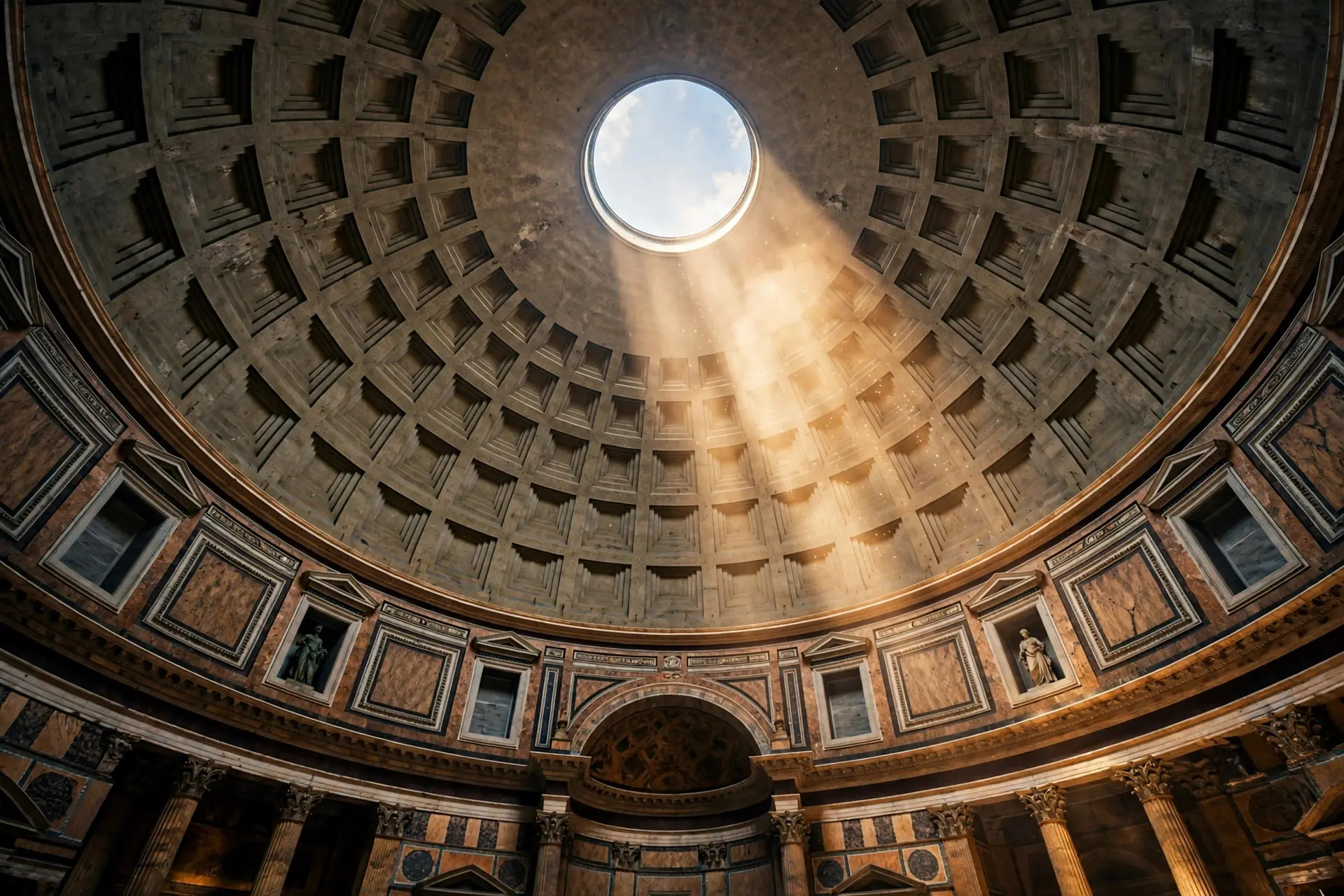
Look up inside the Pantheon and you see 28 coffers per ring of the dome — deep square recesses that rise in five rings toward the oculus. They are beautiful, but their beauty is secondary. Each coffer is concrete that was never poured. Together, the five rings of recesses remove an enormous mass from the dome's interior surface, cutting weight exactly where the structure can least afford it. The coffers were formed by pressing wooden boxes into the concrete as it was placed, and they were removed once the material set. Like everything else in the dome, they show the Roman obsession with shaving away any weight that was not structurally necessary. Aesthetics followed engineering: the stepped recesses draw the eye upward and make the dome look lighter than it is, but they were born as a weight-loss program.
What does the oculus do?
At the crown of the dome sits the oculus, a round opening nine meters across — the dome's only source of light. Standing inside at midday, visitors watch a shaft of sunlight move across the interior like a slow sundial. It is the single most dramatic feature of the building, but it is also engineering.
The crown of a dome is its most vulnerable point. The oculus deletes that point entirely, replacing the heaviest, most stressed ring of concrete with nothing. Weight that would have pressed down on the upper courses is simply gone, and the opening is ringed by a compression structure that redistributes the remaining loads around it. One persistent story claims the oculus was shaped or angled to keep rain out. It is not true. When it rains over Rome, it rains inside the Pantheon. The Romans knew this and built accordingly: the marble floor curves gently upward at the center and slopes toward drains, so water sheets away harmlessly.
Why did this building survive when Rome's other monuments were quarried?
Engineering explains why the Pantheon did not fall down. History explains why nobody knocked it down. In 609 AD the Byzantine emperor Phocas presented the building to Pope Boniface IV, who consecrated it as the church of Santa Maria ad Martyres. That conversion gave the Pantheon a guardian. While other Roman monuments were stripped for stone and bronze — Pope Urban VIII even took bronze beams from the portico in the 1600s, inspiring the Roman saying "what the barbarians did not do, the Barberini did" — the main structure remained in use and under maintenance. That continuity of use is a preservation strategy no engineering can match. A building that hosts worshippers, burials and visitors for fourteen centuries gets its leaks fixed, its floors cleaned and its structure watched. The Pantheon became the mausoleum of Italian kings and of artists like Raphael, ensuring each generation had a reason to protect it. The dome's influence has never faded. Brunelleschi studied it before raising the dome of Florence Cathedral, and Michelangelo's dome for St. Peter's answers it across the centuries. It remains, after nearly two millennia, the yardstick for what concrete can do — a structure that treats weight not as an unavoidable burden but as a quantity to be managed, graded and, where possible, removed entirely. For another Roman feat of managing water and mass on a city-wide scale, see the aqueducts that fed ancient Rome, and for the empire's great entertainment machine, the Colosseum.
Frequently asked questions
Why doesn't the Pantheon dome collapse?
Because it is built like an inverted bowl of decreasing weight: heavy concrete at the base handles the outward thrust, while light pumice concrete at the crown keeps the top from overloading. Thick walls and the oculus complete the system.
Does rain come through the oculus?
Yes. The idea that the oculus keeps rain out is a myth. When it rains in Rome, it rains inside the Pantheon; the slightly convex marble floor and an ancient drainage system carry the water away.
When was the Pantheon built?
The building we see today was rebuilt under Emperor Hadrian between 118 and 125 AD, replacing an earlier temple built by Agrippa around 25 to 27 BC that had burned down.
Is the Pantheon really the biggest concrete dome?
It is the largest unreinforced concrete dome in the world. Larger domes have been built since, but every one of them uses steel or iron reinforcement.