The Pony Express lasted only 18 months, never turned a profit, and was obsolete the moment it mattered — yet it remains the most romantic symbol of the American West. Why? Because it was the last great relay race against time itself, proving a continent could be crossed in 10 days, two years before wires made the feat irrelevant.
A Continent Split in Two
In 1860, the United States was one country in name and two in practice. California had been a state for a decade, but news from Washington reached San Francisco by ship — a voyage of a month or more — or by stagecoach along the overland route, which took 25 days on a good run and many months when it went wrong. As the nation slid toward civil war, the Pacific coast was drifting loose, cut off from the capital that governed it.
Three freighting partners — William H. Russell, William B. Waddell, and Alexander Majors of Russell, Majors & Waddell — saw both a business opportunity and a national mission. They already held government contracts hauling army supplies to the western frontier. Their new idea: a private mounted relay service from St. Joseph, Missouri, to Sacramento, California, delivering letters in 10 days. Many called it impossible. The founders hoped to prove it could work, and then win a million-dollar federal mail contract. The contract never came.
The Relay Machine: 1,900 Miles in 10 Days
On April 3, 1860, the first riders set out. What followed was an extraordinary logistics operation across eight states — Missouri, Kansas, Nebraska, Colorado, Wyoming, Utah, Nevada, and California — and nearly 200 relay stations spaced along a roughly 1,900-mile trail.
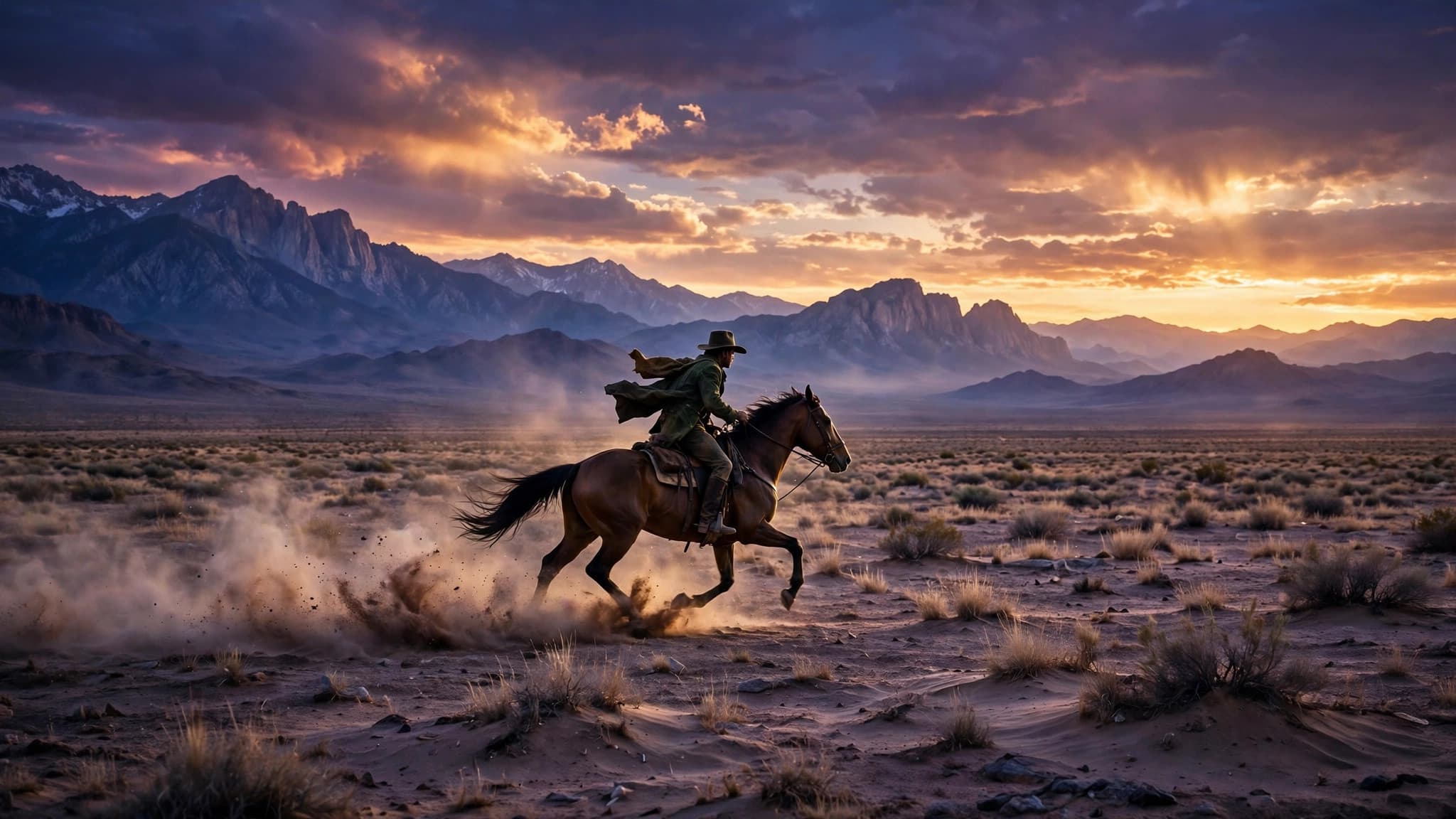
Each rider carried up to 20 pounds of mail in a locked leather pouch called a mochila, riding between 10 and 15 miles before swinging onto a fresh horse — no dismounting finesse required, just speed. A new rider took over every 75 to 100 miles. The result was a system that never slept: riders covered roughly 250 miles a day, day and night, through deserts, the Sierra Nevada, storms, and during the Pyramid Lake War, through territory under attack. The famous hiring call asked for young, wiry riders who could master the saddle — and each signed an oath, sworn on a company-issued Bible, promising no profanity, no liquor, and no quarrels.
The first rides departed simultaneously on April 3, 1860 — one eastbound from Sacramento, one westbound from St. Joseph — so the trail was served in both directions from day one. The service set its personal best in March 1861, carrying President Abraham Lincoln's inaugural address from Nebraska to California in just 7 days and 17 hours.
The men who rode the line were part of the machinery. Only about 180 riders served over the entire 18 months, chosen young and small to spare the horses. The famous hiring call asked for "young, skinny, wiry fellows, not over 18," and lore holds that orphans were preferred — young men with nothing tying them down. Pay ran about $100 a month, good money on the frontier, and each rider swore the company oath — no profanity, no liquor, no quarreling — with a hand on a company-issued Bible. Among them, the most famous was a teenage William "Buffalo Bill" Cody, who reportedly signed on at just 14 or 15. Like the Silk Road's caravans before it, the Pony Express was less a single road than a chain of handoffs — each link trusting the next across hostile terrain.
Bankrupt Before It Mattered
Here is the twist the legends usually skip: the Pony Express was a spectacular financial failure. Postage started at $5 per half-ounce — a fortune in 1860 money — and even then, revenue never covered costs. Historians estimate the enterprise spent some $700,000 and earned only about $500,000, bleeding as much as $200,000 overall.
The wounds came fast. Service ground to a halt just weeks after launch when the Pyramid Lake War erupted between the United States and the Paiute people; the shutdown alone cost an estimated $75,000. Stations were attacked, assets were lost, and the founders' gamble that Congress would hand them a government contract collapsed under political pressure and the outbreak of the Civil War. The company never turned a profit in its entire year and a half. As the builders of the Great Wall could have testified, strategic infrastructure is rarely funded by its users alone — and this one had no emperor.
Killed by the Wire, Saved by the War
The end arrived on October 24, 1861, when Western Union's crews linked the eastern and western telegraph networks at Salt Lake City, Utah. The first transcontinental telegram — sent by California Chief Justice Stephen J. Field to President Lincoln — predicted the wire would help keep the western states loyal to the Union. A message that had taken 10 days by horse now traveled in seconds. Two days later, the Pony Express shut down most of its operations.
Yet the doomed service had served its deeper purpose. Through the perilous months of 1860 and 1861, it kept urgent news flowing between Washington and California during the secession crisis — a role historians credit with helping hold the Far West to the Union. Information is a weapon in wartime, a lesson the codebreakers of Bletchley Park would re-learn eight decades later. The riders who carried secession news and federal orders westward were, in a very real sense, holding the country together one relay at a time.
Why We Still Remember a Failure
The Pony Express should have vanished into footnotes: 18 months, a mountain of debt, a technology rendered useless overnight. Instead it became legend — celebrated in dime novels, songs, stamps, and a national historic trail. The irony is that its failure is exactly what made it mythic. It was the last moment when human nerve and horsemanship were the fastest things on Earth, the final sprint before electricity made speed invisible.
Every relay rider handing off the mochila under torchlight was performing a ritual that stretched back to the relay runners of the ancient Persian Empire and forward to the data packets of the internet. The Pony Express did not survive its own era. But for 18 months, it shrank America — and proved that a divided nation could still talk to itself. That was worth more than the $200,000 it lost.