For a thousand years, knowledge in Europe had a gatekeeper — and it wore a bishop's robes. Books were copied by hand in monastery scriptoriums, each Bible taking a scribe the better part of a year, and what the Church chose not to copy simply ceased to exist. Then a goldsmith in Mainz built a machine that could print 180 Bibles in the time a monk could finish one. The Church's monopoly on information collapsed — and the modern world fell out of the wreckage.
The Fortress of Hand-Copied Knowledge
Before the printing press, the Catholic Church was the undisputed information gatekeeper of medieval Europe. It controlled what was written, what was copied, and — most decisively — how scripture was interpreted. The Bible existed only in Latin, a language the common people could not read. Monks painstakingly copied religious and scholarly texts by hand, which limited supply and gave the Church near-total control over the content and meaning of the written word.
This was not merely a technical bottleneck; it was a structure of power. Like the Great Library of Alexandria, medieval knowledge lived in a handful of fragile copies, stored in cathedral and monastic libraries, accessible only to an educated elite. One fire, one lost manuscript, and a text vanished forever. Literacy itself was rationed: books were so expensive and rare that reading was a privilege of clergy and aristocracy. The Church did not just guard the books — it decided what "the word of God" meant, because it was the only institution that could read it.
Gutenberg's Machine: Type, Ink, and the Screw Press
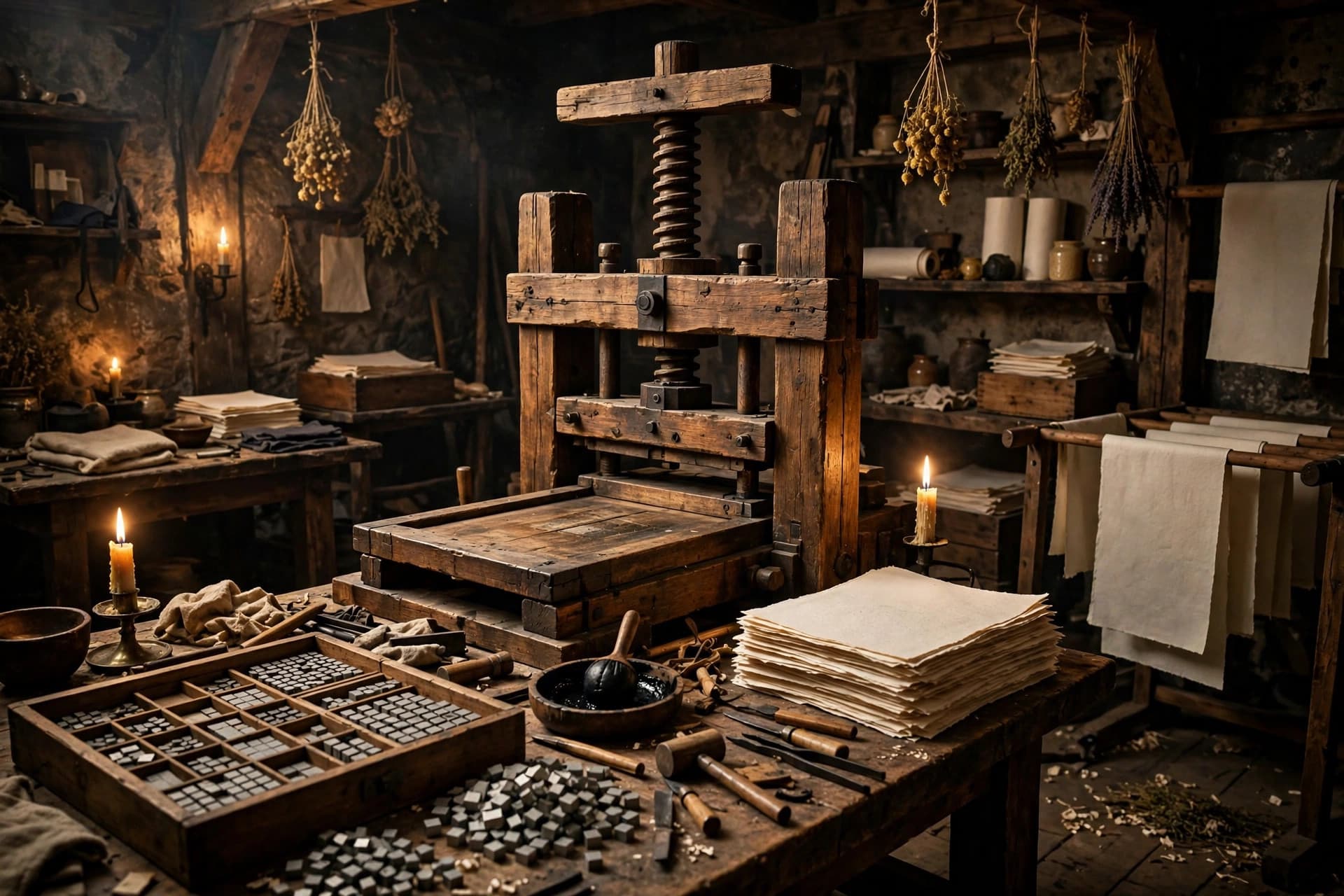
Johannes Gutenberg's breakthrough, perfected in Mainz, Germany, around 1440 and in operation by about 1450, was not one invention but the fusion of several. Drawing on his goldsmith's skill, he developed a reliable metal alloy that melted readily and cooled into reusable type pieces, cast from molds so every letter was identical. He created an oil-based ink that adhered to metal type far better than traditional water-based inks. And he adapted the screw-press design — borrowed from wine presses — to stamp pages with firm, even pressure.
Gutenberg did not build this empire on his own money. He borrowed 800 guilders from the wealthy moneylender Johann Fust, and borrowed another 800 when work on the Bible began in 1452, with the scribe Peter Schöffer joining the enterprise. The press also printed what paid the bills in the meantime — thousands of church indulgences between 1454 and 1455, a profit-making sideline that kept the workshop alive while the Bible was set in type. In a delicious irony, the machine Gutenberg financed with borrowed money to serve the Church would, within two generations, become the instrument that shattered the Church's control over what Europe could read.
The result was a manufacturing process with unprecedented volume and fidelity. Every copy of a page was exactly like every other, a dramatic improvement over hand copying, where scribal errors multiplied with each transcription. His magnum opus, the 42-line Bible — so called for the 42 lines per page — was completed in 1455 in Latin, with a print run of perhaps as many as 180 copies, some on paper and some on costly vellum. Contemporaries were stunned that a machine could produce a book rivaling the finest manuscript. Books that had taken months to copy could now be multiplied almost without limit, and prices fell to a fraction of what they had been. Knowledge, for the first time, was a reproducible commodity.
Luther's Viral Sermon: The Reformation Goes to Print
The first great shockwave arrived 62 years later. In 1517, a German monk named Martin Luther posted his 95 Theses challenging the Church's practices. In a pre-print world, such a protest would likely have been crushed locally and forgotten. Instead, the theses were printed and distributed, racing across Germany in weeks — the first truly viral document in European history.
The press became Luther's primary weapon. He translated the New Testament into common German, and the press produced hundreds of thousands of copies. People could now read scripture for themselves, in their own tongue, testing Luther's central claim — the "priesthood of all believers" — against the Church's insistence that only bishops and the pope could interpret the Bible. The Church's previous monopoly over religious debate was broken: Protestant and Catholic arguments were printed side by side for the public, as in the Augsburg Confession of 1530. Religious controversy had moved from behind closed doors into the streets. Across the Channel, reformers like William Tyndale used the same technology to put the Bible into English. A monopoly that had lasted a millennium fell in a generation.
The Aftershocks: Science, Literacy, and the Public Mind
The collapse of the monopoly did not stop at religion. Science depends on shared, accurate data, and the press turned scholarship from a fragile manuscript tradition into an accumulating enterprise. When Copernicus argued that the Earth circled the Sun, his De revolutionibus orbium coelestium could be printed and studied by scholars across Europe — including Galileo and Kepler, who built on his work instead of starting from scratch. Anatomists like Vesalius printed precise diagrams of the human body, standardizing medicine across the continent. Ideas no longer had to be reinvented; they could be critiqued, corrected, and compounded.
By 1500, Europe's presses had produced millions of books in thousands of editions — more texts than the previous thousand years combined. Book prices fell to roughly a tenth of their former cost, bookstores and printing workshops sprang up in cities across the continent, and literacy began its long climb. Vernacular languages were standardized as printed materials appeared in the tongues people actually spoke, sharpening national identities. The same network effect that once carried spices and silks along the Silk Road now carried arguments, discoveries, and heresies — only faster, and in thousands of identical copies.
What Monopolies on Truth Always Forget
The printing press teaches one enduring lesson: whoever controls the copying controls the truth. For a thousand years, the Church's monopoly felt permanent because copying was slow, expensive, and confined to the monasteries. Gutenberg did not set out to topple that order — he printed 180 Bibles for the Church, in Latin, and his press also ran off thousands of indulgences for church use. The technology was neutral; the monopoly was not.
Once copying became cheap and fast, the gate could never be rebuilt. Every monopoly on information since — from licensed printers to state censors — has tried to stand where the medieval Church stood, and every one has met its own version of movable type. Information, it turns out, is not a fortress. It is a river. And Gutenberg opened the floodgates.