How Did the Byzantines Build the Walls of Constantinople?
How were the walls of Constantinople built? Finished in 413, tripled after the 447 earthquake, its inner wall and 96 towers held the city nearly 1,000 years.
Key takeaways
- The walls went up in two phases: a single wall finished in 413 under the regent Anthemius, and a triple-line system after the 447 earthquake.
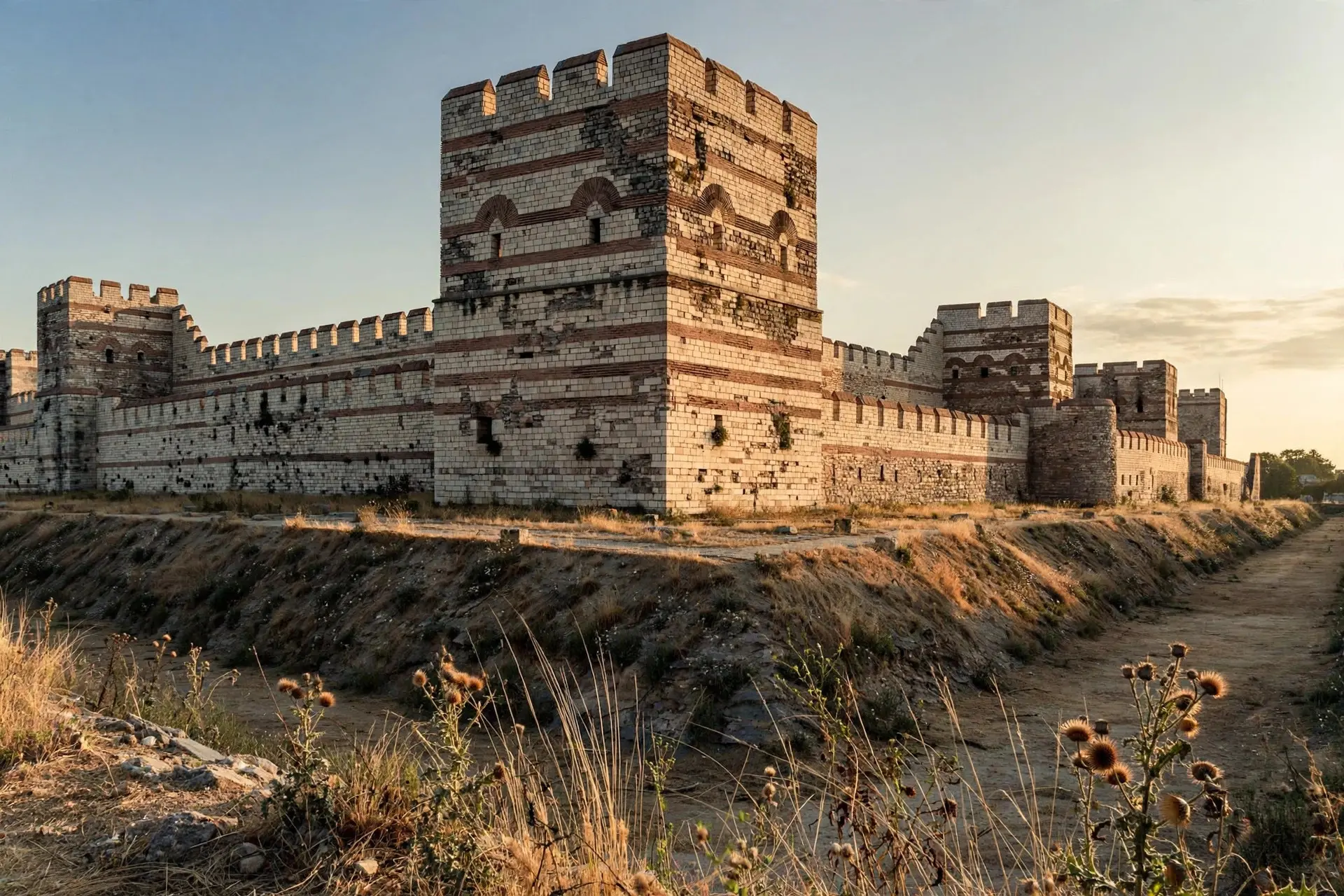
- The finished inner wall stood about 12 m (39 ft) high and 5 m (16 ft) thick, with 96 towers along a line roughly 5.5 to 6.5 km long.
- A surviving inscription claims 16,000 workers, mostly from the city's circus factions, rebuilt the shattered line in about two months.
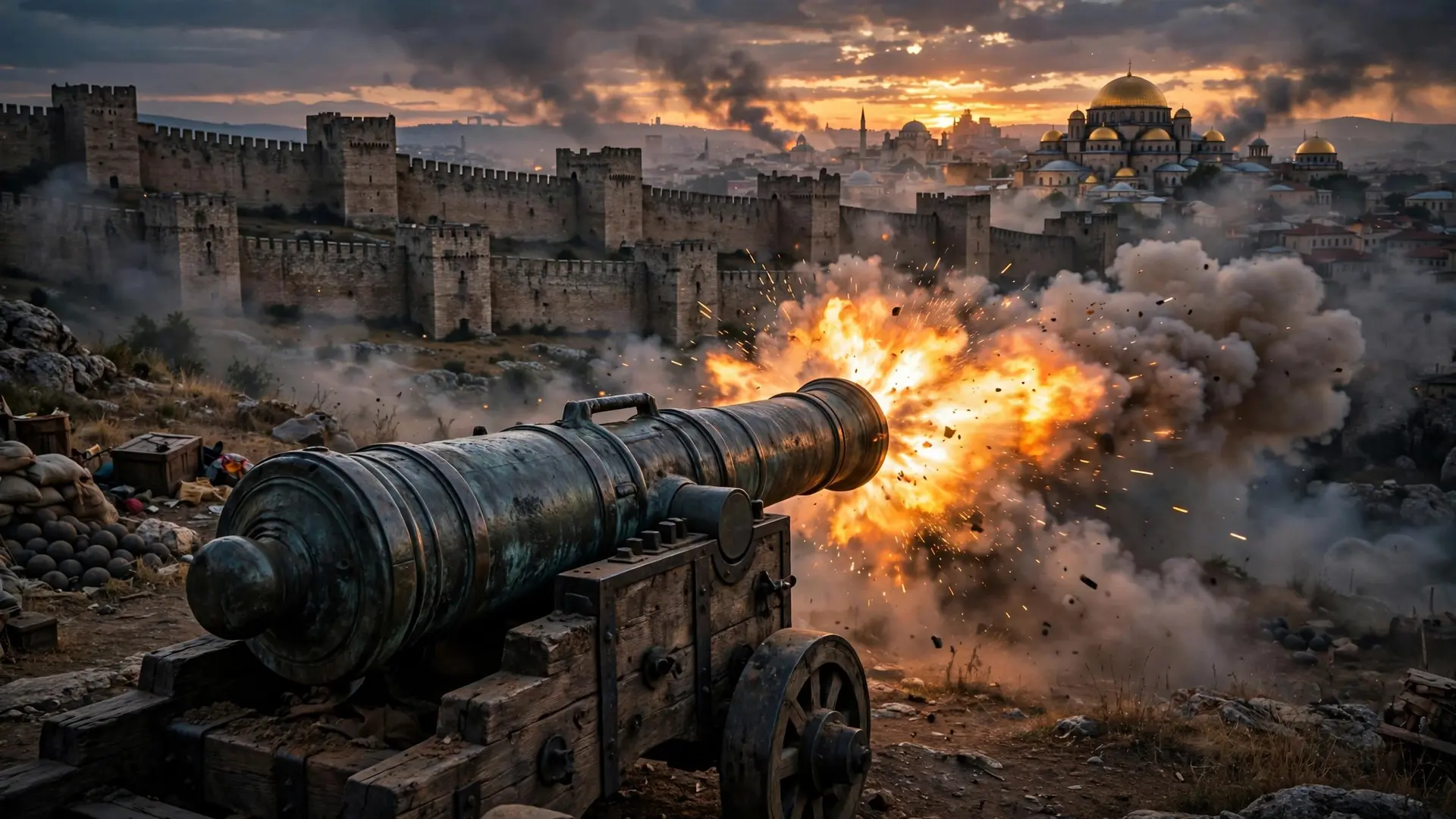
- The land walls held from 413 until Ottoman cannon finally breached them on May 29, 1453.
The Byzantines built the walls of Constantinople in two sprints, not one. A single wall went up under Emperor Theodosius II's regent Anthemius and was finished in 413. After an earthquake flattened 57 of its towers in 447, circus-faction work crews raised the full triple wall in a claimed 60 days, with Attila's Huns closing in.
- The first wall was completed in 413, about 2 km (1.2 miles) west of Constantine's older circuit, under the praetorian prefect Anthemius, who governed the eastern empire while Theodosius II was still a boy (Livius).
- On January 27, 447, an earthquake toppled 57 towers; a surviving inscription claims 16,000 workers rebuilt the line in about two months, with much of the labor coming from the city's circus factions (Turkish Archaeological News).
- The finished inner wall stood about 12 m (39 ft) high and 5 m (16 ft) thick, with 96 towers rising roughly 18 to 20 m (59 to 66 ft) along a line about 5.5 to 6.5 km (3.4 to 4 miles) long (World History Encyclopedia).
- The masonry was limestone facing over a concrete-and-rubble core, tied with horizontal brick bands and a mortar mixed with crushed pumice that made the core unusually tough (Turkish Archaeological News).
- The land walls were never taken by assault until Ottoman cannon breached them on May 29, 1453, after a seven-week siege (Turkish Archaeological News).
How were the walls of Constantinople actually built?
The project began from fear. In 410, Visigothic forces under Alaric I sacked Rome, and the news stunned the Roman world. Constantinople had outgrown Constantine the Great's old wall, leaving whole neighborhoods outside it, while Hunnic tribes crossed the Danube and pushed into Thrace, almost at the city's doorstep. The eastern court needed a new frontier line, fast. The man who delivered it was not the emperor. Theodosius II reigned from 408 to 450, but he was seven when he took the throne, so the eastern empire was run by his praetorian prefect, Anthemius. Under his direction, the first phase of construction produced a single great wall running from the Sea of Marmara in the south to the Golden Horn, the deep natural inlet that formed the city's harbor, in the north. A law in the Codex Theodosianus dates its completion to 413.
This first wall was already a serious structure: about 12 m (39 ft) high, roughly 5 m (16 ft) thick, studded with 96 projecting towers. It pushed the defended area out to roughly 12 square km (4.6 square miles), more than doubling the walled city. The Golden Gate, a marble triple arch built in 391 under Theodosius I, was folded into the new line as its ceremonial entrance. Then, in the early hours of January 27, 447, an earthquake tore the line apart. Turkish Archaeological News reports that the shock collapsed long sections and toppled 57 towers, just as Attila's Huns were raiding aggressively through the Balkans. Theodosius ordered the praetorian prefect Cyrus of Panopolis to rebuild, and the city answered with an extraordinary mobilization. According to surviving inscriptions near the Rhegium Gate, the labor came from the demes, the circus factions: the Blues, Greens, Reds and Whites were chariot-racing fan clubs that also served as neighborhood organizations, and the emperor set them to wall-building. One inscription claims the faction crews finished in 60 days; another says 16,000 workers took about two months. Either way, the rebuilt line was not merely repaired but enlarged: a second wall about 8 m (26 ft) high went up in front of the original, and the total number of towers doubled to 192. The low breastwork and the moat were added afterward, completing the layered system we see today.
What did the triple defense system look like?
Attackers faced four belts, each one forcing them to fight uphill against a higher wall behind it. The brick-lined moat came first, 15 to 20 m (49 to 66 ft) wide and up to 7 m (23 ft) deep, divided by bulkheads and sometimes flooded with water fed through pipes. Then came a low breastwork about 2 m (6.5 ft) high where defenders could shoot freely over the parapet. Behind that rose the outer wall, 8 m (26 ft) tall and 2.8 m (9 ft) thick, with 82 projecting towers. Finally, the main inner wall: 12 m (39 ft) high, about 5 m (16 ft) thick, with 96 towers offset from the outer ones so their fields of fire overlapped. The table below compares the layers using figures from the opened sources:
| Defensive layer | Height / depth | Thickness | Towers |
|---|---|---|---|
| Moat | 15-20 m (49-66 ft) wide, up to 7 m (23 ft) deep | - | - |
| Low breastwork | ~2 m (6.5 ft) high | - | - |
| Outer wall | 8 m (26 ft) high | 2.8 m (9 ft) | 82 |
| Inner wall | 12 m (39 ft) high | ~5 m (16 ft) | 96 |
| Broad terraces ran between the walls: the parateichion, about 18 m (59 ft) wide, behind the moat, and the peribolos, 15 to 20 m (49 to 66 ft) wide, between the walls, giving defenders room to mass troops and shift artillery. From the bottom of the moat to the tallest tower tops, the whole belt reached nearly 30 m (98 ft). |
The masonry was engineered for a city that shakes: limestone blocks faced a concrete-and-rubble core, tied with horizontal brick bands that helped the walls absorb earthquakes, and the mortar was mixed with crushed pumice for extra strength. Towers were not bonded into the curtain wall, so each could settle without cracking its neighbor. The same brick-and-stone craft later shaped Hagia Sophia's dome, and its tough mortar echoes Roman harbor concrete. The towers held catapults and Greek fire, the Byzantine incendiary weapon.
Why did the Byzantines rush a second wall in 447?
The 447 panic shows what the walls were really for: buying time against a threat that was already at the door. The original 413 wall had a single line of defense, and the earthquake opened it just as Attila's armies were operating in the Balkans. Had the Huns arrived before the repairs, Constantinople could have fallen the way Rome had in 410. The rebuild turned a crisis into an upgrade. Instead of simply patching the broken wall, the prefects thickened the whole line into a defense in depth. The outer wall, the terraces and the towers doubled the defenders' firing positions, and the moat put 60 m (197 ft) of ground between an attacker's siege engines and the main wall. World History Encyclopedia notes that the walls were built on a rising embankment, so defenders on each line looked down on the one in front, and no attacker could bring siege engines close to the all-important inner wall. With the city sealed again, the immediate Hunnic threat passed westward. The upgraded walls then held off Avars, Slavs, Persians, Arabs and Bulgars for centuries: Arab fleets tested them in 674-678 and 717-718, Russian fleets in 860, 941 and 1043, and none broke the land wall by force.
What do most people get wrong about the Theodosian Walls?
The biggest mistake is crediting Theodosius II himself. The emperor was a child during the first phase, and Livius notes that he can take little personal credit: the project belonged to Anthemius, the praetorian prefect who ran the eastern empire as regent. The second mistake is imagining the triple wall as the original design. The 408-413 wall was a single line with one set of towers. The triple system, moat, breastwork, outer wall and doubled towers, was the product of the 447 earthquake and the panicked rush that followed, with the low wall and moat finished later still. The third is the claim that the walls stood for a thousand years without ever being breached. The land walls themselves were never taken by assault before 1453, but the city did fall in 1204, when the Fourth Crusade entered through a neglected sector of the defenses rather than by smashing the masonry. The distinction matters: the land walls did their job; the city fell around them. The fourth is thinking the walls failed in 1453 because they were poorly built. They failed because warfare changed: once the Ottoman sultan acquired cannon, the walls were rendered obsolete, and weeks of bombardment near the Gate of Saint Romanus ended the fall of Constantinople in 1453. Gunpowder beat stone, not bad engineering. In the end, a terrified city, a child emperor's regent, and chariot fans drafted into masons for 60 days produced a wall that guarded Constantinople for nearly a thousand years. How we made this article: FactSpire researched and drafted it with AI assistance and checked every fact against the sources listed above.
Frequently asked questions
How long did it take to build the walls of Constantinople?
The first phase took several years and was completed in 413, during the minority of Emperor Theodosius II. The dramatic second phase came after a January 447 earthquake leveled 57 towers: a surviving inscription claims the rebuilt, triple-line wall was finished in about two months, just as Attila's Huns pressed toward the city.
Who actually built the walls of Constantinople?
Not Theodosius II himself. The work was directed by his praetorian prefect Anthemius, who ruled the eastern empire as regent while the emperor was a boy. After the 447 earthquake, the rebuild used thousands of workers drawn from the demes, the city's chariot-racing fan clubs that also served as neighborhood labor pools.
Why did the walls finally fall in 1453?
Gunpowder made them obsolete. On May 29, 1453, Sultan Mehmed II's massive cannon pounded a breach near the Gate of Saint Romanus after a seven-week siege. The walls were designed to defeat siege engines and ladders, not weeks of sustained artillery fire, so the 1453 siege ended the empire the walls had guarded for nearly a thousand years.
Can you still see the walls of Constantinople today?
Yes. Long stretches of the land walls still stand in modern Istanbul, and restored sections are among the city's most striking surviving monuments from late antiquity. The land walls were added to the UNESCO World Heritage List in 1985 as part of the Historic Areas of Istanbul.
Sources
- Theodosian Land Walls of Constantinople, Turkish Archaeological News
- Constantinople, Theodosian Walls, Livius
- Theodosian Walls, World History Encyclopedia