The Fall of Constantinople: Cannons vs. Ancient Walls
On May 29, 1453, Ottoman cannons breached walls that had stood for a thousand years, ending the Roman Empire. Here is how gunpowder took Constantinople.
Key takeaways
- On May 29, 1453, Ottoman forces breached Constantinople's walls - the first enemy breakthrough in a thousand years - ending the Roman Empire.
- The Theodosian Walls, built in the early 5th century, formed a triple defense of moat, outer wall, and inner wall that had repelled every attacker for nearly a millennium.
- Mehmed II, only 21, deployed the Great Bombard: a 27-foot bronze cannon weighing some 20 tons, firing 600-kilogram stone balls about a mile.
- The cannonsmith Orban first offered his services to Constantine XI, who could not afford him; Mehmed II could.
- After the conquest, Mehmed converted Hagia Sophia into a mosque, renamed the city Istanbul, and made it the Ottoman capital.
On the morning of May 29, 1453, the Roman Empire died on its own doorstep. Ottoman soldiers poured through a breached wall into Constantinople — the first time in a thousand years that an enemy had fought its way over the city's land defenses. The weapon that made it possible was still a crude, temperamental novelty: the great bronze cannon. This is the story of how gunpowder finally beat the greatest fortifications of the ancient world.
The Walls That Defied a Thousand Years
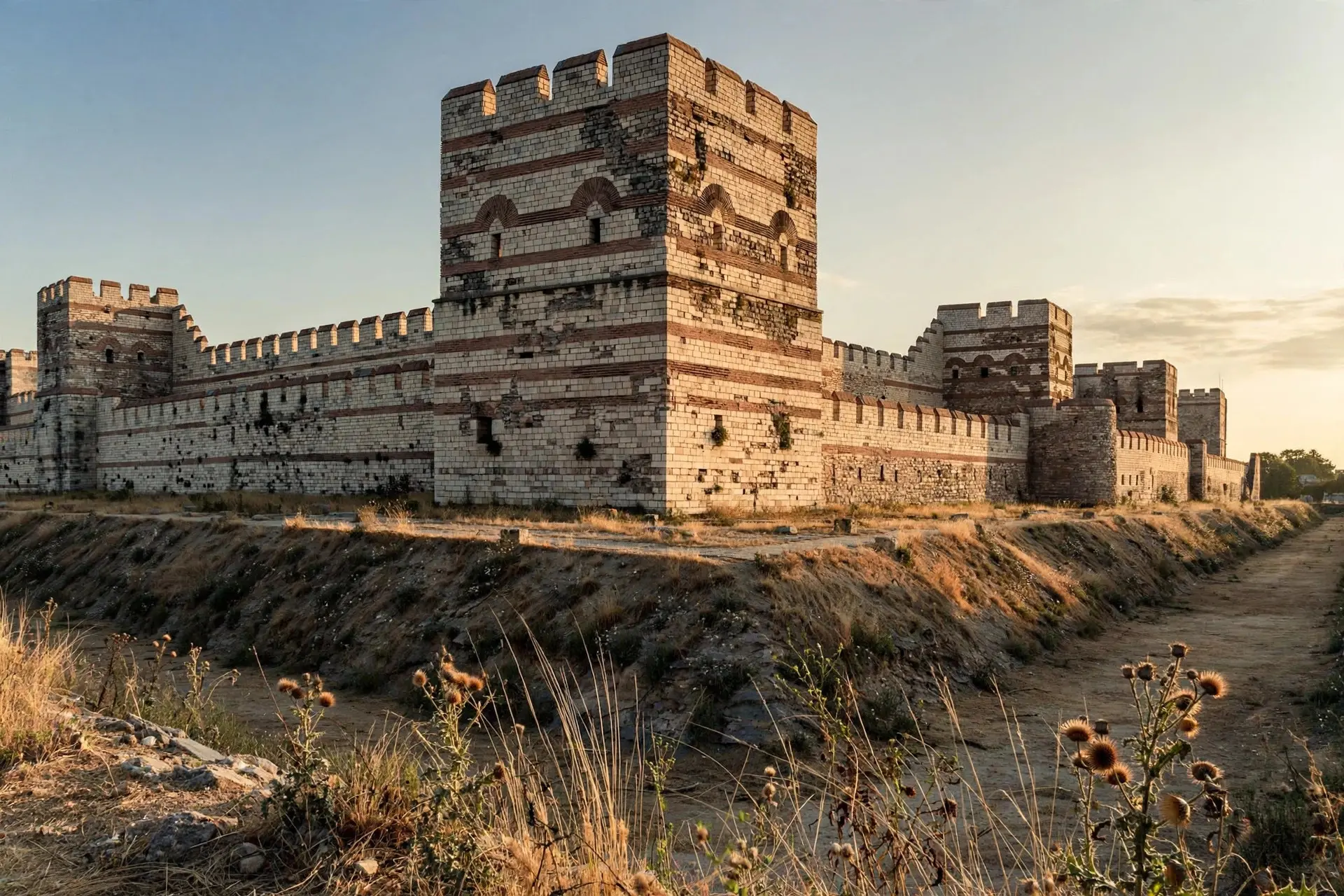
The Theodosian Walls were the most formidable fortifications of the ancient world, and they had the record to prove it. Built in the early 5th century under Emperor Theodosius II, they formed a triple system: a deep moat, a lower outer wall studded with towers, and a massive inner wall rising behind it. Attackers who crossed the moat faced withering fire from two tiers of defenders standing on ground that rose sharply beneath them. For nearly a millennium, the system worked. Persians, Arabs, Avars, Bulgars, and Rus all broke against those walls and went home. Even the Crusaders, who eventually sacked the city in 1204, never breached them — they got in by other means. By 1453, the walls remained the city's greatest asset, but also its last one. The Byzantine Empire had shrunk to little more than Constantinople itself, with perhaps 40,000 to 50,000 people behind the walls. The defenders who manned the ramparts numbered between 7,000 and 10,000, including Genoese and Venetian volunteers. They faced an Ottoman army of roughly 80,000 to 120,000 men. The defenders were led by the emperor himself, Constantine XI Palaiologos, who refused every offer of safe passage and took his stand on the walls. His chief field commander was the Genoese captain Giovanni Giustiniani, whose heavy infantry formed the backbone of the defense. Both men understood that the walls were everything. Like the great defensive walls of other empires, these fortifications bought time — but only if someone was coming to help.
A Sultan, a Cannonsmith, and a Giant Gun
The man determined to end that thousand-year record was only 21 years old. Mehmed II had ascended the Ottoman throne determined to capture the city that had eluded his predecessors for generations. Constantinople was the last Byzantine stronghold, the bridge between Europe and Asia, and the gatekeeper of the trade routes that carried Eastern wealth through the Bosporus. Taking it would make him a legitimate emperor, not merely a sultan.
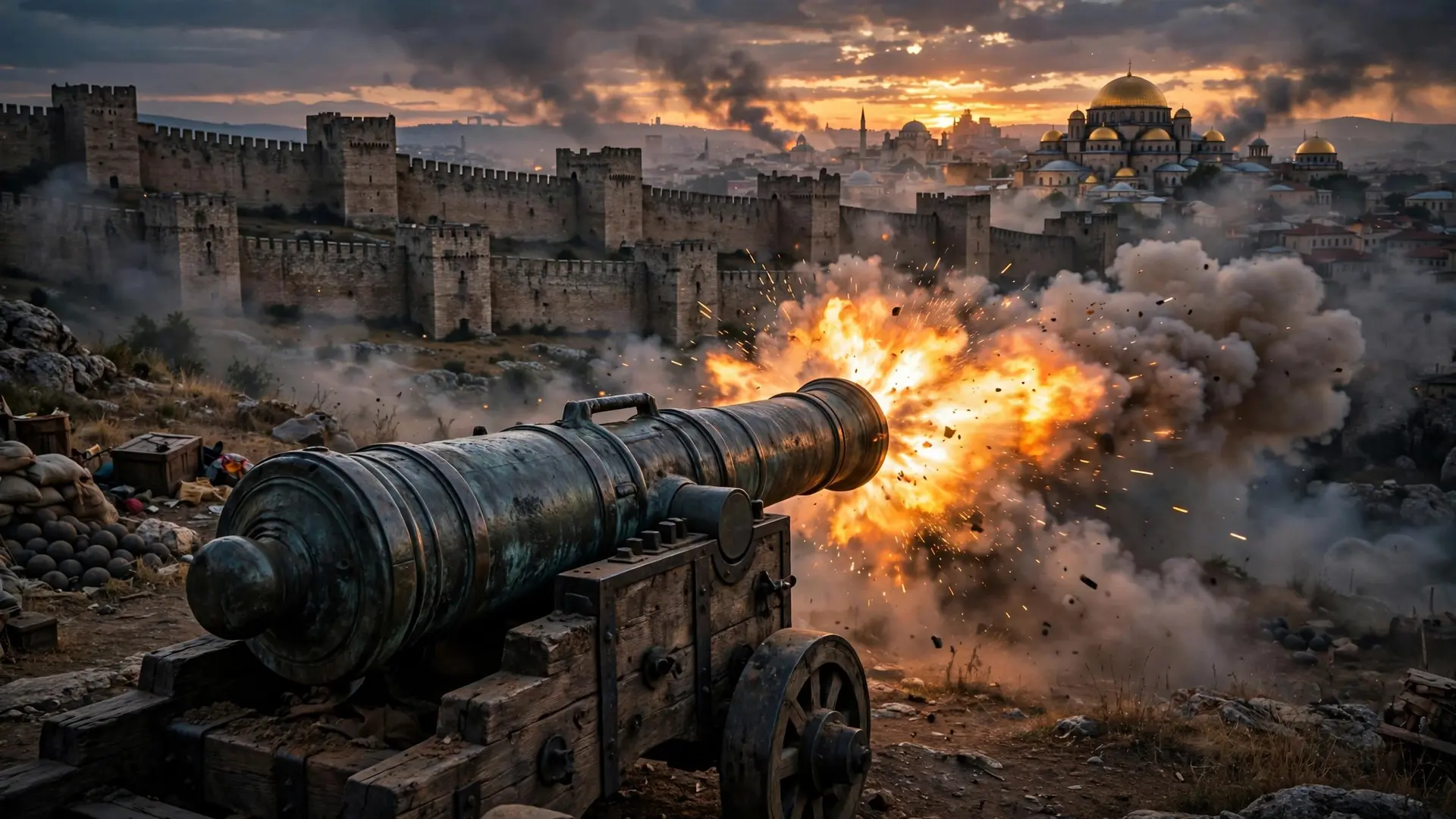
Mehmed's decisive advantage came from an unlikely source: a Hungarian or German founder named Orban, who first offered his services to Constantine XI. The emperor, nearly bankrupt, could not afford him. Mehmed could. Orban cast for the young sultan an enormous bronze bombard — the largest gun ever built to that date. The Great Bombard, called the Basilica, was roughly 27 feet long and weighed some 20 tons. It fired stone balls weighing around 600 kilograms (1,300 pounds) over a distance of about a mile. Moving it to Constantinople required 60 oxen and 200 men. When it fired, the blast shook the valley around it, and witnesses reported that the roar could be heard for miles. The Ottomans brought dozens of smaller bombards as well, but the Great Bombard was the centerpiece of Mehmed's plan. Before the siege, his engineers built a fortress on the European shore of the Bosporus to choke off the city's sea traffic, and a fleet was assembled to blockade the harbor. Constantinople would be attacked from land and sea, and its walls — which no army had breached — would be tested against a force they had never faced: sustained artillery bombardment.
Fifty-Three Days of Thunder
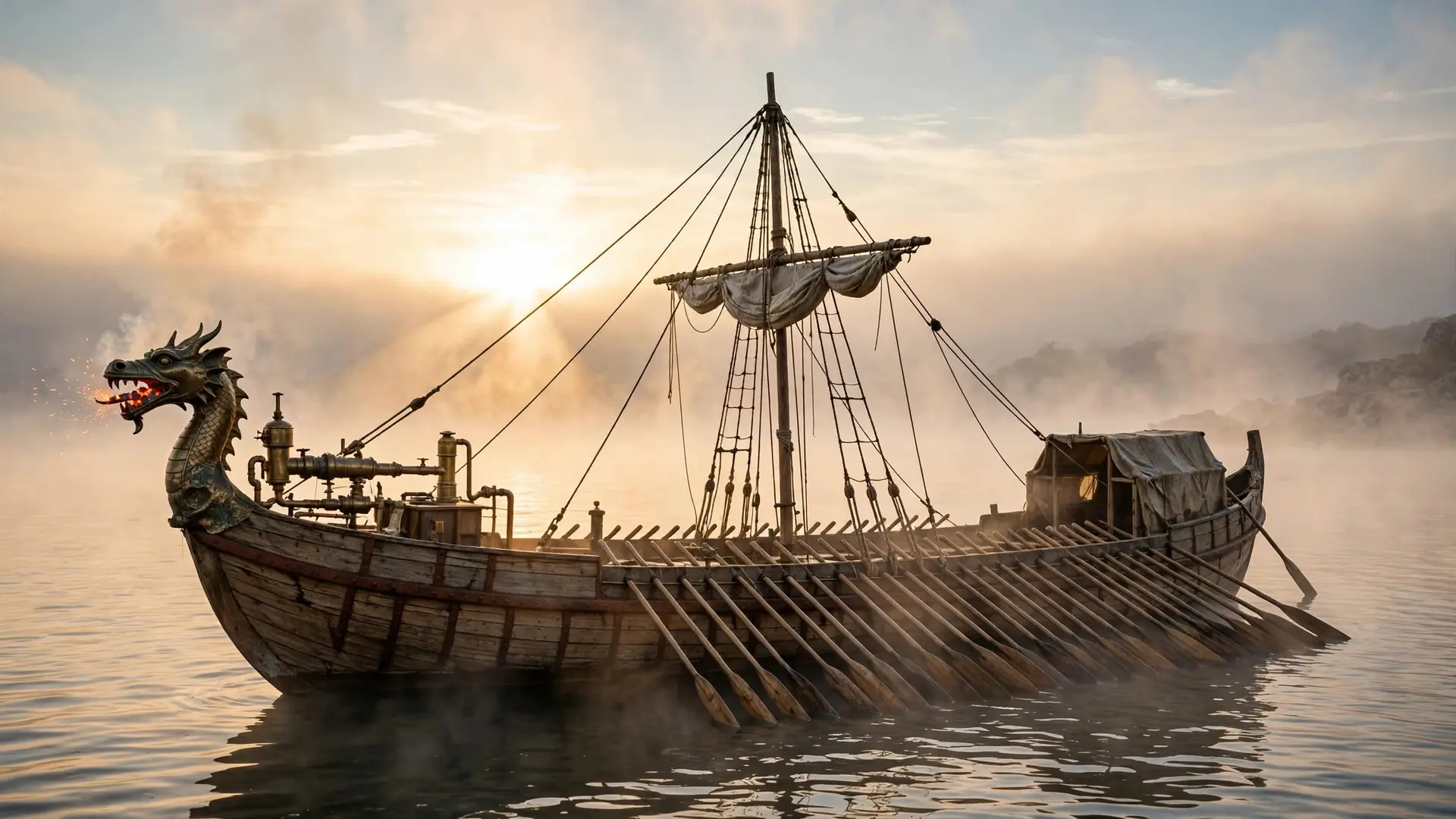
The siege began on April 6, 1453, and settled into a grinding rhythm that neither side had expected. Day after day, the Ottoman guns pounded the Theodosian Walls, concentrating on the weaker Blachernae section. Day after day, the defenders worked a near-miracle of resilience: under cover of darkness, they repaired the breaches with rubble, timber, and earth, filling the holes the bombards had torn open by day. The defenders were not passive. They deployed Greek fire — the incendiary weapon that had terrorized Arab fleets centuries earlier — against Ottoman ships. They launched sorties to spike guns and burn siege works. And the great chain stretched across the Golden Horn held the Ottoman fleet at bay, keeping the harbor open to Genoese supply ships that slipped through with food and reinforcements. Mehmed answered with one of the most audacious maneuvers in military history. On greased wooden rollers, his engineers hauled some 70 ships overland, over the hills behind Pera, and launched them into the Golden Horn — completely bypassing the great chain. The defenders had to stretch their thin lines to man sea walls along the Golden Horn that had been lightly held, opening a dangerous new front. Still the walls held. Week after week, the rhythm continued: bombardment by day, repair by night, sorties and counterattacks, and no help from the West. The promised crusade never materialized. Constantinople stood alone, exhausted, hungry, and still defiant.
The Night Everything Broke
Shortly after midnight on May 29, Mehmed launched his final assault. The first waves were expendable irregular troops — bashi-bazouks and azaps — thrown against the walls to wear down the defenders. They were followed by Anatolian contingents that managed to breach the damaged Blachernae walls briefly before being driven back out. Then came the final wave: the elite Janissaries, the sultan's disciplined household infantry, led by the standard-bearer Ulubatlı Hasan.
At the critical moment, disaster struck the defenders. Giovanni Giustiniani was grievously wounded by gunfire on the ramparts. His evacuation from the wall to receive treatment — a reasonable decision in the chaos — panicked his Genoese troops, who abandoned their posts and fell back toward the harbor. The coordinated defense of fifty-three days unraveled in minutes. Ottoman forces poured through the breaches, and at one small postern gate in the Blachernae section — the Kerkoporta — probing Ottoman soldiers found a gate left unlocked by a returning raiding party. They slipped inside, climbed the outer wall, and raised the Ottoman banner. Defenders who saw the flag above them believed the wall had fallen, and the line broke. Emperor Constantine XI understood what had happened. According to Byzantine witnesses, he cast aside his purple imperial robes, dressed as a common soldier, and charged into the oncoming Janissaries. His body was never definitively identified. The empire that had begun with Augustus ended with an emperor dying anonymously in a street fight at dawn. By agreement with military custom, the city was given over to three days of looting. Then Mehmed rode to the Hagia Sophia and ordered the great cathedral converted into a mosque. He renamed the city Istanbul and made it the capital of the Ottoman Empire. The last Byzantine state, the Empire of Trebizond, held out until 1461.
The Myth of the Superweapon
It is tempting to tell this story as a simple technology fable: gunpowder beat stone. But the reality is more interesting, and the cannons were less decisive than they look in retrospect. The Great Bombard was a temperamental beast. It could fire only a handful of times per day — some accounts say as few as seven shots — and it cracked under its own explosive force more than once, requiring repair mid-siege. The smaller bombards were more reliable but far less powerful. And for all the noise and spectacle, the defenders' nightly repair crews meant that artillery alone was never going to win the siege. What the cannons actually did was change the geometry of the siege. By keeping the entire land wall under constant bombardment, they pinned the defenders in place and exhausted them. By battering the weaker Blachernae section into a permanent construction site, they forced Constantine to keep his best troops — and Giustiniani himself — at one point on the wall. The cannon did not open the door. It locked the defenders in the corridor where exhaustion, the wounded commander, and the unlocked postern gate could finally break them. There is a deeper irony. Orban's guns were not an Ottoman invention. The technology came from Europe, and the founder had offered it to Constantinople first. The city's fall was less a triumph of Eastern arms over Western stone than a case of one bankrupt empire failing to buy the weapon that a richer rival then turned against it. The fall sent shockwaves through Europe and helped set in motion the Age of Discovery, as Christian powers sought new sea routes to the East that bypassed Ottoman-controlled straits. It also sent Greek scholars fleeing westward with their manuscripts, carrying the classical learning that would feed the Renaissance — the preserved knowledge of antiquity finding new life in Italy. Constantinople fell, but what it had guarded for a thousand years scattered across the world.
Frequently asked questions
When did Constantinople fall and to whom?
On May 29, 1453, Ottoman forces under the 21-year-old Sultan Mehmed II breached the walls and took the city, ending the Byzantine (Roman) Empire.
What role did cannons play in the 1453 siege?
Orban's Great Bombard and smaller guns battered the walls for 53 days, but defenders repaired breaches nightly; the cannons exhausted and pinned the defenders rather than single-handedly winning the siege.
How did the Ottomans finally break through?
During the final assault, commander Giustiniani was wounded and evacuated, his troops panicked, and Ottoman soldiers slipped through the unlocked Kerkoporta gate, raising their banner and breaking the defense.