Vinland: The Viking Settlement in North America
Around 1000 AD, Norse sailors settled in Newfoundland, five centuries before Columbus. Excavations at L'Anse aux Meadows show the Viking sagas were true.
Key takeaways
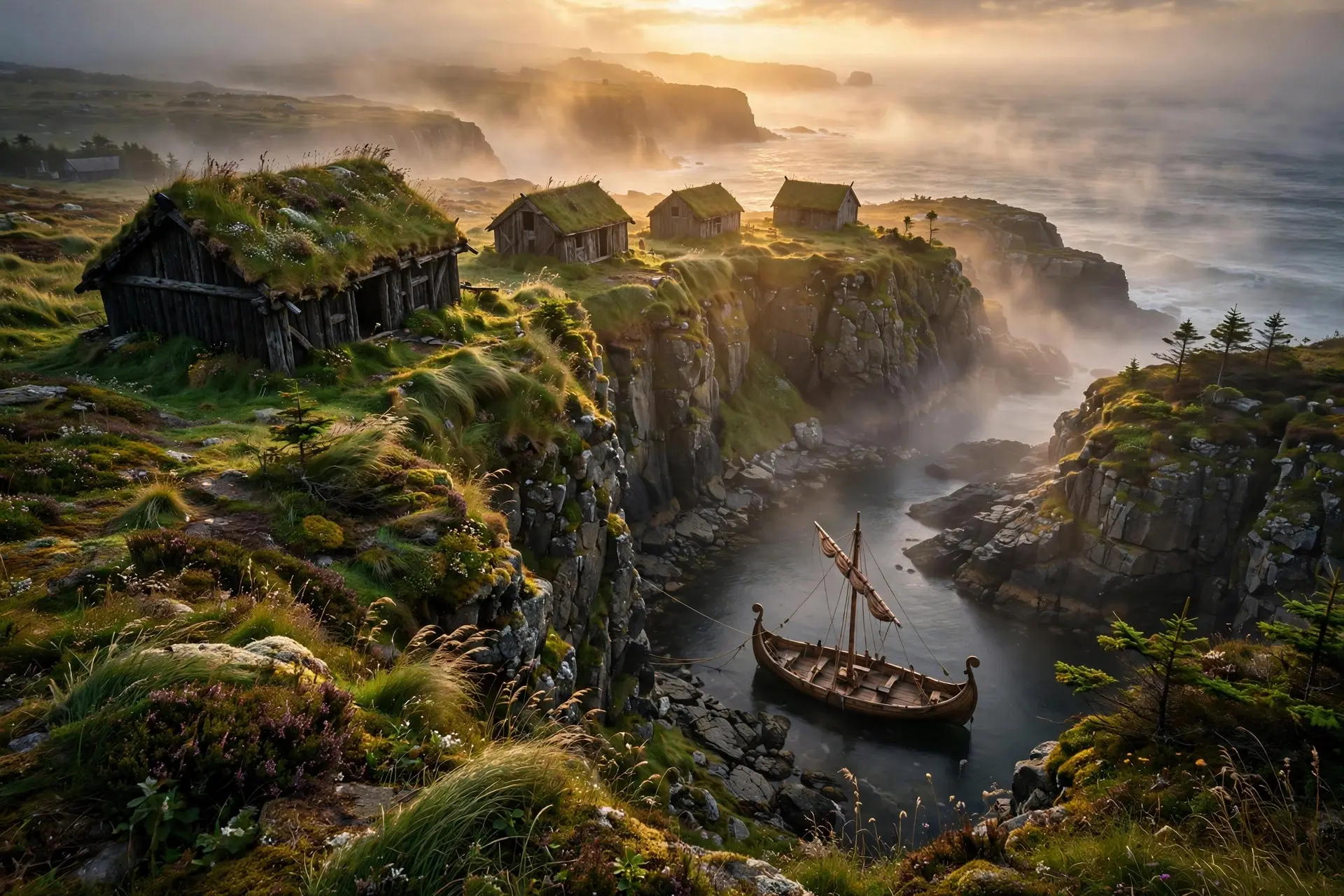
- Around the year 1000, Norse sailors built turf-and-timber houses at L'Anse aux Meadows, Newfoundland - five centuries before Columbus.
- Tree rings from the site, dated via a cosmic-ray storm signature from AD 993, show timbers felled in AD 1021: the first precisely dated European presence in the Americas.
- The 1961-1968 excavations uncovered eight buildings and about 800 artifacts, including a forge smelting bog iron - proof of Norse technology.
- It remains the only confirmed Viking settlement in North America and became a UNESCO World Heritage Site in 1978.
- The settlement lasted perhaps 10-25 years as a base camp for timber gathering, abandoned amid conflict with Indigenous peoples the Norse called skraelings.
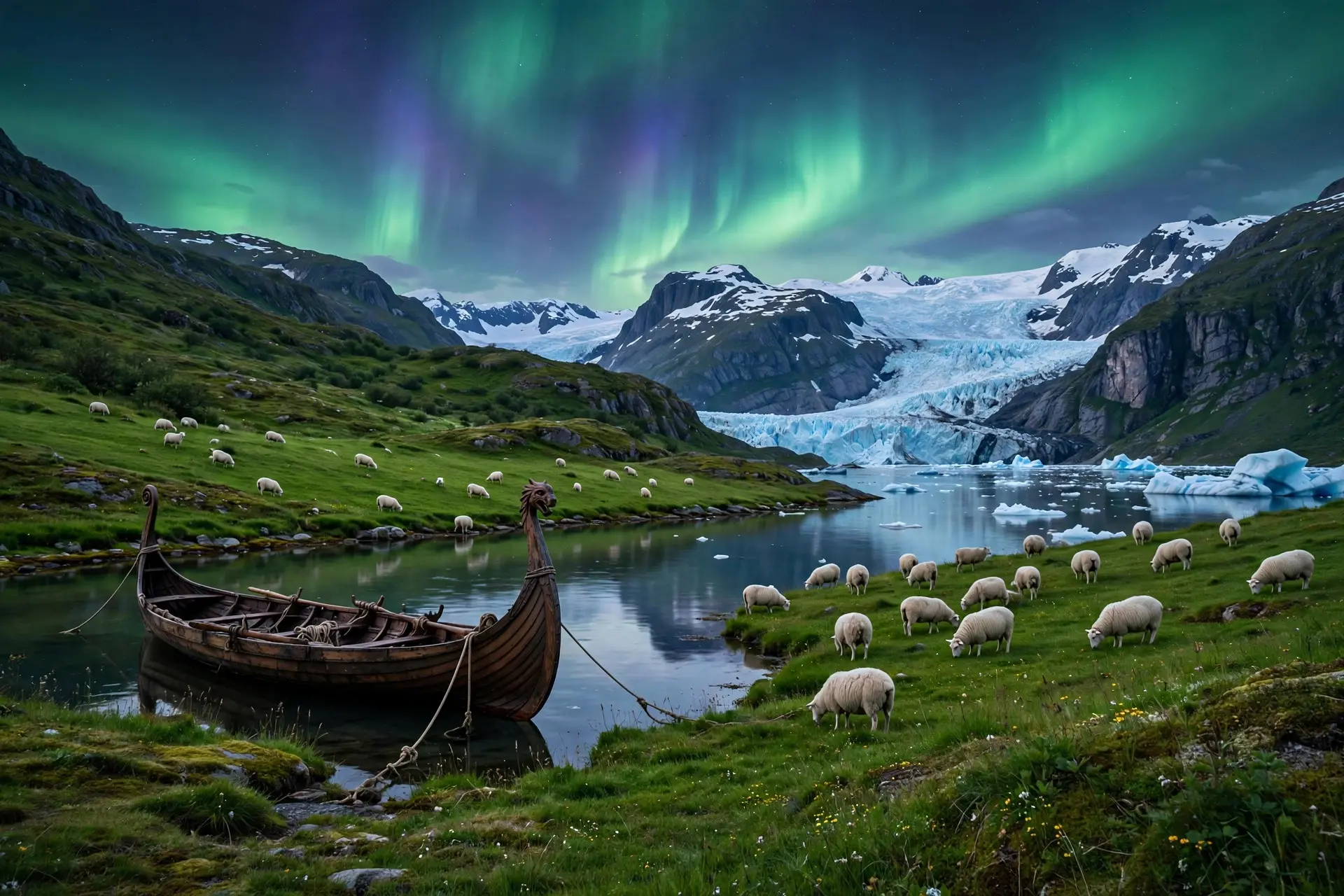
Nearly five hundred years before Columbus sailed, Europeans were already building houses in North America. Around the year 1000, Norse sailors from Greenland crossed the stormy Atlantic in open wooden ships and put up turf-walled halls on the northern tip of Newfoundland. They called the region Vinland — wine land — and for centuries scholars assumed the whole story was a legend. Then archaeologists found the settlement. The Viking sagas, it turned out, were true.
A Sighting No One Believed
The story begins with a man who did not want to discover anything. Around 985 or 986, an Icelandic merchant named Bjarni Herjólfsson was sailing from Iceland to Greenland to join his father when storms blew him far off course to the west. For days he saw wooded coastlines — land he did not recognize and had not been looking for. Because his destination was Greenland, Bjarni simply turned around and went home. He never set foot on the shore he had seen. Back in Greenland, Bjarni told his story in the halls of Brattahlid, the farm of Erik the Red. Among those who listened carefully was Erik's son Leif. Sometime around the year 1000, Leif bought Bjarni's ship and retraced the voyage with a crew of about 35 men. Sailing west, he first found a land of flat stones and glaciers — Helluland, probably Baffin Island — then a forested shore he called Markland, likely Labrador. Continuing south, he reached a place with mild winters, wild grapes, salmon-rich rivers, and deep grass. A German member of his crew named Tyrkir found vines climbing wild among the trees, and Leif named the region Vinland. The crew built timber-and-turf houses they called Leifsbudir — Leif's Houses — and spent one winter there, loading the ship with timber and grapes before sailing home to Greenland. Timber was the real prize: Greenland had almost no trees, and wood meant ships, houses, and tools. On the voyage back, Leif rescued a shipwrecked crew, earning the name Leif the Lucky. He never returned to Vinland, but his ship did — borrowed by his brother Thorvald for the next voyage west.
The Sagas Meet the Spade
For centuries, the two Icelandic sagas that preserve these voyages — the Saga of the Greenlanders and Erik the Red's Saga — were filed alongside myths like Atlantis. The grapes bothered scholars most: wild grapes do not grow in Newfoundland, so surely "wine land" was a fantasy. The skeptics had a point about the grapes, but they were wrong about the settlement.
The search that ended the debate began with a Norwegian explorer, Helge Ingstad, and his wife, the archaeologist Anne Stine Ingstad. Reasoning from the sagas rather than the grape hypothesis, they believed the Norse would never have felt secure settling far down the exposed Atlantic coast. In 1960, a local fisherman named George Decker led Helge to a cluster of grassy mounds near the village of L'Anse aux Meadows, at the very tip of Newfoundland's Great Northern Peninsula. The mounds looked like the remains of houses. Seven excavations between 1961 and 1968 proved it: the site was Norse. The team uncovered the remains of eight buildings — large halls and smaller houses, workshops, and a forge — built of turf over wooden frames in exactly the style the Norse used in Iceland and Greenland. The digs produced about 800 artifacts: iron ship nails, a ringed pin, a spindle whorl, a stone oil lamp, and jasper fire-starters. Most telling of all was the forge, where the Norse had smelted bog iron — unmistakable proof of Norse technology, since Indigenous peoples of the region did not work iron. In 2021, scientists added the final confirmation. Examining timbers from the site, researchers found wood that had been cut with metal tools, and by counting tree rings back from a distinctive radiocarbon signature left by a cosmic-ray storm in AD 993, they determined the trees had been felled in AD 1021. That date — 1021 — became the first precisely dated European presence in the Americas, published in the journal Nature. The United Nations had already recognized the site's significance: L'Anse aux Meadows became a UNESCO World Heritage Site in 1978, and it remains the only confirmed Viking settlement in North America. Like other remote outposts rediscovered centuries after their builders left, it rewrote what the history books were allowed to say.
Life, Trade, and Blood in the New World
The archaeology gives us the site. The sagas give us the people — and their story is wilder than the ruins suggest. Leif's brother Thorvald borrowed Leif's ship and wintered at Leifsbudir, then set out exploring. According to the sagas, his crew came upon nine Indigenous people sleeping under skin boats and attacked them, killing eight; one escaped. Days later the survivors returned with a fleet of canoes, and in the fight Thorvald took an arrow wound. He asked to be buried on the headland he had admired, with crosses at his head and feet, and the place was called Krossanes — Crossness — ever after. The Norse called the Indigenous peoples skrælings, a term roughly meaning "wretches." The most ambitious venture belonged to Thorfinn Karlsefni, who arrived with his wife Gudrid Thorbjarnardottir and a colonizing party. At first the Norse traded with the skrælings — red cloth and milk for furs — but relations collapsed into violence after a dispute over weapons. The Norse abandoned the colony and withdrew. Gudrid, however, made the voyage immortal in a different way: her son Snorri was born in Vinland, the first European child born in the Americas. The family returned to Greenland, and Gudrid later became a Christian pilgrim who reportedly traveled to Rome.
Why did the Norse leave? The sagas blame infighting and clashes with the Indigenous population. The archaeology suggests a cooler logic: L'Anse aux Meadows was never a farming settlement. Its buildings, iron-working, and ship-repair facilities point to a base camp — a gateway for expeditions gathering timber and exploring farther south, occupied for perhaps ten to twenty-five years. Greenland's colonies were small, the ocean crossing was brutal, and there were simply not enough Norsemen to hold a continent against its peoples. The Norse came, saw, harvested, fought, and sailed home.
The Point Is Not the Point
The biggest misconception about Vinland is that it was a place — a single dot on the map where the Vikings landed and built. It wasn't. As archaeologist Birgitta Wallace, who excavated at L'Anse aux Meadows for Parks Canada, has emphasized: Vinland was a region, a territory like Greenland or Iceland, not a pin on a map. L'Anse aux Meadows was the northern gateway; the Norse almost certainly ranged far beyond it. The grapes prove it. Wild grapes don't grow in Newfoundland — but they do grow in New Brunswick and the St. Lawrence River valley. And in the Norse layers of the L'Anse aux Meadows bog, archaeologists found butternuts — nuts from a tree that doesn't grow in Newfoundland either. Someone carried butternuts north from the St. Lawrence region, which means the Norse sailed deep into the grape-growing country and brought the evidence home. Tyrkir's grapes were real; they just grew farther south than the camp. The long-distance voyagers of the medieval world routinely traveled farther than their bases, and the Norse were no exception. There is a second misconception worth clearing: the Vikings did not "discover" an empty America. The sagas are explicit that Indigenous peoples were there first, and the abandonment of Vinland was, in large part, their doing. The Norse left because they could not hold what they had found. The continent's story was never waiting for Europeans to begin it.
What Vinland Changes
The Norse crossed the North Atlantic in open boats with no compass, navigating by sun, stars, and the behavior of birds and whales. They did it five centuries before the caravels, built iron forges on a foreign shore, and left a date — 1021 — written in tree rings for science to read a thousand years later. Vinland matters not because the settlement lasted — it barely did — but because it proves the world was connected earlier than our textbooks assumed. The Vikings were not just raiders of the European imagination; they were explorers who reached farther than anyone in their age dared, found a continent rich beyond their Greenland home, and chose, in the end, to let it go. The grapes are still there. The butternuts still grow. The turf walls have melted back into the Newfoundland grass, but the sagas were telling the truth all along.
Frequently asked questions
When did Vikings reach North America?
Around the year 1000. Timbers from L'Anse aux Meadows were felled in AD 1021, confirmed by tree-ring dating against a cosmic-ray storm signature from AD 993.
How was the Viking settlement in America found?
Norwegian explorer Helge Ingstad and archaeologist Anne Stine Ingstad followed the sagas to L'Anse aux Meadows in 1960; excavations from 1961 to 1968 proved the site was Norse.
Why did the Norse abandon Vinland?
The sagas blame infighting and clashes with Indigenous peoples; archaeology suggests it was a short-term base camp, and Greenland's small colonies could not hold a continent.
Was Vinland a single place?
No - archaeologist Birgitta Wallace emphasizes Vinland was a region like Greenland or Iceland. Butternuts found at the site prove the Norse ranged as far south as the St. Lawrence grape country.