How Do Waterspouts Form and Why Do They Appear Over Water?
A waterspout is a spinning funnel of sea mist that grows from the sea surface upward, not downward. Here is how both types form and how they differ.
Key takeaways
- Most waterspouts form from the sea surface upward, reaching near-maturity before the funnel is even visible.
- Fair-weather waterspouts grow under developing cumulus clouds, last 2-20 minutes, and drift slowly at 10-15 knots.
- Tornadic waterspouts are tornadoes over water that descend top-down from severe thunderstorms and hit harder.
- When a waterspout moves onshore, the National Weather Service issues a tornado warning and boaters should steer at a 90-degree angle to its path.
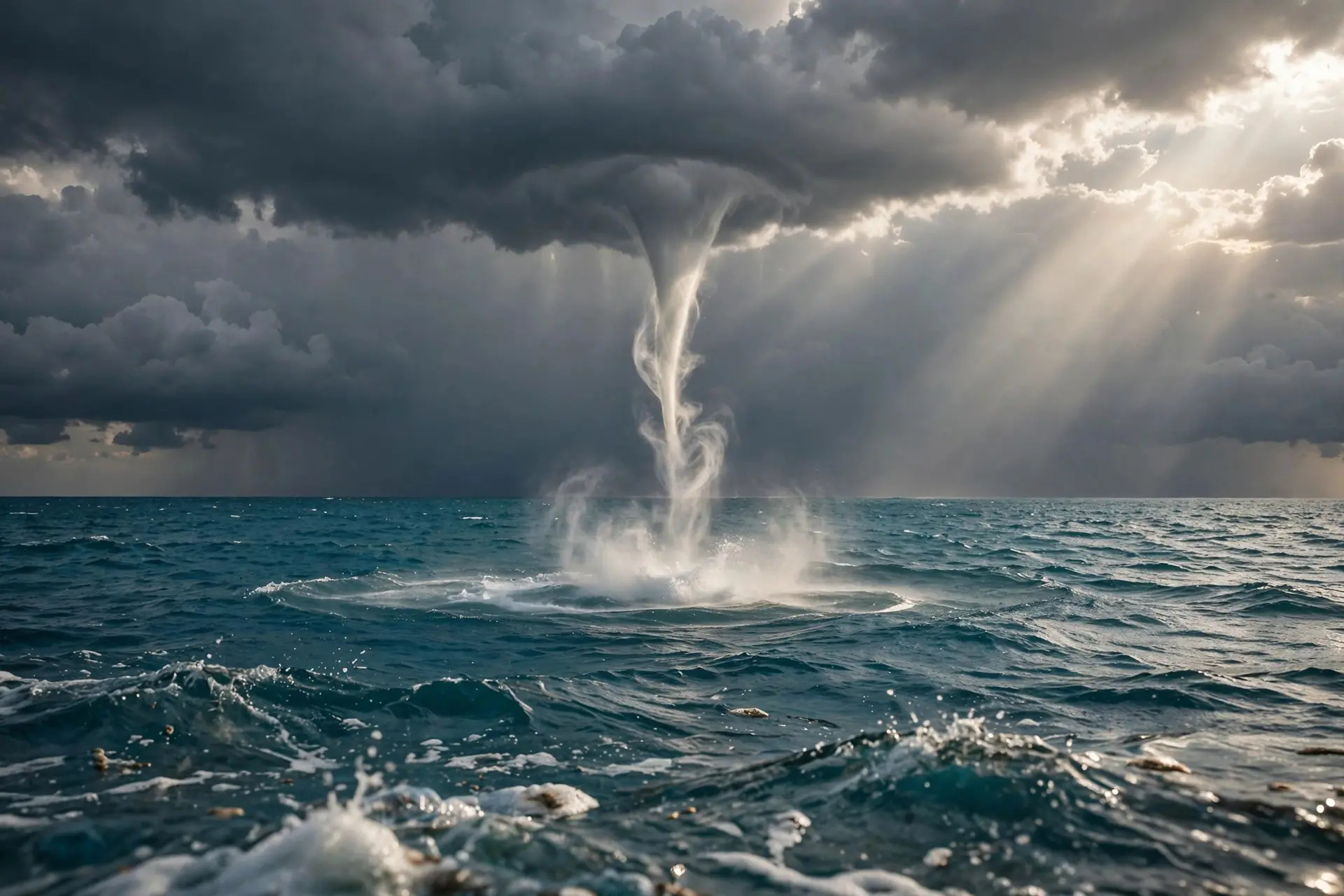
A waterspout is a spinning funnel of air and sea mist that stretches from a cloud to the water below. The surprise is that most of them do not drop from the sky at all. They build upward from the sea surface, and the funnel is nearly finished forming by the time you can see it. Two very different kinds share the name, and knowing which one you are looking at changes everything about the danger.
Key facts
- Fair-weather waterspouts form only over open water, growing bottom-up beneath the dark, flat base of a line of developing cumulus clouds, and they are nearly mature before the funnel becomes visible (NOAA Ocean Service).
- Most waterspouts last just 2 to 20 minutes, drifting very little because they form in light-wind conditions, at speeds of 10 to 15 knots (12 to 17 mph) (NWS Gaylord).
- The common fair-weather type rates at tornado intensity F0, with winds up to 73 mph (117 km/h), while a "significant" waterspout reaches F2 or higher, at 113 mph (182 km/h) and above (NWS Melbourne).
- Marine researcher Joseph Golden described five life stages: a dark spot on the water, a spiral pattern, a ring of sea spray, a mature funnel, and decay (NWS Gaylord).
- Florida's west coast and the Keys are among the most reported hotspots, with peak season running from late spring through early fall (NWS Tampa Bay).
How do the common, fair-weather waterspouts form?
Fair-weather waterspouts are the most common type, and they form under conditions that look harmless: a developing cumulus cloud line, warm water, and light winds. They appear during the formative stage of showers, usually not under full thunderstorms. The process starts on the water, not in the cloud. Warm, humid air near the surface begins to converge and rotate, kicked off by small boundaries like sea-breeze fronts or the outflow edges of nearby showers. This spin organizes into a narrow column that stretches upward toward the cloud base. By the time the funnel is visible, it is close to maturity, which is why waterspouts seem to appear out of nowhere (NOAA Ocean Service).
Golden, a National Oceanic and Atmospheric Administration researcher who studied Florida waterspouts from aircraft in the 1960s and 1970s, broke the life cycle into five stages. First a dark spot appears on the water. Then a spiral pattern winds across the surface. Next a ring of spray rises around the dark spot. The funnel becomes visible in the mature stage, and its spray vortex can rise several hundred feet, leaving a visible wake and wave train as it moves. Then it decays and the funnel fades (NWS Gaylord). Because they grow in weak winds, fair-weather waterspouts drift very little, moving at 10 to 15 knots (12 to 17 mph). Australian Bureau of Meteorology senior forecaster Dean Narramore says most last no more than five minutes, occasionally up to ten, though the US National Weather Service gives an upper range of 20 minutes. Their small size and short life make exact forecasting nearly impossible, Narramore adds (NWS Gaylord; Weatherzone).
How is a tornadic waterspout different?
A tornadic waterspout is a tornado that happens to be over water. It forms top-down from the rotating mesocyclone of a mature severe thunderstorm, exactly the same mechanism as a land tornado, and it can be just as dangerous. High winds, rough seas, large hail, and dangerous lightning travel with it (NOAA Ocean Service). This matters for anyone on a boat. A fair-weather waterspout usually rates F0, with winds up to 73 mph (117 km/h), while tornadic waterspouts are rated F0 to F1 (74 to 112 mph, or 119 to 180 km/h), and the strongest are rated F2 or above, starting at 113 mph (182 km/h) (NWS Melbourne). Even a typical fair-weather waterspout can produce winds above 100 km/h (62 mph), enough to capsize small boats and tear loose deck gear (Weatherzone). The confusion goes both ways. Some tornadoes move from land to water, and observers sometimes call any rotating column over water a waterspout. Meteorologists keep the distinction because the formation mechanism, and the warning approach, are different. Tornadic waterspouts are covered by the same tornado forecasting as land tornadoes; fair-weather ones are simply too small and brief to be forecast at all. For a closer look at how forecasters track the storms that produce the dangerous kind, see how hurricane forecasts are made, and the Coriolis effect on hurricanes.
Where and when are waterspouts most likely?
Geography and season do most of the work. Florida's west coast, especially the Keys, is among the most reported waterspout regions in the world, with the season running from late spring through early fall, when the water is warm and afternoon cumulus lines build daily (NWS Tampa Bay).
The Great Lakes get their turn later. In August through October, the lakes hold summer warmth while cold air masses sweep across them, and northern Michigan's National Weather Service office tracks waterspouts through that window (NWS Gaylord). In Australia, the pattern flips with the hemispheres: waterspouts are most common off the New South Wales and Queensland coasts in autumn and winter, when the land cools but the sea stays warm (Weatherzone).
What should you do if one moves toward shore?
This is where the two types diverge sharply, and where myths run ahead of facts.
| Myth | What actually happens |
|---|---|
| A waterspout "sucks up" water and drops it on land | The visible funnel is condensed water vapor and sea spray, not a rising pipe of seawater; when it weakens, the rain it drops is ordinary precipitation |
| Fair-weather waterspouts are always harmless | They are weaker than tornadoes but can capsize small boats, injure swimmers, and damage docks |
| Waterspouts die instantly at the shoreline | Fair-weather ones usually dissipate rapidly on land and rarely push far inland, but tornadic ones keep going with tornado strength |
| When a waterspout moves onshore, the National Weather Service issues a tornado warning, and you should treat it exactly like one (NOAA Ocean Service). The 2010 Lennox Head event in northern New South Wales shows why: a tornadic waterspout that came ashore destroyed about a dozen homes (Weatherzone). | |
| On the water, the official guidance is to move at a 90-degree angle to the waterspout's apparent movement, keeping a safe distance, and never try to sail through or around the near side (NOAA Ocean Service). Dust devils, the land-dwelling cousins of fair-weather waterspouts, form the same bottom-up way; see how dust devils form for the comparison. | |
| Waterspouts sit in a family of strange sky phenomena. The mammatus clouds that hang beneath the same storm systems make a good companion read. | |
| A waterspout is weather at its most photogenic and most misleading. The gentle-looking funnel that builds from the sea in five quiet minutes is a fair-weather waterspout, worth watching from a distance. The dark, ropey funnel descending from a towering thunderstorm is a tornado with a different mailing address, and it deserves the same respect you would give one over land. | |
| How we made this article: FactSpire researched and drafted it with AI assistance and checked every fact against the sources listed above. |
Frequently asked questions
Are waterspouts the same as tornadoes?
Only the tornadic kind is literally a tornado over water, forming top-down from a severe thunderstorm. Fair-weather waterspouts are a separate phenomenon that builds bottom-up from the sea surface under developing cumulus clouds and never connects to a rotating mesocyclone, so they are usually much weaker.
How long does a typical waterspout last?
The National Weather Service reports lifetimes of 2 to 20 minutes. A senior Australian Bureau of Meteorology forecaster says most dissipate within about five minutes, occasionally lasting up to ten. They form in light-wind conditions, so they move very little while they spin.
Can a waterspout come ashore and hurt people?
Yes, but the common fair-weather type usually falls apart quickly on land and causes little or no damage. Tornadic waterspouts keep the strength of a land tornado and can destroy homes, as one did in Lennox Head, Australia, in 2010. The National Weather Service issues a tornado warning whenever one moves onshore.
Where are waterspouts most common?
Florida's west coast and the Keys, from late spring through early fall, are among the most reported hotspots. They also appear on the Great Lakes in August through October, when warm water meets cold air, and off the coasts of New South Wales and Queensland in Australia's autumn and winter.
Sources
- What is a waterspout?, NOAA Ocean Service
- Science - Waterspouts, NOAA National Weather Service, Gaylord
- Waterspouts, NOAA National Weather Service, Tampa Bay
- Waterspout Threat, NOAA National Weather Service, Melbourne
- What are waterspouts, and how do they form? An expert explains, Weatherzone