The Coriolis Effect: Why Hurricanes Spin Differently
Earth's rotation bends everything moving on the planet. How this invisible force spins hurricanes in opposite directions — and why no storm crosses the equator.
Key takeaways
- The Coriolis effect is not a true force: it is the bending of long-traveling winds, currents, and projectiles caused by living on a spinning planet.
- Earth's equator races along at roughly 1,040 miles per hour while the poles move slowly, so moving air deflects right in the Northern Hemisphere and left in the Southern.
- That deflection spins Northern Hemisphere hurricanes counterclockwise and Southern Hemisphere ones clockwise — no storm in recorded history has spun the other way.
- The effect vanishes at the equator, so storms forming within about five degrees of it never get the spin needed to organize, and no hurricane has ever crossed it.
- Gaspard-Gustave de Coriolis first described the effect in an 1835 paper analyzing rotating machinery like waterwheels — not weather at all.
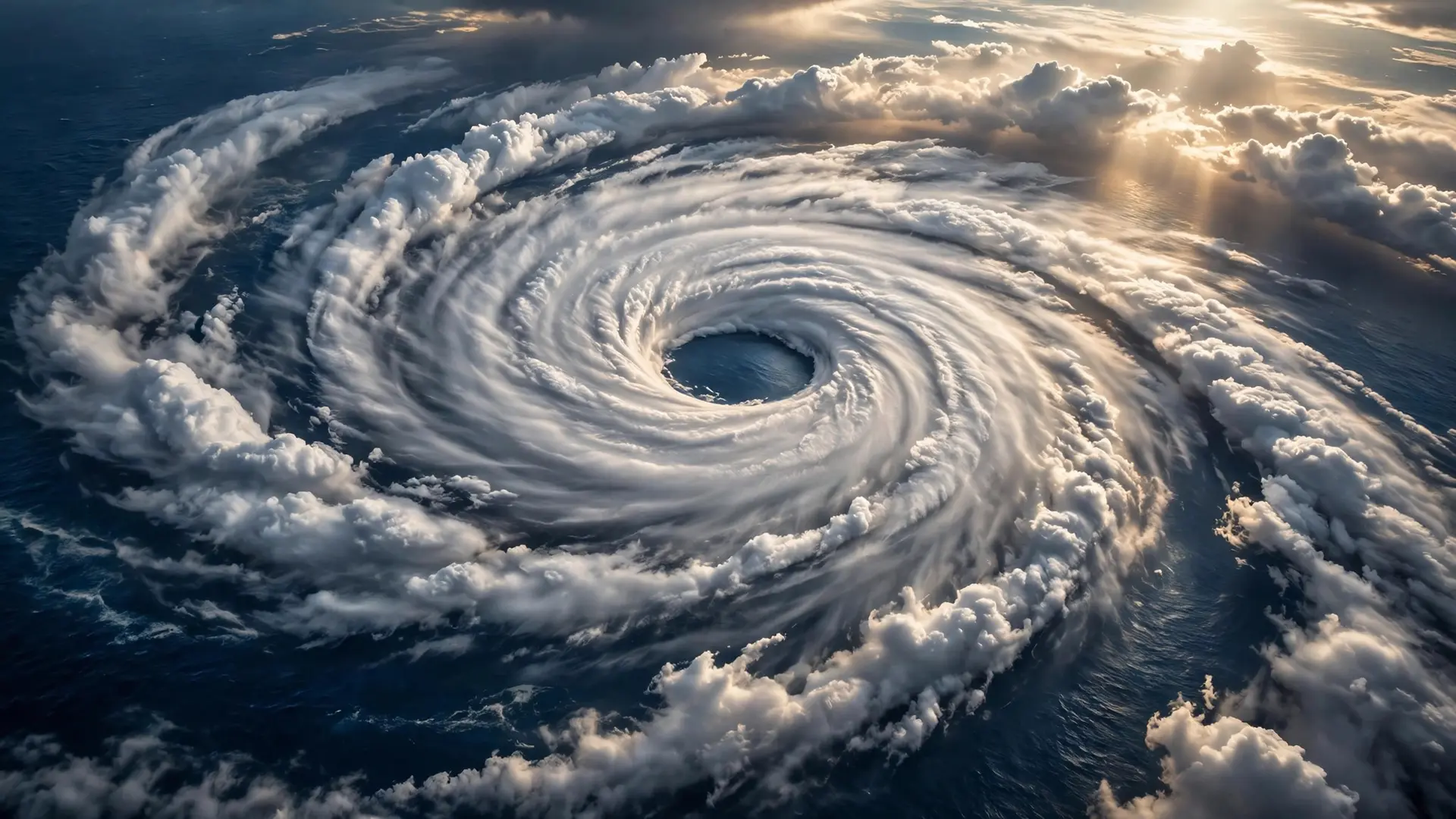
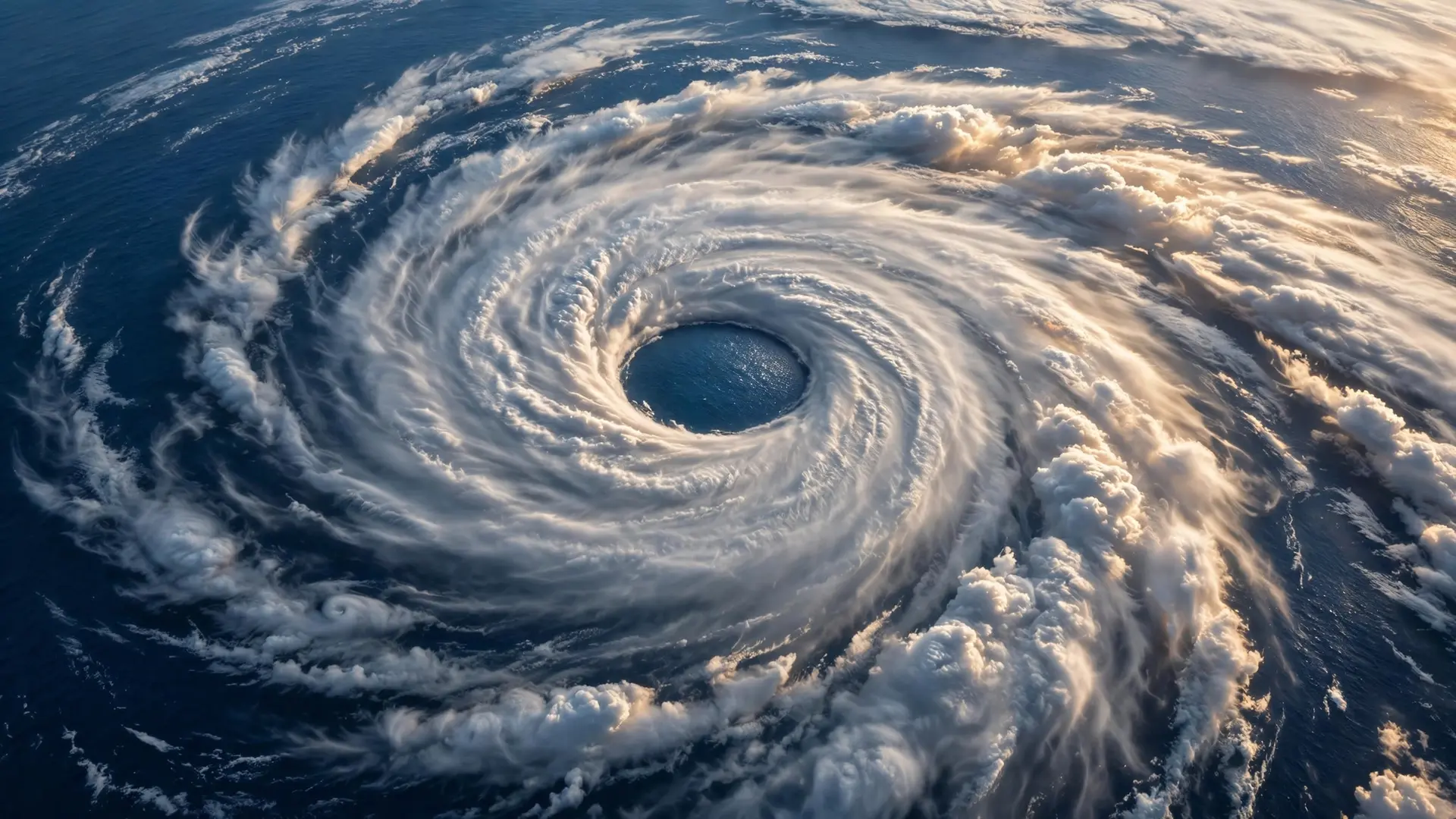
Pull up a satellite photo of a hurricane approaching the Atlantic coast and you will see an unmistakable counterclockwise spiral. Look at a cyclone bearing down on Australia and everything is mirrored: it spins clockwise. No Northern Hemisphere storm has ever spun the other way, and no hurricane in recorded history has ever crossed the equator. The reason is not weather magic. It is the rotation of the planet itself, bending every long journey across Earth's surface into a curve — an invisible hand called the Coriolis effect, and hurricanes are its most dramatic signature.
The Curve That Isn't Really There
The Coriolis effect is not a force at all. It is a consequence of the fact that we live on a spinning platform. Imagine standing on a playground carousel that turns counterclockwise and throwing a ball to a friend opposite you. To you, the ball appears to curve to the right; to someone watching from the ground, the ball flew straight and it was you who rotated away from it. No hand touched the ball mid-flight. The curve exists only in your rotating frame of reference. Earth plays the same trick on everything that moves across its surface. Our planet completes one full rotation every 24 hours, but not all parts of it travel at the same speed: the equator races along at roughly 1,040 miles per hour to complete its vast circumference, while points near the poles cover far shorter distances in the same time and move much more slowly. Any wind, current, or projectile traveling long distances across these latitude zones inherits this mismatch, and from our ground-level perspective its path bends — always to the right in the Northern Hemisphere, always to the left in the Southern Hemisphere.
The mathematics of this effect was first written down by French scientist Gaspard-Gustave de Coriolis in an 1835 paper analyzing rotating machinery like waterwheels — not weather at all. The weather came later: meteorologists realized the same equations explained why winds, which should flow straight from high pressure to low pressure, instead curl into grand circulating systems. Even the atmosphere itself is a rotating fluid, and the aurora — another of the planet's great displays — traces its dance to forces in that same turning sky.
How a Hurricane Gets Its Spin
A hurricane begins as a low-pressure zone over warm ocean water. Air rushes inward from every direction to fill the "vacuum" of that low pressure — but because of the Coriolis effect, none of those inward-rushing currents travels straight. In the Northern Hemisphere, every current is deflected to the right of its path; the result is a steady state in which the wind no longer flows into the storm's center at all, but circles around it, counterclockwise, in a vast rotating spiral. In the Southern Hemisphere, the deflection reverses, and the same machinery produces a clockwise storm. The warm ocean is the engine. Rising moist air feeds heat into the system, and as the storm grows, the spin that started as a gentle nudge becomes the towering spiral visible from space, with winds circling at more than a hundred miles per hour around a calm central eye. The physics is the same one that shapes other great fluids on Earth: even the difference between a glass of hot and cold water can hide strange surprises, as the counterintuitive Mpemba effect shows — though a hurricane's spiral is no accident of plumbing.
Why No Hurricane Has Ever Crossed the Equator
Here is the Coriolis effect's strangest signature: it vanishes at the equator. The deflecting force is weakest at zero latitude and strongest near the poles, which means storms forming within about five degrees of the equator feel almost no rotational nudge at all. Without that initial spin, the inward-rushing air never organizes into a spiral; the storm simply cannot become a hurricane.
That is why hurricanes are born in the tropics but never at the equator — and why they cannot travel across it. If a storm drifts too close to the equatorial line, the balance that holds it together breaks down and the storm falls apart. Tropical-cyclone track records stretching from 1948 onward confirm the pattern: storm after storm, hemisphere after hemisphere, and not a single one has ever made the crossing. The equator is not just a line on a map for these storms; it is a wall made of physics.
What the Coriolis Effect Can't Do
For an effect with such sweeping power, the Coriolis force is famously misunderstood. The most common myth is that it controls which way water spirals down a sink or toilet — that Australian drains rotate opposite to American ones. The truth, confirmed by physicists and meteorologists alike, is that the effect is far too weak to matter over such short distances: the swirl in your sink is set by the shape of the basin and the last movement of the water, not by Earth's rotation. What it can do is bend anything that travels far and fast. During the final year of World War I, German gunners firing artillery at Paris from 75 miles away had to correct their aim by about half a mile to account for it. On a planetary scale, it shapes the great trade winds and jet streams, and it deflects the surface ocean currents into their vast clockwise and counterclockwise gyres. And on other worlds it works even harder: Jupiter spins much faster than Earth, so Coriolis forces there are larger — one reason the gas giant's atmosphere is striped with enormous storms. The solar system's planets each write their weather in the handwriting of their own rotation. So the next time you see that spiral on a satellite map, remember what you are really looking at. A hurricane is Earth's rotation made visible — ten trillion gallons of water and air, bent into a pinwheel by nothing more than the quiet fact that the ground beneath it is turning. Discover beyond the known.
Frequently asked questions
Why do hurricanes spin counterclockwise?
A hurricane begins as a low-pressure zone over warm ocean water. In the Northern Hemisphere, every inward-rushing current is deflected to the right, so the air ends up circling the storm counterclockwise instead of flowing into its center.
Why has no hurricane ever crossed the equator?
The Coriolis deflecting force is weakest at zero latitude and vanishes at the equator. Storms within about five degrees of it feel almost no rotational nudge, and a storm drifting toward the line loses the balance that holds it together.
Does the Coriolis effect change the way water drains?
No. The effect is far too weak over such short distances — the swirl in a sink is set by the shape of the basin and the water's last movement, not by Earth's rotation.
What real things does the Coriolis effect influence?
Trade winds, jet streams, ocean gyres, artillery fire (German guns firing 75 miles at Paris in WWI needed half-mile corrections), and even Jupiter's striped storm bands, which are larger because Jupiter spins faster.