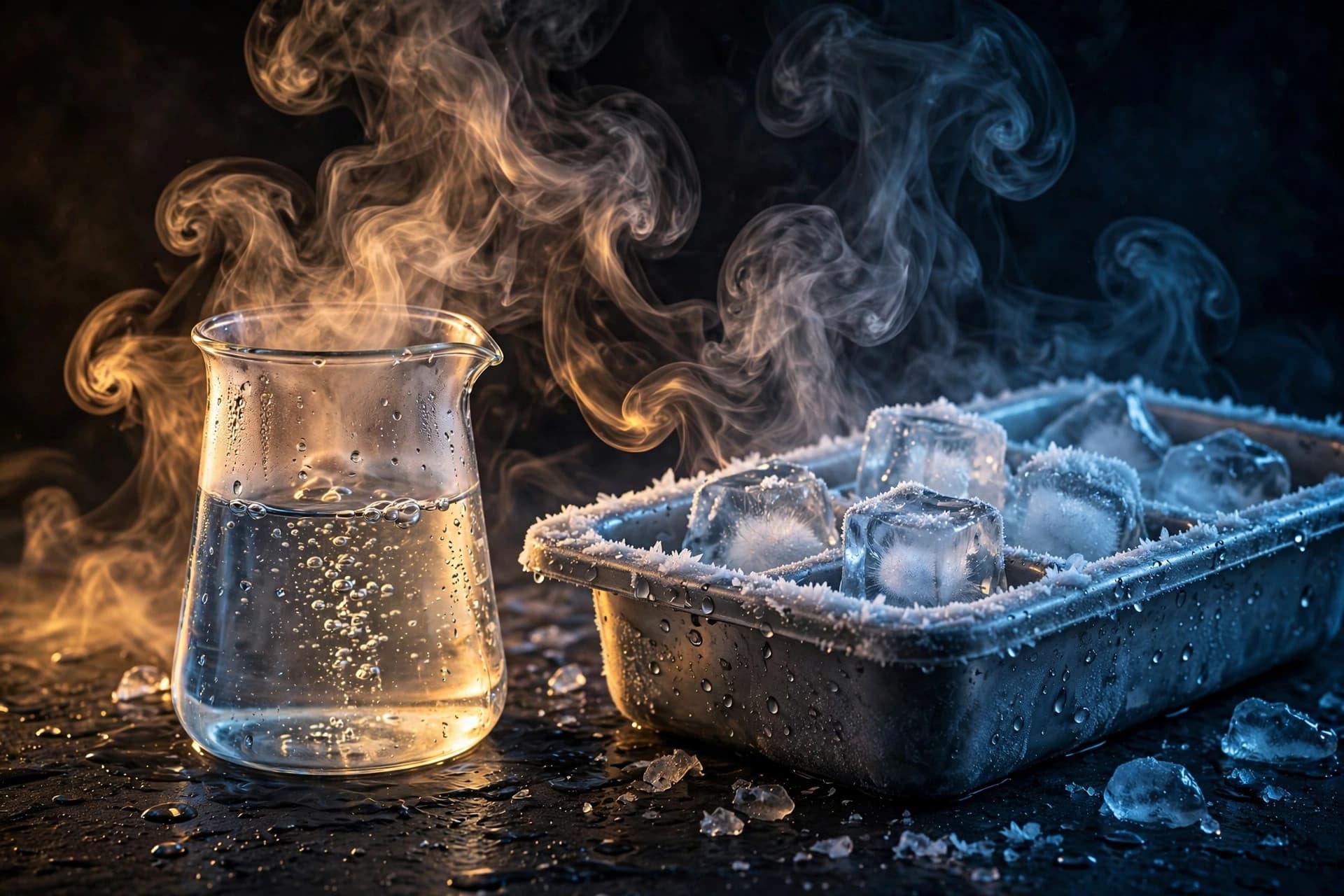
In 1963, a 13-year-old Tanzanian schoolboy named Erasto Mpemba was making ice cream in class when he noticed something absurd: his hot mixture froze before his classmates' cold mixture. His teacher laughed him off — "that is Mpemba's physics, not the universal physics" — yet the same observation had been written down more than two thousand years earlier by Aristotle. So does hot water really freeze faster than cold? The honest answer is: mostly no. But the physics hiding underneath the myth is stranger and more profound than the legend itself.
What the Claim Actually Says
Precision matters here, because the Mpemba effect is two claims wearing one name. The weak claim is about cooling: that hot water reaches 0°C faster than cold water starting closer to it. The strong claim is about freezing: that hot water turns to ice first. They are not the same thing, and confusing them is the source of most of the folklore.
Cooling to zero and freezing are different physical events. Water does not have to freeze the moment it hits 0°C — it can supercool, staying liquid several degrees below freezing until the first ice crystal nucleates. Freezing is a two-step drama: first the water cools, then it must find a molecular trigger to crystallize. Any experiment that only times "reaching 0°C" has measured cooling, not freezing, and the two can tell completely different stories.
There is also a stubborn logical objection that will not go away. If hot water at 70°C and cold water at 30°C are placed in identical freezers, the hot water must pass through 30°C on its way down. At that moment, is it in any way different from the cold sample at its starting line? If not, it can never win the race. For the effect to be real, the hot water must arrive at 30°C in some different state — less mass, stronger currents, fewer dissolved gases — that lets it pull ahead. That "some different state" is where six decades of argument have lived.
A 2,300-Year-Old Puzzle
The observation is ancient. Aristotle noted that warm water seemed to freeze faster than cold. Francis Bacon recorded in his Novum Organum that "water a little warmed is more easily frozen than that which is quite cold." René Descartes described the phenomenon in his 1637 Les Météores and, in a 1638 letter to Marin Mersenne, insisted he had tested it himself — proposing that heating drives off the water's finest, most restless particles through evaporation.
Then came the schoolboy. Erasto Mpemba's 1963 ice-cream observation reached physicist Denis Osborne, who tested it in his own lab and found something there. Their 1969 paper, titled with deadpan brevity "Cool?", put the effect into the scientific literature and gave it Mpemba's name — a rare case of a physical phenomenon named for the teenager who refused to let a teacher's mockery stand, in the grand tradition of accidental discoveries that began as kitchen observations.
Since then, physicists have proposed a small zoo of explanations. Evaporation: hot water loses mass as steam, leaving less water to freeze. Convection: hot water sets up stronger circulation currents that carry heat to the surface faster. Dissolved gases: heating drives out gases and impurities that otherwise interfere with ice formation — a reminder that what is dissolved in water changes how it behaves, as the Dead Sea's extreme saltiness shows on a grand scale. Thermal contact: a hot container melts the frost on the freezer shelf, settling into better contact and conducting heat away faster. And supercooling: hot and cold samples may supercool by different amounts, so the "start" of freezing is not synchronized at all.
Why It Sometimes Happens Anyway
Here is where the story gets deliciously messy, because careful experimenters keep getting contradictory answers — and the contradictions themselves are informative.
James Brownridge spent years chasing the effect with sealed vials and concluded that it appears only when the water supercools, and only when the cooler sample happens to have a lower nucleation temperature than the warmer one. In his framing, it is not the starting temperature that decides when a sample freezes but its "spontaneous freezing temperature" — the point where ice nucleation becomes inevitable. Two samples that look identical can carry different nucleation temperatures, and the supposedly "hot" one can win purely on that hidden difference. He also caught a classic confound red-handed: a hot container melts frost on the cooling surface, improving thermal contact, so the two samples are not really experiencing identical conditions at all.
In 2016, physicists Henry Burridge and Paul Linden tried to reproduce the effect rigorously and could not — and their failure was illuminating. In convecting water, they showed, temperature is not a single number: the top, middle, and bottom of the sample can differ substantially, so where you place the thermometer decides what you think you measured. A "hot freezes faster" result can be an artifact of measurement geometry.
A 2025 study sharpened the picture further by embracing randomness. Its authors argued that in pure water the effect is rooted in the stochastic nature of ice nucleation — the first crystal forms at an inherently unpredictable moment. They found the effect appearing in roughly one-third of trials, but only when the freezer temperature sat very close to the water's nucleation temperature, where the natural variability in freezing onset could outweigh the hot sample's cooling delay. Crucially, they confirmed that hot water does not cool to 0°C faster — ruling out evaporation and convection as the drivers of the effect itself. Sometimes the "effect" is just luck, amplified by conditions.
The Version of the Effect That Is Real
And yet — buried under the murk of kitchen experiments — there is a version of the Mpemba effect that is rigorously, mathematically real. It just is not about water.
In 2017, Oren Raz and Zhiyue Lu analyzed how systems relax toward equilibrium and found something counterintuitive. A relaxing system is a sum of decaying modes, and one of them is always the slowest — the bottleneck that sets the finishing time. What matters is not how far you start from the goal but how much of that slowest mode your starting state contains. A hotter state can carry less of the slow mode, skip the slow lane entirely, and overtake a colder state that started closer. Distance from the finish line is not the same as time to reach it.
In 2020, Avinash Kumar and John Bechhoefer made this concrete in Nature with an experiment of beautiful precision: microscopic glass beads, 1.5 micrometers across, rattling in a laser-sculpted energy landscape, measured over a thousand trials. The "hot" beads — started with more energy — settled to equilibrium faster than the "cold" ones, sometimes exponentially faster, in what they called the "strong Mpemba effect." They even demonstrated the inverse: a cold system heating up faster than a warm one. It was, one theorist said, the first clean, perfectly controlled demonstration of the effect — achieved by abandoning water entirely.
Since then the phenomenon has turned up in clathrate hydrates, in 3D-printing plastics, and in magnetic materials that demagnetize faster when they start more strongly magnetized. As physicist John Goold put it, "it became clear that this is a very generic phenomenon — it's everywhere." Which is exactly why the arrow toward equilibrium is so subtle: reaching it is not about where you begin but about which paths are open to you, a theme at the heart of the physics of time's arrow.
The Takeaway
So: should you fill your ice trays with hot water? As a kitchen rule, no — under ordinary conditions it will not beat cold water to ice, and any victory likely comes from melted frost, lucky nucleation, or a misplaced thermometer. The legend is mostly myth. But myths sometimes guard real treasure. The Mpemba effect forced physicists to think hard about what "freezing" even means, and that thinking uncovered a genuine law of nature: a system that starts farther from equilibrium can finish first, because the race is decided not by the starting distance but by the slowest road home.