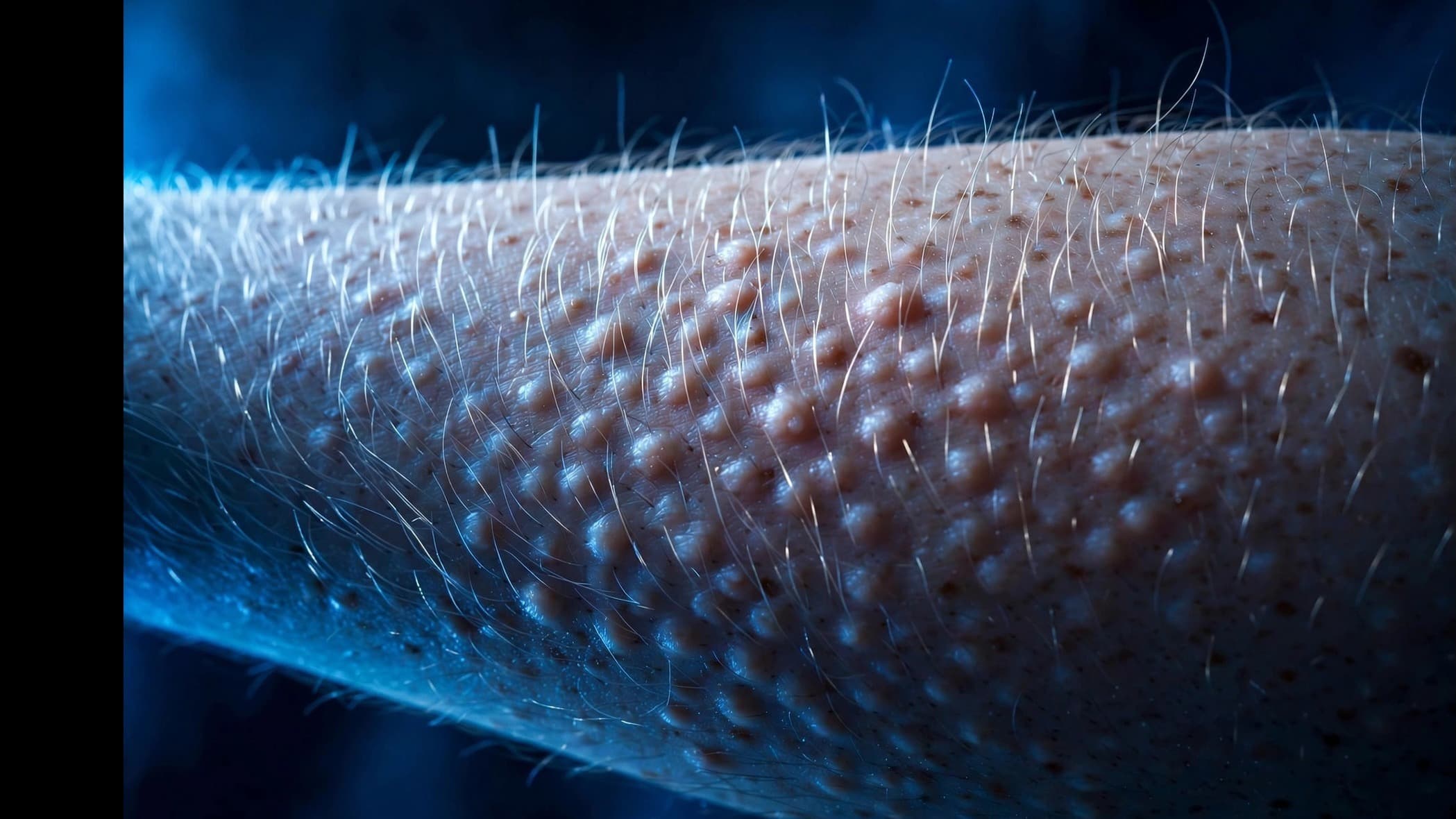
Every goosebump on your skin is a leftover survival order from an ancient past. A microscopic muscle gripping the root of each hair fires without your permission, raising the hairs on your body for a reason that once meant the difference between warmth and freezing — or between being eaten and scaring off a predator.
The machinery behind it is astonishingly simple. Each bump marks a single hair follicle being yanked upright by a tiny bundle of smooth muscle called the arrector pili — Latin for "erector of hair." These muscles answer to the sympathetic nervous system, the body's autopilot for fight-or-flight, which is why you cannot consciously decide to raise goosebumps the way you decide to lift your arm. The signal travels from a cold breeze or a fright through your spinal cord and out to the skin, and within a fraction of a second, thousands of these muscles contract at once.
The Tiny Muscle Behind Every Bump
The arrector pili is one of the smallest muscles in your body, yet every mammal has one per hair follicle. When cold, fear, or strong emotion strikes, the sympathetic nerves tell it to shorten. The hair shaft tilts upward, the follicle is pulled slightly outward, and the skin around it dimples — that dimpling is the "goose" texture, named because plucked goose skin looks exactly the same.
What makes this reflex unusual is what the sympathetic nerves were caught doing around the follicle. Using high-resolution electron microscopy, Harvard researchers found in 2020 that the nerve fibers do not just touch the muscle — they wrap around the hair follicle's stem cells like ribbons, forming synapse-like connections with cells that are not neurons at all. That odd arrangement turns out to be the key to why the reflex survived.
Job One: A Thicker Coat of Warm Air
Imagine one of our ancestors on a freezing night, covered in dense fur. When the arrector pili muscles contracted, every hair stood at attention, and the lifted fur trapped a thicker layer of still air against the skin. Still air is a poor conductor of heat, so that invisible blanket slowed heat loss dramatically. For a small, furry mammal, this quick thickening of the coat was the fastest defense against a sudden drop in temperature — faster than shivering, which burns precious energy.
You can still see this trick working perfectly in other mammals. A wet dog shakes, then fluffs. Porcupines bristle. Seals rely on the same muscle action to keep their insulation layered. In us, the machinery survives but the coat is gone: on nearly hairless human skin, the same contraction produces only bumps and a vague chill, which is why biologists call goosebumps a vestigial reflex — a physiological leftover whose original job no longer applies.
Job Two: Looking Bigger Than You Are
The second ancient job of piloerection had nothing to do with cold. A startled cat's hackles rise along its spine. A threatened dog's ruff stands up. A porcupine becomes a bigger, spikier problem. Raised fur makes an animal look substantially larger and more formidable — a visual bluff that can persuade a predator to look for easier prey.
Charles Darwin himself was fascinated by this connection. He studied goosebumps and bristling fur as part of his investigation into the expression of emotions in animals, noting that the same skin response appears in fear and aggression across species. That cross-species pattern is exactly what evolutionary biologists expect from a reflex that predates humans by hundreds of millions of years: cold and fear both meant danger, so one alarm circuit served both.
Interestingly, the circuit is not perfectly sealed. In curious documented cases, some people can actually switch goosebumps on and off at will, suggesting the "involuntary" label has rare exceptions.
The 2020 Plot Twist: Goosebumps Grow Hair
For decades, the textbook story ended at "useless leftover." Then a 2020 study in the journal Cell, led by Harvard stem-cell biologist Yulia Shwartz, gave the arrector pili a surprising new job.
The team discovered that the sympathetic nerve and the arrector pili muscle form a dual-component niche that regulates the stem cells responsible for regenerating hair follicles. During prolonged cold, the nerves ramp up their activity, releasing more neurotransmitter onto the stem cells — and that signal tells them to wake up and grow a new, thicker coat. As Shwartz explained it, the response has two layers: "Goosebumps are a quick way to provide some sort of relief in the short term. But when the cold lasts, this becomes a nice mechanism for the stem cells to know it's maybe time to regenerate new hair coat."
In other words, the bump is the emergency blanket, and the nerve firing that causes it is also a message to the stem cells: winter is coming, build more insulation. The muscle turned out to be a structural link — when researchers removed it, the nerve-to-stem-cell connection collapsed. The same trio also appears to influence skin repair, and scientists are now exploring whether this nerve-muscle-stem-cell partnership could point toward better treatments for hair loss, wound healing, and certain skin cancers. The reflex may not be vestigial after all — just repurposed.
Why Music and Fear Pull the Same Lever
That leaves the strangest trigger of all: why does a beautiful song in a warm room raise the same bumps as an icy wind? The answer lies in the wiring. Cold, fear, awe, and musical chills — the phenomenon psychologists call frisson — all converge on the sympathetic nervous system. It is the body's general alarm and arousal circuit, and goosebumps are one of its outputs, fired whether the stimulus is a predator or a perfect chord progression.
There is a subtle difference in what happens upstream. Fear runs on adrenaline and threat detection; musical chills run through the brain's reward circuitry, the same system that responds to food and other deep pleasures. But downstream, both pull the same ancient lever, and the skin answers the same way. That is partly why a goosebump is so hard to fake: it is the body quietly leaking how it really feels, bypassing conscious control entirely.
The next time a song gives you chills, remember what is happening under the surface. A nerve older than our species is wrapping its fibers around your hair follicles, a muscle smaller than a grain of sand is hauling every hair upright, and stem cells may be listening for instructions to grow a thicker coat — all because your body briefly believes it is a furry animal facing a cold night. Like so many of the body's quirks, from the hidden machinery in our genes to the strange involuntary flickers explored in the science of déjà vu, goosebumps are a reminder that evolution rarely throws anything away. It just keeps the old wiring and plugs in something new.
Takeaway: Goosebumps are piloerection — a fight-or-flight reflex that once insulated furry ancestors and made them look bigger to predators. A 2020 Harvard study revealed it is not fully vestigial: the same nerve-muscle unit also signals stem cells to regrow hair during prolonged cold.