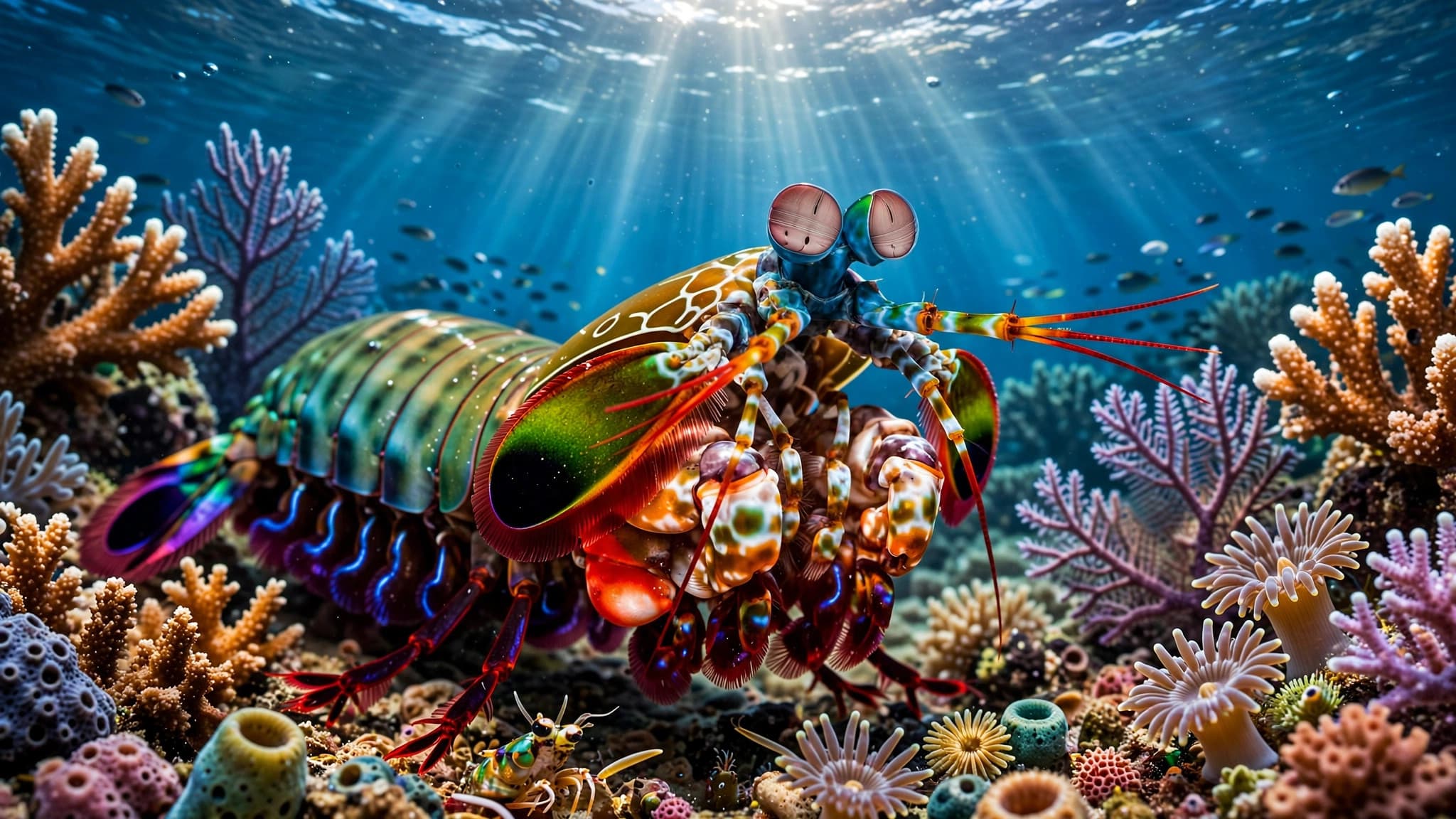
The mantis shrimp packs twelve color channels, vision stretching from ultraviolet into the deep red, and the ability to detect a kind of light that almost no other animal on Earth can see. Yet the most shocking discovery about its legendary eyes is this: despite all that hardware, it is surprisingly bad at telling similar colors apart.
That paradox has made the mantis shrimp one of the most studied — and most misunderstood — eyes in the animal kingdom. Unpacking it reveals that nature does not always build vision the way we assume, and that more sensors do not necessarily mean richer perception.
An Eye Unlike Any Other
Each mantis shrimp eye is a compound eye mounted on a stalk, and the two stalks move independently, swiveling in three dimensions like tiny periscopes. But the real strangeness is inside. Each eye is divided into three regions, and the central strip — the midband — contains six parallel rows of enlarged light-sensing units called ommatidia.
The midband is where the magic happens. The first four rows are dedicated to color, including receptors tuned to several different wavelengths of ultraviolet. The last two rows handle polarization — the plane in which light waves vibrate — including circularly polarized light, which almost no other animal can detect. Add the twelve color channels to the polarization channels and you get the often-quoted figure of sixteen photoreceptor classes: the most complex visual hardware known in any animal.
The eyes are independently mobile and can even judge distance with a single eye, because multiple ommatidia focus on the same point. For a creature famous for its other superpower — a spring-loaded claw strike so fast it briefly boils the water around it through cavitation — this visual system is the targeting computer behind the weapon.
The Numbers Behind the Legend
Humans see color with just three cone types — roughly red, green, and blue — whose overlapping sensitivity curves let the brain compare signals and compute millions of hues. Some mantis shrimp species carry twelve narrow-band color receptors spanning roughly 300 to 720 nanometers, from ultraviolet through the red edge of human vision. As many as six of those receptors sit in the ultraviolet alone, each tuned to a different UV wavelength by pigment filters layered in front of them like sunglasses stacked in sequence.
The molecular machinery is even wilder than the receptor count suggests: researchers have found more than 30 different types of opsins — the light-sensitive proteins at the heart of vision — in mantis shrimp eyes, far more than the three or four most animals use. Light passes through biological filters before it even reaches the receptors, pre-sorted before the visual process truly begins. On paper, this is an eye that should perceive a riot of color utterly beyond human imagination. It is the kind of sensory excess that shows up whenever biology pushes a trick to extremes, the way quantum effects turn up in places physicists never expected.
The 2014 Experiment That Punctured the Myth
Then came the behavioral test. In a 2014 paper in Science (vol. 343, pp. 411–413), University of Queensland researcher Hanne Thoen and colleagues trained individuals of a small mantis shrimp species, Haptosquilla trispinosa, to recognize colors. The shrimp learned to associate a food reward with a particular hue, then faced a two-way choice between the trained color and a slightly different one.
The results defied the legend. When the two colors differed by 50 to 100 nanometers of wavelength — say, powder blue versus neon green — the shrimp chose correctly up to 80 percent of the time. But when the colors differed by less than 25 nanometers, accuracy collapsed to around 50 percent: no better than guessing. Humans, by comparison, can distinguish hues just 1 to 4 nanometers apart. The shrimp was worse at fine color discrimination than bees, butterflies, and fish — animals with far fewer color channels.
"The critical finding is that mantis shrimp do not do this," Thoen said of the human strategy of comparing receptor outputs, "and this means their way of encoding color is different to all other animals known."
Recognition, Not Discrimination
The proposed explanation flips the usual logic of vision on its head. Instead of comparing the outputs of overlapping receptors the way our brains do, the mantis shrimp's channels appear to be hardwired to specific wavelengths — more like a barcode reader than a painter's eye. Each channel reports, in effect, "my color is present or it isn't," and the brain recognizes the resulting pattern instantly without doing any cross-channel math.
This is color recognition rather than color discrimination: fast, coarse, and pre-wired. The tradeoff is obvious — the animal sacrifices the ability to savor subtle shades — but the payoff is speed. On a coral reef, one of the most visually chaotic environments on Earth, identifying a mate's signal, a rival's warning colors, or a prey item in a split second matters far more than appreciating the difference between teal and turquoise. More channels also create a problem of their own: comparing twelve overlapping signals would demand far more neural processing than a shrimp brain can spare, so evolution took the shortcut.
That shortcut still leaves mysteries. Why carry six ultraviolet channels if the animal cannot finely discriminate among them? Why more than 30 opsins for twelve receptors? One theory is that some channels are reserved for private communication — visual signals broadcast on ultraviolet or polarization channels that predators cannot see, like a coded radio frequency. The same polarization sense may also help the shrimp spot transparent prey, since many see-through animals still distort polarized light.
From Shrimp Eyes to Cancer Cameras
The mantis shrimp's alien optics have already leapt from reef to laboratory. Professor Justin Marshall's team at the University of Queensland — the same lab behind much of the vision research — collaborated with scientists in the US and UK to build a camera inspired by the shrimp's polarization vision. Cancerous tissue and healthy tissue scatter polarized light differently, and the mantis-shrimp-inspired camera can pick out those differences instantly, potentially giving surgeons real-time feedback or even letting smartphones monitor suspicious tissue one day.
It is a fitting twist: an eye that evolution built for instant threat-and-mate recognition on a coral reef may end up helping human eyes see what they were never built to detect. Biology's strangest light detectors, from the physics of why the sky is blue to the molecular machinery written in our DNA, keep turning out to be instruction manuals for technology.
Takeaway: The mantis shrimp has twelve color receptors and sees ultraviolet and polarized light — but a landmark 2014 study showed it discriminates similar hues worse than humans. It trades fine color vision for instant color recognition, a completely different strategy from every other known animal.