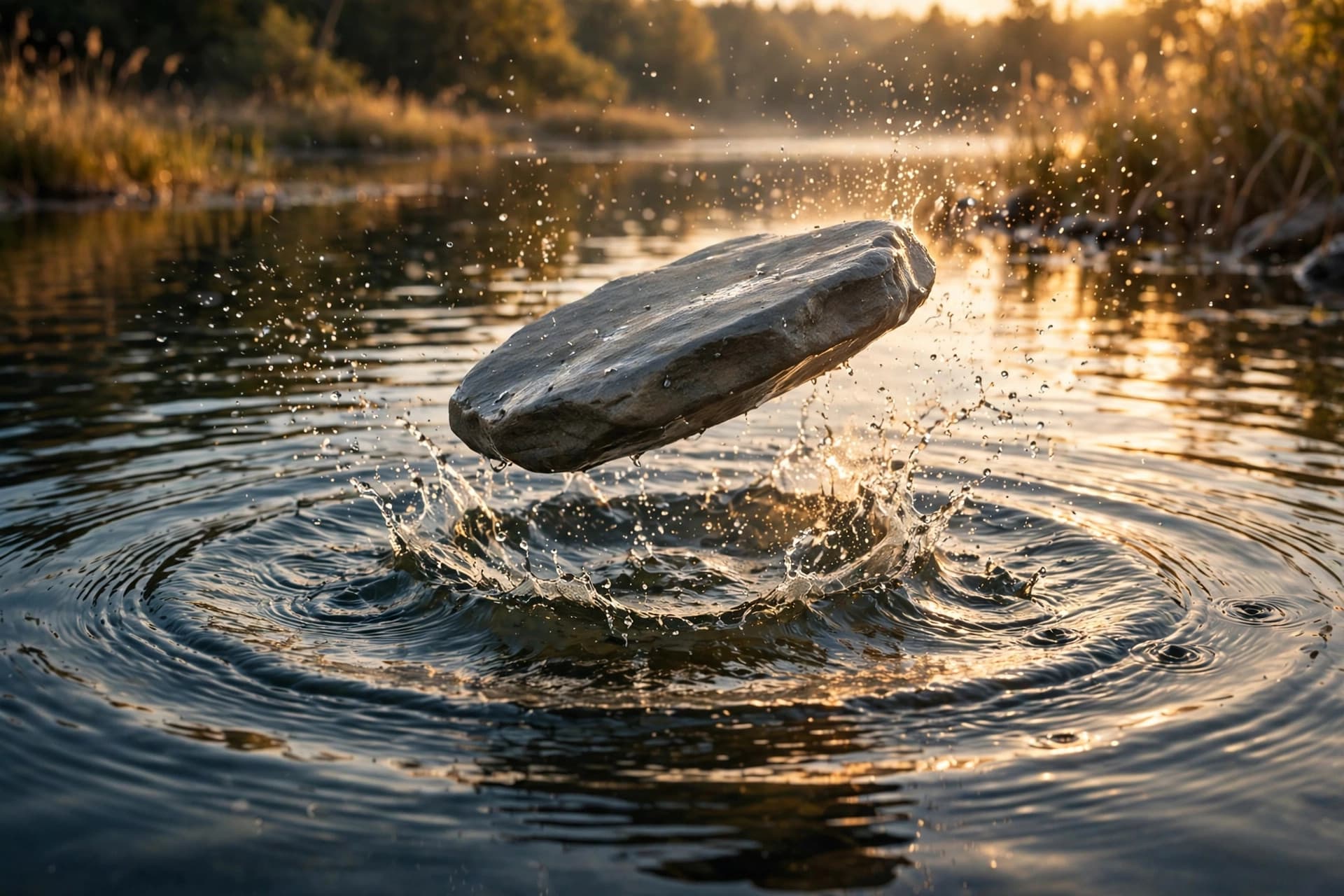
A well-thrown flat stone can bounce across a lake dozens of times before it finally gives up and sinks. The secret is not strength alone: the stone must generate enough lift to beat its own weight, spin fast enough to stay flat like a gyroscope, and strike the water tilted at a "magic angle" of about 20 degrees. Get all three right and water, briefly, behaves like a trampoline.
The First Bounce: How Water Pushes Back
When a stone smacks into water, the impact is a contest between two forces: the stone's weight pulling it down, and the water's resistance shoving it back up. A flat stone has a decisive advantage. Because its weight is spread across a wide surface, each square centimeter of water only has to push back a little. A round or jagged stone concentrates all its weight on a small point, punches straight through the surface, and vanishes with a plop.
Physicists describe the upward shove as a hydrodynamic lift force — the same family of force that holds an airplane wing aloft, as explored in why airplane windows are rounded for flight safety. For the stone to bounce, that lift has to balance the stone's weight during the brief collision. Working through the numbers, researchers found a minimum speed for a successful skip: for a typical 100-gram stone about 10 centimeters across, anything faster than roughly one meter per second can work. That is barely a brisk walking pace, which is why even a casual throw can produce a skip or two.
The tilt matters enormously. The stone should meet the water with its front edge raised slightly above its back edge. As the trailing edge digs in, it piles water up in front of itself, and the stone rides up that little watery ramp like a skateboarder hitting a curb cut. Come in flat and the stone slaps and stalls; come in too steep — much beyond 45 degrees — and no amount of speed will save it.
Spin: The Gyroscope in Your Fingertips
Speed and tilt alone cannot explain the great skippers, because a stone that lands tilted should tumble. The instant the front edge lifts, torque should flip the stone nose-over-tail into the drink. What stops this is spin.
Throwing the stone with a flick of the fingers sets it spinning like a Frisbee, and a spinning object resists any change to its orientation. This is the gyroscopic effect — the same principle that keeps a spinning top upright and steadies the gyroscopes aboard spacecraft. Experiments by physicist Lydéric Bocquet's group showed that a stone needs a minimum spin to stay stable: it must rotate at least once during the split-second collision with the water. That means the required spin rate is roughly the inverse of the collision time. Fall below it and the stone's attitude goes chaotic; a second bounce becomes unlikely.
Here is the subtle part. Spin does not just stabilize the stone — it also steers it. In 2021, a team led by Kun Zhao at Harbin Institute of Technology spun aluminum disks with laboratory precision and watched what happened at each impact. When the spin was slow, a second force called the Magnus effect took over and the disk veered left or right depending on its spin direction. Only above about 18 rotations per second did the gyroscopic effect dominate and the disk hold a straight line. So the sideward curve of an amateur's throw is not bad luck; it is the Magnus effect winning a tug-of-war that spin usually settles.
The "Magic Angle" and the Scientists Who Found It
For most of human history, skipping stones was pure folk knowledge — something grandparents taught without equations. That changed in the early 2000s, when Bocquet's team at the University of Lyon began filming stone impacts and building the first real mathematical model of the skip. Their 2004 study revealed something the old-timers had felt in their wrists: there is an optimal tilt.
The researchers found that the stone's inclination to the water surface — the tilt angle, distinct from the trajectory angle — has a sweet spot near 20 degrees. Computer simulations by Japanese physicists using smoothed-particle hydrodynamics confirmed it: across a wide range of speeds and approach angles, a tilt of about 20 degrees consistently gave the longest skips. They dubbed it the "magic angle." Stray too far from it and the lift collapses; sit near it and each bounce steals the minimum possible energy.
It is worth pausing on a common misconception here. Many people assume surface tension — the skin-like film on water — is what bounces the stone. It is not. Surface tension is far too weak to matter at these scales. The real work is done by the inertia of the water itself: thousands of water molecules that must be shoved aside in milliseconds, pushing back with a force that briefly exceeds the stone's weight. Surface tension is the rumor; hydrodynamic lift is the story.
88 Skips and the Stone That Surfs
The human benchmark for all this physics is Kurt Steiner of Pennsylvania. On September 6, 2013, at Red Bridge in the Allegheny National Forest, Steiner threw a stone that skipped 88 times — the current Guinness World Record. He had already held the record from 2002 to 2007 with a 40-skip throw, and his rivalry with fellow skipper Russell Byars pushed both men to treat rock selection like a science. Steiner hunts for stones weighing 3 to 8 ounces, smooth, with flat bottoms, between a quarter and five-sixteenths of an inch thick — each one an optimized lifting surface.
Steiner's record also illuminates an edge case the physicists found in the lab. Zhao's team discovered that the violence of the impact decides everything: when the disk's upward acceleration exceeded four times gravity, it bounced cleanly. But at around 3.8 g, something strange happened — the disk "surfed." It skimmed along the surface at an oscillating angle, never quite bouncing, never quite sinking. Watching a great skipper's throw in slow motion, you can see the final skips of a long run blur into exactly this surfing regime as the stone runs out of energy: the bounces get lower and faster until the stone is simply planing across the surface on its last reserves of speed.
The Takeaway: From Lakeshores to Spacecraft
A skipping stone is a masterclass in how simple rules produce rich behavior: lift versus weight, spin versus tumble, a magic angle discovered by experiment rather than intuition. And the physics is not just a lakeside curiosity. Zhao's team explicitly framed their work around spacecraft — understanding how a vehicle behaves when it slams into water at an angle could mean the difference between a survivable ocean landing and a catastrophe, a problem as old as Apollo-era splashdowns.
So the next time a flat stone leaves your hand, you are running a small experiment in fluid dynamics, gyroscopic stability, and energy management — the same experiment, scaled up, that engineers run for machines falling out of the sky. Aim for 20 degrees, give it a good flick of spin, and see how many bounces physics owes you.