What Is Heat Lightning, and Why Can't You Hear It?
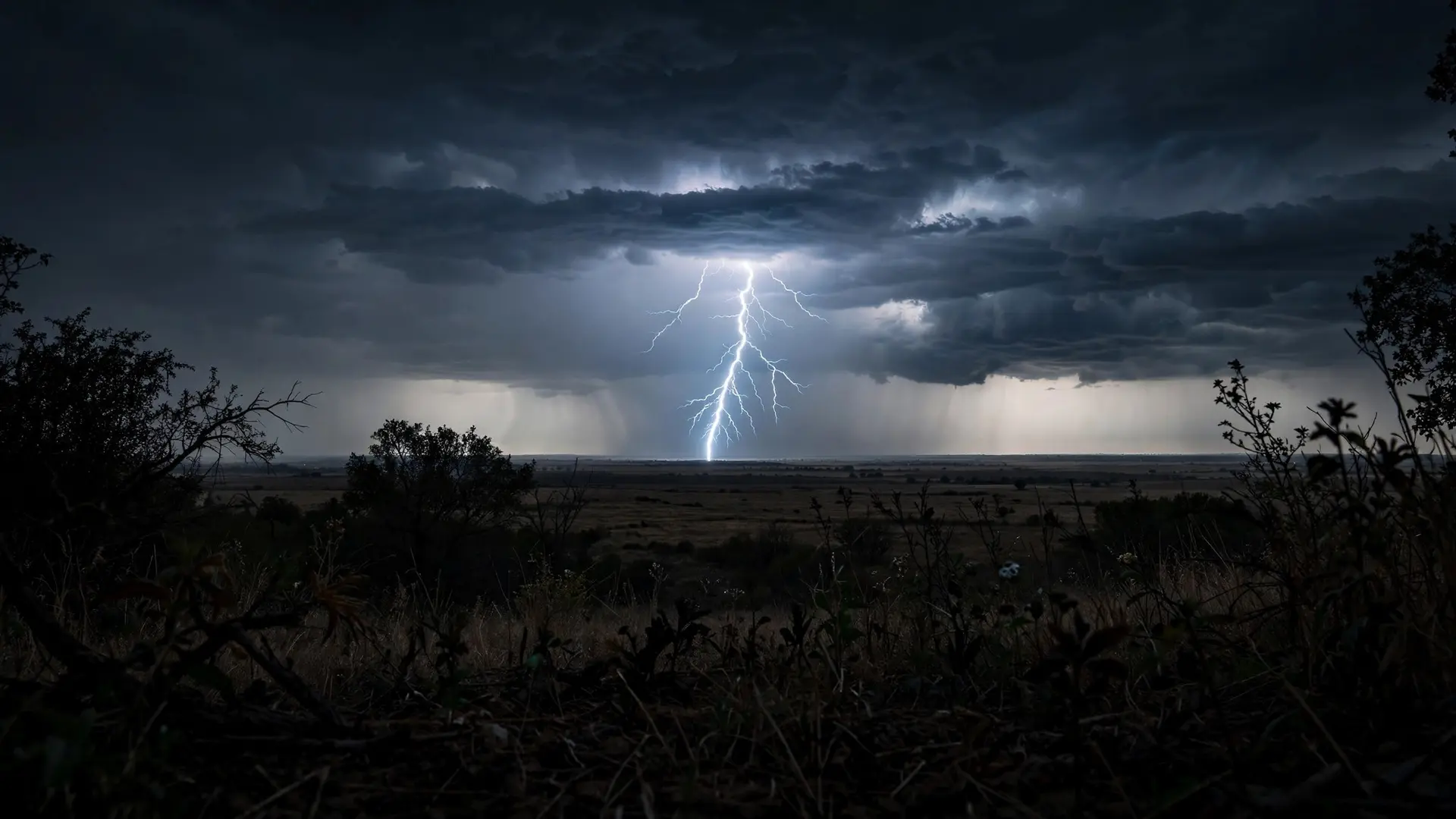
There is no such thing as heat lightning. It is ordinary lightning from a storm more than about 10 miles away, too far for its thunder to reach you.
Key takeaways
- There is no such thing as heat lightning: it is ordinary lightning from a thunderstorm too far away to hear.
- Thunder can only be heard within about a ten-mile radius of a lightning strike, while the flash can be seen from dozens of miles away.
- The name stuck because silent flashes are most common on hot summer nights, when heat-driven storms are everywhere.
- Sheet lightning is the same idea: the bolt is hidden inside the cloud or below the horizon, so you see only the glow.
- Lightning can strike up to 25 miles from its parent storm, so 'no thunder' does not always mean 'no danger.'
There is no such thing as heat lightning. What you are seeing is ordinary lightning from a thunderstorm more than about 10 miles away, too far for its thunder to reach you. The name stuck because these silent flashes are most common on hot summer nights, when heat-driven storms are everywhere.
- According to the National Weather Service, "heat lightning" is simply the light produced by a distant thunderstorm, not a specific type of lightning. (WBKR)
- Thunder can only be heard within about a ten-mile radius of a lightning strike; if the storm is tall enough, its flashes can be seen from over 100 miles away. (WBKR)
- Mountains, trees, or the curvature of the Earth can hide the actual cloud-to-ground flash, leaving only a faint flicker lighting up the upper clouds. (WBKR)
- Lightning is bright enough to be seen across the horizon, even dozens of miles away when the storms are tall and the horizon is flat. (FOX Weather)
- Sound waves can only travel so far before air molecules scatter them; generally thunder dissipates to near inaudible levels after about 10 miles. (FOX Weather)
- Lightning strikes have been known to travel as far as 25 miles from their parent thunderstorm, a genuine "bolt from the blue." (FOX Weather)
Why does distance silence the thunder but not the flash?
Light and sound play by different rules. A lightning bolt is essentially instantaneous to your eyes at 186,000 miles per second, while sound crawls along at about 760 miles per hour. Thunder starts as a sharp crack from superheated air and loses energy as it spreads through the atmosphere, getting scattered by air molecules and refracted by layers of different temperature. After roughly 10 miles, there is little left to hear. The flash has no such problem. On a flat horizon, the light from a tall cumulonimbus can travel dozens of miles, and the glow from a storm's upper clouds can be visible from over 100 miles away. So the same storm delivers both signals, and your eyes get one while your ears get nothing. Meteorologists at NOAA dislike the term "heat lightning" partly because it implies the lightning is harmless; they prefer "distant lightning," which is less poetic but more honest.
Why is it always a summer thing?
Because summer is thunderstorm season, especially in places like the American Midwest and Mid-Atlantic. The sun beats down all day, the ground heats up, and hot air rises fast. If there is enough moisture, that rising air builds pop-up "air-mass thunderstorms" that flare up, dump rain on one county, and leave the neighboring county dry but illuminated by distant flickers. The flashes you see from your porch are the leftovers of a storm that happened to form over someone else's town. There is nothing special about the lightning itself. Every flash begins the same way, as a discharge between regions of charge inside a storm cloud. The heat only sets the stage for the storms, not a new kind of electricity. Summer heat actually builds two kinds of storms, and both produce silent flashes for someone. Air-mass thunderstorms are the pop-up kind: a single cell that lives and dies in under an hour, fed by the day's heat and local moisture. Frontal storms are the organized kind: long squall lines riding a cold front for hundreds of miles. Either way, once the storm drifts far enough, all that is left for a distant observer is the flicker. The storm does not know you are watching, and it does not care.
What about sheet lightning?
Sheet lightning gets the same debunking. It is what you see when the bolt stays hidden: contained inside the cloud, masked by another cloud, or flashing below the horizon. The sky lights up like a white sheet instead of showing a fork. It can look like a different phenomenon, but it is the same regular lightning you just cannot see in the traditional sense. Upward lightning, which climbs from tall structures toward the sky, is a genuinely distinct form. Heat and sheet lightning are not.
How far away is that storm, really?
You can estimate the distance with nothing but counting. Because light arrives instantly and thunder needs about five seconds per mile, divide the seconds between flash and bang by five:
| You count | Storm distance (miles) | Storm distance (km) | What it means |
|---|---|---|---|
| 5 seconds | ~1 mile | ~1.6 km | very close, take shelter |
| 15 seconds | ~3 miles | ~4.8 km | storm approaching |
| 30 seconds | ~6 miles | ~9.7 km | thunder still clear |
| 50 seconds | ~10 miles | ~16 km | near the limit of hearing |
| no thunder at all | beyond ~10 miles | beyond ~16 km | this is "heat lightning" |
| Method: 1 mile per 5 seconds, converted at 1.609 km per mile. The rule breaks down when wind and terrain bend sound in odd directions, and ducting in the atmosphere can occasionally carry a faint rumble much farther than 10 miles while people closer hear nothing. |
What do people get wrong about silent lightning?
First, that heat causes it. The heat only causes the storms. Second, that it is harmless by definition. Most of the time a silent flash does mean the storm is safely distant, but lightning can strike up to 25 miles from its parent storm, so "no thunder" is not a guarantee of safety, only a probability. Third, that it is a summer-only mystery. Distant lightning happens year-round; we just notice it most on warm nights when we are outside looking up. The National Weather Service puts the safety rule in four words: when thunder roars, go indoors. And when the sky flickers without a sound, you are watching a real storm having a real argument with the ground, far beyond the reach of your ears. How we made this article: FactSpire researched and drafted it with AI assistance and checked every fact against the sources listed above.
Frequently asked questions
Why can't I hear thunder during heat lightning?
Because the storm is more than about 10 miles away. Sound waves scatter and fade as they travel, and past roughly 10 miles thunder drops to near inaudible levels, while the lightning's light keeps going for dozens of miles. You are seeing the flash of a real storm; your ears just cannot reach it.
Is heat lightning dangerous?
Usually it means the storm is far away, but not always. Lightning strikes have been known to travel as far as 25 miles from their parent thunderstorm, a so-called bolt from the blue, and you can miss thunder cues when terrain or wind blocks the sound. The National Weather Service rule is simple: when thunder roars, go indoors.
What is sheet lightning?
It is not a real type either. Sheet lightning is the glow you see when a bolt is contained inside the cloud, hidden behind other clouds, or flashing below the horizon. The cloud lights up like a white sheet while the bolt itself stays out of view. Again, it is regular lightning, just partly hidden.
How far away is a storm if I count seconds between flash and thunder?
Divide the seconds by five to get miles. Light travels essentially instantly, while sound takes about five seconds per mile, so a 15-second delay means roughly 3 miles, and a 50-second delay means roughly 10 miles. If you never hear thunder at all, the storm is probably beyond 10 miles, where sound has faded out.
Sources
- Is 'Heat Lightning' or 'Sheet Lightning' a real thing?, FOX Weather
- Indiana & Kentucky Weather Myths: What is Heat Lightning?, WBKR (citing the National Weather Service)
- Severe Weather Awareness Week Thursday, National Weather Service