Why Do We Shake Hands as a Greeting? The 3,000-Year Story
The handshake began as a weapon check among armed men — an empty right hand meant no sword. It became an everyday greeting only a few centuries ago.
Key takeaways
- The oldest known handshake image is a 9th-century BCE relief of two kings sealing an alliance, making the gesture at least 3,000 years old.
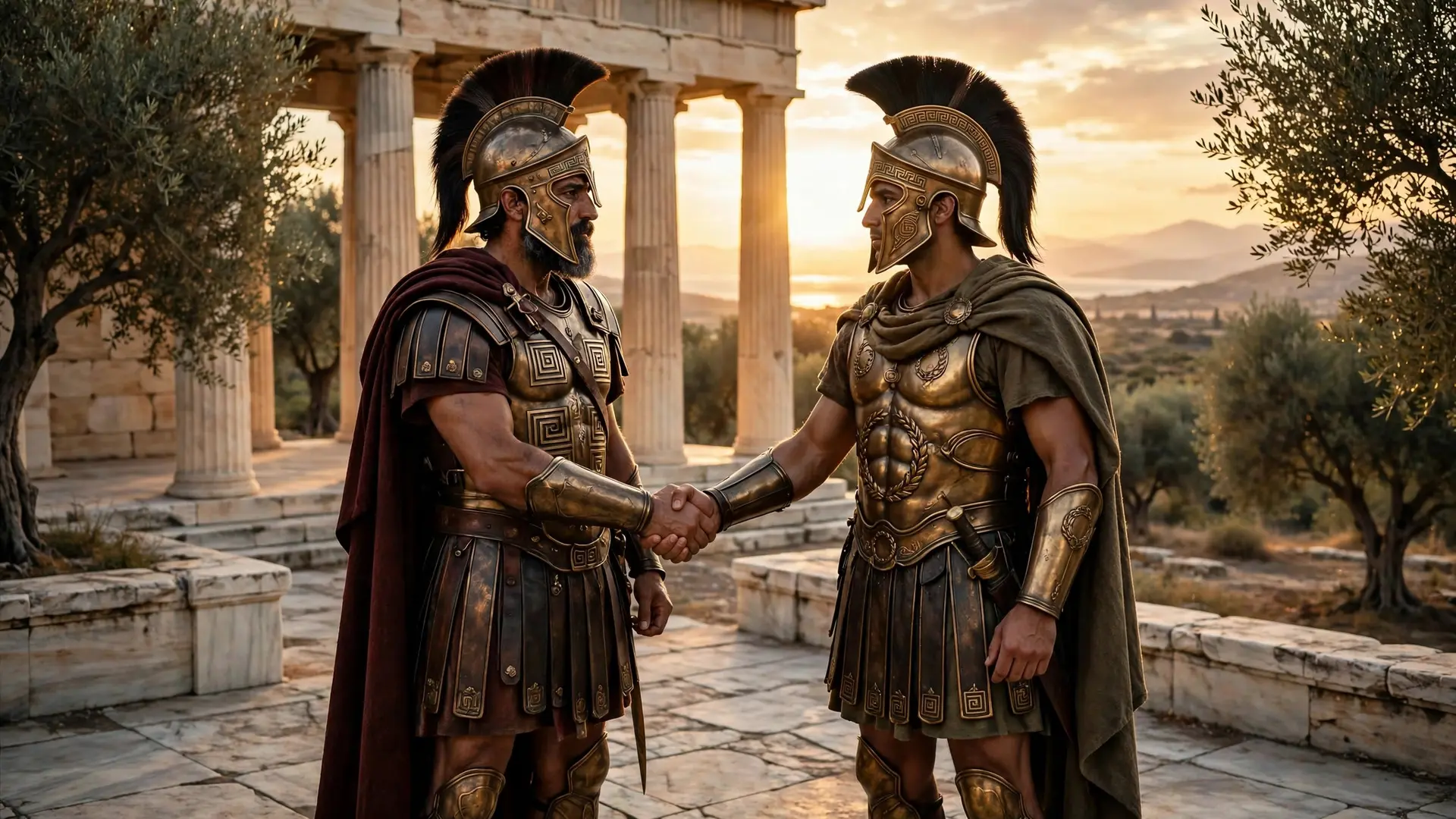
- The leading theory: extending the empty right hand — the sword hand — proved to armed strangers that you carried no weapon.
- Ancient Greeks called it dexiosis and carved it on funerary monuments; Romans stamped clasped hands on coins as a sign of harmony.
- The everyday handshake is much younger: 17th-century Quakers adopted it as an egalitarian alternative to bowing and hat-tipping.
- Authorities have repeatedly tried to ban it — in 1793 Philadelphia, 1918 Soviet Russia, and 2020 — and it has always come back.
A handshake is a weapon inspection wearing a smile. Thousands of years ago, extending your empty right hand — the sword hand — proved to the armed stranger in front of you that you weren't about to draw on him. The grip became a greeting, and the greeting became so automatic that we now do it before job interviews and wedding photos without ever wondering what we're reenacting. The surprising part isn't that the gesture is ancient. It's that the casual, everyday version is only a few centuries old.
How far back does the handshake go?
Further than almost any other thing you do with your body. Historians trace the modern handshake back at least 3,000 years, to a stone relief from the 9th century BCE depicting the Assyrian king Shalmaneser III clasping hands with the Babylonian king Marduk-Zakir-Shumi I to seal an alliance between their realms. Two monarchs, one gesture, carved in stone: the handshake as diplomacy. The ancient Greeks picked it up and gave it a name — dexiosis — and a much wider job. Handshakes appear on Greek vases, reliefs, and funerary monuments from the 5th century BCE onward, including a stele in Berlin's Pergamon Museum showing two soldiers joining hands. In these contexts the clasp conveyed peaceful intentions among armed men, but also loyalty, agreement, and bonds meant to outlast death. Homer wove the gesture into the Iliad and the Odyssey, where men grasp hands as displays of trust. The Romans adopted the custom from the Greeks as a way for strangers to signal they meant no harm — people clasping hands even appeared on Roman coins — and the poet Ovid, writing in the first century CE, described the Sabine women ending a battle this way: the men laid down their swords, and fathers-in-law shook hands with their new sons-in-law. It is one of the oldest recorded peace treaties sealed the way we still seal deals.
Why the right hand — and why shake it?
Here we move from evidence to the leading theory, and it's worth being honest that it is a theory. The most widely accepted explanation holds that the handshake began as disarmament theater. Most people are right-handed, and the right hand was the sword hand; extending it open and empty was a visible, checkable promise. The up-and-down motion, in the popular elaboration of the story, may have served as a final inspection — a vigorous shake that would dislodge any small dagger hidden up a sleeve. It makes sense, and it fits the ancient art: the gesture shows up precisely where armed men needed reassurance. But it has never been proven, and the Greeks themselves clearly used dexiosis for more than weapon checks — as a pledge of loyalty, a mark of agreement, a symbol carved on tombs. The handshake may have been born as a safety procedure and immediately moonlighted as a social contract. Like the urge to knock on wood after tempting fate, it sits at the intersection of practical caution and ritual.
When did it become an everyday hello?
This is the twist: for most of its long life, the handshake was special-occasion equipment — for alliances, oaths, and farewells — not something you did with the barista. The handshake as a routine greeting is only a few hundred years old, and we can thank a religious minority for it. In the 17th century, the Quakers of colonial America adopted the handshake as a deliberate alternative to the bowing, curtseying, and hat-tipping of the day. Those older gestures reinforced hierarchy — you bowed down to someone above you — while a handshake treated both parties as equals. For colonists who had fled Europe's rigid social order, that equality was the point. The gesture's plainness became its selling point, and it spread from meeting houses into counting houses, where merchants found it the perfect seal for a deal. Not everyone was charmed. The French, in particular, regarded the whole business with suspicion; in 1884 a French society was actually founded to abolish the handshake, denouncing it as a "vulgar English innovation." By the Victorian era, the gesture had acquired a thicket of etiquette instead. Eliza Duffey's The Ladies' and Gentlemen's Etiquette (1877) laid down the law: "The etiquette of handshaking is simple. A man has no right to take a lady's hand until it is offered. He has even less right to pinch or retain it." Gentlemen removed their gloves; hands were to be cool and dry; some manuals advised against shaking the hands of working men at all.
Has anyone ever tried to kill the handshake?
Repeatedly — and it keeps surviving them. In 1793, a yellow fever epidemic in Philadelphia made the gesture so alarming that the publisher Mathew Carey observed "the old custom of shaking hands fell into such general disuse, that many persons shrank back with affright at the offer of the hand." After the 1918 influenza pandemic, the Soviet health commissar Nicholay Semashko imposed a strict ban on handshaking, and the Soviet government kept the prohibition alive into the 1940s with posters declaring the populace "Free of Handshakes." In 1929, a nurse writing in the American Journal of Nursing noted flatly that "the hands are agents of bacterial transfer." And in April 2020, Anthony Fauci suggested the handshake might never come back at all. Every time, it came back. The folklorists at the Smithsonian, who have studied the gesture's long career, argue this resilience is the real story: greeting gestures wax and wane across cultures and centuries — the dap, the hand-kiss, the "call me" sign all rose and fell — and the handshake's comebacks say less about hygiene than about what humans want from a greeting. Russia offers the perfect miniature of this cycle: handshakes were uncommon there before the 19th century (the empire preferred a mitten-buffered hand-slap called Rukobit'e, believing skin contact stirred improper tension between the sexes), then the European handshake arrived, then the Soviets banned it, and then it returned anyway.
So what are we actually doing when we shake?
Probably several things at once, most of them older than we are. The weapon-check theory remains the best explanation for the gesture's origin, but the Greeks were already using it as a loyalty pledge 2,500 years ago, the Romans as a peace signal, the Quakers as an equality ritual — and every generation since has layered its own meaning on top. Nobody invented the handshake; every era reinvented it. That may be why attempts to retire it keep failing. A bow says I respect your rank. A hug says I know you well. The handshake says something rarer and more useful: I come unarmed, and I meet you as an equal — a 3,000-year-old message, delivered in two seconds, to a stranger. Like saying "bless you" to a sneeze or clinking glasses before a toast, it's a ritual whose original danger is long gone and whose meaning we carry in our muscles. We shake hands because, once, not shaking them could get you killed — and because, ever since, it has been the simplest possible way to say: I trust you this far.
Frequently asked questions
Why do we shake with the right hand?
Because for most of history the right hand was the weapon hand. Offering it empty was the whole point of the gesture: a visible, checkable promise that you weren't about to draw a blade.
How old is the handshake?
At least 3,000 years. A relief from the 9th century BCE shows the Assyrian and Babylonian kings clasping hands to seal an alliance, and the Greeks were carving handshakes on stone monuments by the 5th century BCE.
Did the handshake really start as a weapon check?
That is the leading theory among historians, supported by ancient art showing the gesture used between armed men — but it has never been proven, and the Greeks also used it as a symbol of loyalty and agreement.
Why did the Quakers popularize the handshake?
Seventeenth-century Quakers rejected the bows, curtseys, and hat-tipping of their day because those gestures reinforced social hierarchy. The handshake treated both parties as equals, which fit their beliefs — and their business dealings.