Why Do Cats Knead? The Science of Making Biscuits
From nursing instinct to affectionate ritual, kneading carries a cat from kittenhood into adulthood. Here is what science knows about 'making biscuits'.
Key takeaways
- Kneading is instinctual: nursing kittens press their paws around their mother's mammary glands to stimulate milk flow, and the behavior is retained into adulthood.
- The leading explanation is a retained kitten behavior tied to comfort and affection; cats most often knead when relaxed, settled, or bonding with a favorite person.
- Kneading may also activate scent glands in the paw pads, quietly marking a person or sleeping spot as the cat's own.
- Experts advise never punishing kneading — trim claws instead and never declaw — and note that not kneading does not mean a cat lacks a bond with you.
Kneading — the slow, alternating press of a cat's front paws into something soft — begins life as a survival tool: nursing kittens tread their mother's belly to keep the milk flowing. Most behavior experts believe adult cats keep doing it because the motion never lost its emotional wiring — it still signals comfort, safety, and affection, with scent-marking and nest-building as plausible bonus motives. Here is the honest caveat: as Kansas State veterinarian Susan Nelson has pointed out, cats don't attract the research funding dogs do, so much of what follows is well-reasoned theory rather than settled science.
What does kneading actually look like?
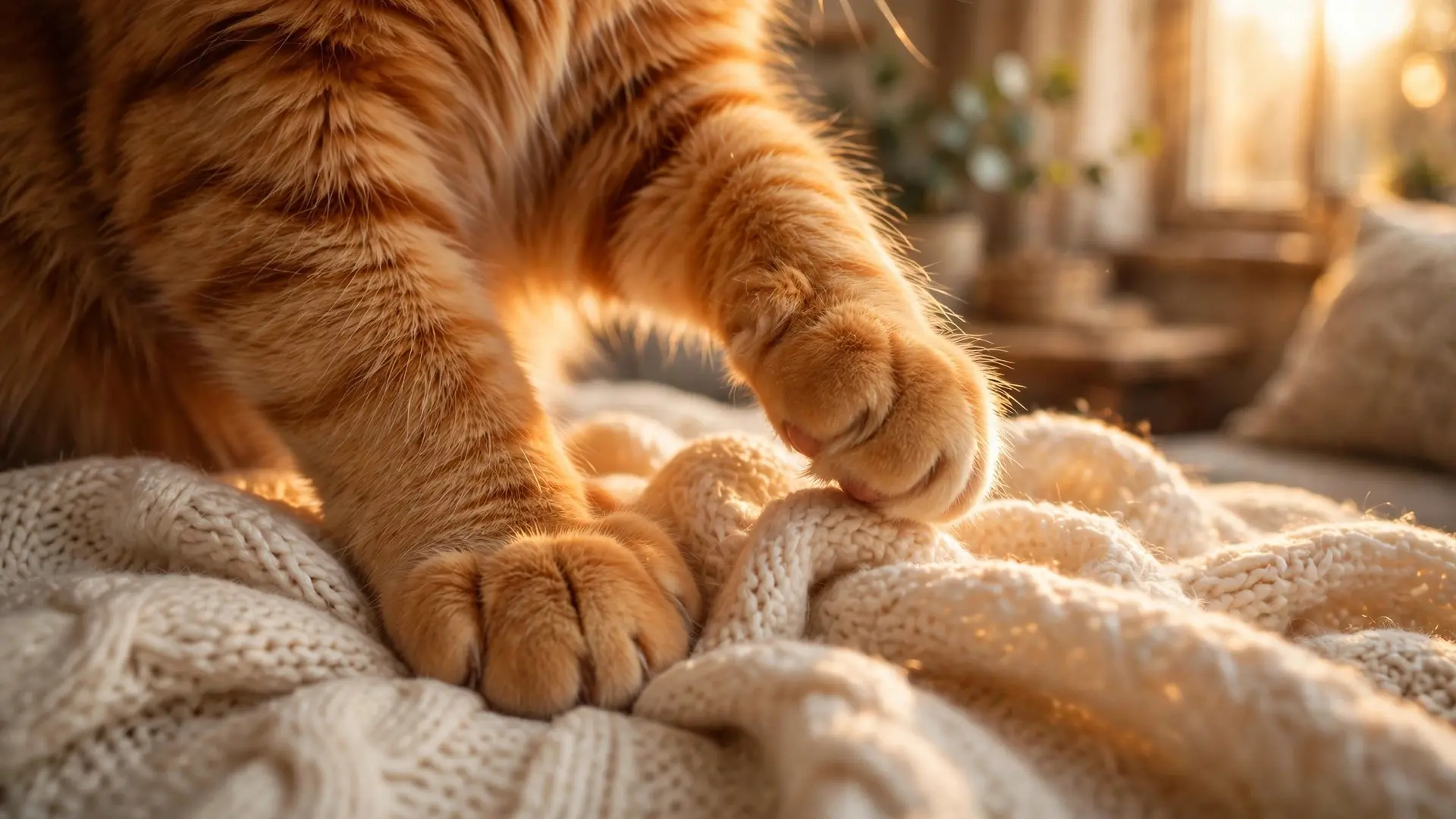
If you share a home with a cat, you already know the choreography. The cat settles on a soft surface — a blanket, a cushion, your lap — extends its forelimbs, and presses each paw down in turn, alternating left and right as if walking in place or working dough. Hence the nickname "making biscuits." The posture is usually slack and dreamy: half-closed eyes, slow blinking, and often purring, the other great nursery sound that followed cats into adulthood. Some cats extend their claws with each push and leave tiny punctures in the fabric; others keep them neatly sheathed. And some — the connoisseurs of contentment — drool. Zoologist Desmond Morris gave the behavior an even older name: "milk treading." The term is telling, because whatever else kneading does in adulthood, its engineering is unmistakably infantile. Leticia Fanucchi, an animal behavior scientist at Oklahoma State University, notes that kittens are never taught to knead; the motion is instinctual, built in from the start. No cat ever learns to make biscuits — every cat simply arrives knowing how.
Where does kneading begin?
It begins in the dark warmth of the nest, within days of birth. Nursing kittens rhythmically press their paws against the area around their mother's mammary glands while feeding, and the pressure stimulates the flow of milk. Susan Hazel, an associate professor of animal behavior at the University of Adelaide, told Live Science that the kneading motion closely resembles what kittens do when suckling, and that the pheromones released around the mammary glands probably make the whole activity deeply pleasurable. Fanucchi adds a further layer: the kitten's kneading may trigger the release of oxytocin, the social-bonding hormone, in the mother. So the earliest version of kneading is a two-way street — nutrition for the kitten, a chemical reward for the mother, and a shared warmth that wires the motion to comfort before the kitten's eyes have even fully opened.
That wiring is why adult cats keep the behavior long after weaning. Biologists have a word for juvenile traits that survive into adulthood: neoteny. It is the same phenomenon that explains why dogs look and act more like wolf cubs than adult wolves. Kneading is, in a sense, a kitten behavior wearing an adult cat's body. There is a striking parallel in how cats talk. According to the ASPCA, adult cats do not meow at each other — they meow almost exclusively at humans, exactly as kittens meow at adult cats. Under human companionship, whole suites of infantile behavior seem to persist, redirected. As Kristyn Vitale, a certified applied animal behaviorist at Unity Environmental University, puts it, juvenile behaviors that were once directed at the mother may now be directed at the owner. When your cat kneads on your lap, it may be treating you as the stand-in for that first warm body — a strange, overgrown parent who is, admittedly, terrible at hunting.
Why do adult cats keep doing it?
Because the origin story is clear but the adult story is not, experts hold several theories at once, and the honest answer is that more than one is probably true. The most widely accepted explanation is comfort and self-soothing. Adult cats knead when they are relaxed, settled, or preparing to nap — the exact emotional temperature of the nursery, recreated on a sofa. Cats may also knead in darker moments: Vitale notes that injured cats sometimes knead and purr in a way experts interpret as an attempt to comfort themselves, though this is a less common use of the behavior. Either way, the rhythm reads like a self-regulation tool, a way of pressing the body back into a feeling of safety. A second theory centers on affection and bonding. "Cats will knead on preferred people in the house or their favorite person," Vitale says, which makes kneading an affiliative, social behavior — one that builds and maintains the relationship. Read plainly: a cat kneading on you is a vote of confidence. The animal feels happy, friendly, and safe, and it is choosing to share that state with you. A third theory is chemical rather than emotional. Cats have scent glands in their paw pads, and Fanucchi points out that kneading activates those glands, pressing a faint signature into whatever is being kneaded. It is not a loud territorial claim like spraying; it is a quiet, personal marking — a way of saying this blanket, this lap, this spot is mine, in a language only cats fully read. Kneading is, in this view, part of a broader sensory conversation: animals constantly read and write to their world, whether through the echo-senses of bats or the scent a cat leaves with its feet.
A fourth theory reaches back even further, to the wild. PetMD, the veterinarian-run health site, notes that the wild ancestors of domestic cats used their paws to tread down tall grass and leaves, fashioning a comfortable sleeping spot and — possibly — checking the ground for unwelcome visitors hiding in the foliage. On this reading, the cat kneading your duvet is rehearsing an ancient housekeeping ritual, testing the nest before settling in. And a final, humbler idea: kneading stretches the muscles. The full extension of the forelimbs, the alternating press — it is, biomechanically, a lovely stretch. Comfort, affection, chemistry, instinct, and a good stretch may all be true at once.
What is your cat telling you when it kneads?
Mostly, that it likes you. But experts caution against reading every batch of biscuits the same way. "Some cats might want to be petted while they're kneading on you; some cats might just want to be talked to; some cats might just want to knead and have no other interaction with you," Vitale says — there is, in her words, so much individual variability. The context matters: kneading on a favorite person means something different from kneading a sun-warmed cushion, and the rest of the cat's body language is the dictionary. The droolers, at least, are easy to read. "Some of these cats start drooling as well when they knead — those are the really happy guys," Nelson says. Suckling at the kneaded surface is another nursery echo: the motion sometimes drags its sibling behavior along, and the adult cat ends up kneading and mouthing the blanket the way a kitten works its mother. And if your cat never kneads at all, don't take it personally. "If your cat doesn't knead, that doesn't mean it doesn't have a bond with you," Vitale says — the animal may simply express affection differently, through purring, rubbing, or just sitting near you. These are all affiliative behaviors; kneading is only one dialect of love. One piece of practical advice survives all the theories: don't punish kneading, even when the claws come out. Keep the claws trimmed, protect yourself with a thick blanket or pillow, and never declaw — the procedure is harmful, and as Nelson puts it, the cat is only showing you affection. Discouraging the behavior means pushing away the compliment. In the end, kneading may be the most honest thing a cat does. It is a motion born in the first days of life, carried unchanged across weaning, across the long wild-to-couch transition, into an adulthood it was never designed for — and offered, freely, to the softest surface available. Whether it means "I am safe," "you are mine," or simply "this feels good," it is never meaningless. A cat that makes biscuits on you has decided you are part of the nest.
Frequently asked questions
Why does my cat knead on me and not on the couch?
It likely sees you as safe company. Behaviorist Kristyn Vitale notes that cats knead on their preferred person as an affiliative, bonding behavior — you are, in effect, the chosen nest.
Should I stop my cat from kneading with its claws?
No — experts advise against punishing the behavior, since it signals comfort and affection. Trim the claws regularly instead, place a thick blanket over your lap, and never declaw, which harms the cat.
My cat drools while kneading. Is that normal?
Yes. Drooling and suckling the kneaded surface are nursery echoes, and as Kansas State veterinarian Susan Nelson notes, the cats that drool while kneading are the really happy ones.
Do all cats knead?
No. Some cats never knead, and that does not mean they lack a bond with you — they simply express affection through other behaviors like purring, rubbing, or sitting near you.